
Buy Birkenstocks from birkenstock.com, a Birkenstock store, or an established shoe retailer such as Nordstrom, Zappos, DSW, REI, or Journeys, and skip Amazon unless you accept that the brand does not authorize any sales there. That one rule settles authenticity and the warranty. The harder decision is fit: Birkenstocks come in whole European sizes only, in two widths, on three footbed constructions, and the right combination matters more than the color or the store.
This page contains affiliate links. We may earn a commission at no extra cost to you.
Birkenstock is a German footwear company, with a shoemaking tradition it traces to 1774, that builds sandals, clogs, and closed shoes around an anatomically shaped cork-latex footbed. Under a soft lining sit a cork-latex core and jute layers, pressed into a deep heel cup, longitudinal arch support, transverse arch support, a raised toe bar, and a roomy toe box. The toe bar is there to encourage the natural gripping motion of your feet as you walk, and the bed slowly takes the shape of your foot through body heat and pressure. That molding is why the footbed comes up so often in conversations about foot health and long shifts on hard floors, and why nurses who live in scrubs so often pair them with a Boston clog.
Authorized Sellers, Amazon, and the Warranty
Birkenstock USA states that it does not authorize product sales at Amazon, Gilt, Rue La La, Walmart, Sam’s Club, or Costco, and that pairs sold there are either counterfeit or unauthorized. The company stopped supplying Amazon in the US at the start of 2017, citing counterfeits and unauthorized sellers it could not police.
The practical cost is the warranty: pairs from those channels carry no Birkenstock consumer warranty, even when they are genuine gray-market stock. The brand’s counterfeit policy page names three safe routes: its own website, Birkenstock retail stores, and the authorized retailers listed in its store locator. If a shop is not on that list, treat it as unverified.
Sizing Birkenstocks: EU Numbers, Two Widths, No Half Sizes
Birkenstock sizes are European whole numbers with no half sizes, and the US number on a chart is a conversion, not a separate size. When your measurement falls between two sizes, the usual advice is to take the larger one and close the gap with the adjustable buckle on an Arizona or Boston.
Width is the detail that trips up first-time buyers. Regular width suits medium to wide feet and Narrow suits narrow to medium feet, and the length is the same in both. Birkenstock marks the choice with a footprint symbol on the box label and in online listings: an outlined footprint means Regular, a filled footprint means Narrow. What the size chart does not tell you is that a narrow foot in a Regular footbed rarely feels too loose; it slides sideways off the arch support, so the contour sits in the wrong place and the sandal feels flat.
Then run the footbed check:
- Measure the longer foot. Trace both feet and measure heel to longest toe in centimeters. Use the bigger number.
- Match it to the EU chart. Add roughly a centimeter of walking room, then find that length on the official chart.
- Stand on the footbed, not in the shoe. With the buckles loose, put your weight on it. Your heel should settle inside the heel cup.
- Check the gap. Your toes should not touch the front edge of the footbed. Birkenstock’s fit guide suggests about a quarter inch of space around the foot. Toes on the toe bar means size up.
- Confirm the width. The ball of your foot should sit inside the raised edges, not on top of them. Riding the edges means you need Regular.
Classic, Soft, or EVA: Choosing the Footbed
The classic footbed is firm on day one and softens as it contours to your arch. The Soft Footbed keeps the same support but adds a latex foam layer under the lining for cushioning straight out of the box, which is why people with sensitive feet often prefer it. EVA styles are single-piece foam: waterproof, light, and easy to clean, with less arch definition.
| Footbed | Feel out of the box | Best for | Can it be resoled? |
|---|---|---|---|
| Classic | Firm, molds with wear | All-day standing | Yes |
| Soft Footbed | Cushioned right away | Sensitive feet | Yes |
| EVA foam | Light and springy | Pool, beach, travel | No, molded in one piece |
Break-in matters on the classic and soft versions. Birkenstock’s own advice is to flex the footbed by hand first, keep the buckles loose, wear the pair around the house for one to two hours at a time, and tighten as the bed molds. A pair that feels unforgiving in week one often fits best a month later.
Models and Uppers Worth Knowing
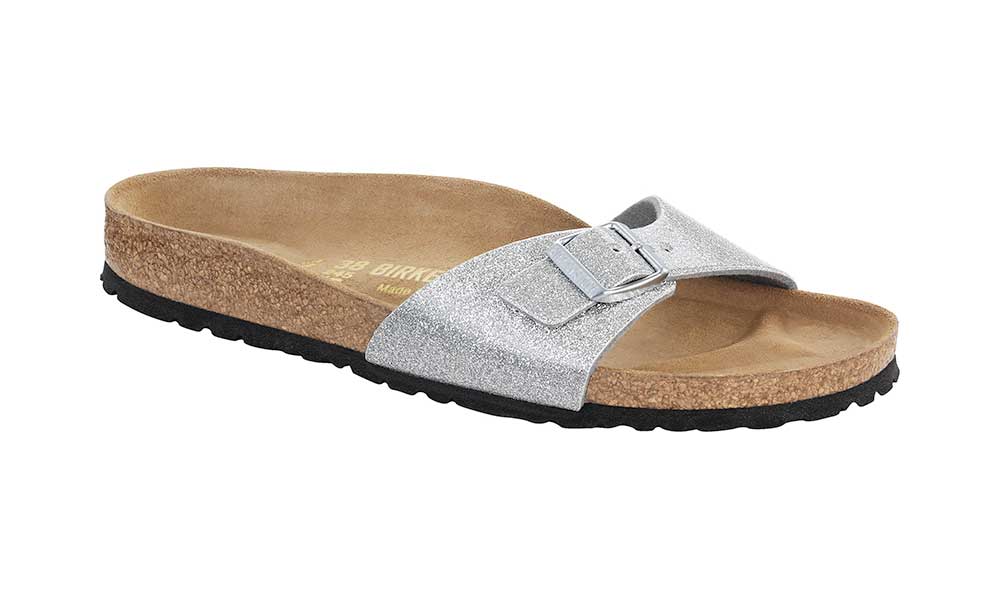
Five styles anchor the Birkenstock collection. The Arizona, an iconic two-strap slide with adjustable buckles, is the Birkenstock sandal most people picture. The Gizeh is a thong, the Madrid a single wide band, the Mayari a crossed band with a toe loop, and the Boston a closed clog that buckles over the instep. Newer silhouettes such as the Utti moccasin sit on the same footbed design.
Uppers come in oiled leather, nubuck leather, suede, Birko-Flor (a synthetic with a leather-like face), and vegan microfiber. Oiled leather wipes clean with a cloth, Birko-Flor costs less and is easy to clean, and suede feels softest but marks fastest in rain. Leather uppers want conditioner once or twice a year, and the exposed cork rim wants sealer on the same schedule, which protects durability more than any other habit.
Where to Try Them On In Store
Trying a sandal or clog on settles the width question in minutes. The chains below carry the brand; check a specific store against the Birkenstock locator before you count on the warranty.
Company Stores and Outlets
Brand-owned stores are the place to compare the classic footbed against the soft one and Regular against Narrow in a single visit. Outlets run past-season stock.
Nordstrom and Nordstrom Rack
Nordstrom keeps a broad selection in the shoe department. Ask an associate to check the stockroom for narrow widths, since floor displays usually show Regular. The Rack gets past-season colorways cheaper.
DSW (Designer Shoe Warehouse)
DSW stocks the high-volume models, mainly the Birkenstock Arizona and the Boston clog, along with EVA versions. Selection swings hard by store, so phone ahead for a specific color and width.
REI
REI carries the travel and water end of the range, including EVA styles for river trips and campgrounds. Co-op members earn an annual dividend. If you also need running shoes, one trip covers both.
Tip: Dick’s Sporting Goods, Journeys, Macy’s, and Famous Footwear stock the mainstream models, and independent shoe and outdoor shops often keep wider size runs. Call ahead for narrow widths and seasonal releases.
Buying Birkenstocks Online
The official site is the only channel where every pair is guaranteed authorized. Everything else trades some of that certainty for selection, price, or return terms.
The Official Site
The official store lists every current model, exclusive colorways, collaboration releases, and a chart that converts foot length into an EU size. Shop online there when you want the full width and footbed range for a model.
Zappos
Zappos is the pick when you don’t know your size. Free return shipping within the US and a 60-day window let you order the same sandal in two sizes and send one back unworn.
Journeys
Journeys sells sandals and clogs through their online storefront, runs frequent promotions, and leans toward trending colorways rather than the full catalog. For cheaper slip-ons, see our guide to where to buy Crocs.
Amazon and Marketplaces
Amazon still shows plenty of listings, but they come from third-party sellers, not from the brand, so none of them carry the Birkenstock warranty. If you buy there anyway, check the seller’s own return terms and inspect the footbed the day the box arrives. Poshmark and eBay are where secondhand pairs surface; used pairs have already molded to someone else’s foot, so ask for close photos of the footbed.
How to Spot a Counterfeit Pair
The reason fakes give themselves away is the Birkenstock footbed. The silhouette is easy to copy, but a layered bed with real arch and toe-bar contours is not, so most counterfeits use flat or printed foam that feels lifeless underfoot.
- Seller. Birkenstock says the only way to be sure is to buy from its site or an authorized dealer. Anything else is a gamble.
- Origin. The brand states that all its sandals and footbeds are made in Germany, with shoes and boots made in Europe. A sandal labeled with another country of origin is a red flag.
- Price. Steep discounts on current-season colorways are the clearest signal there is. Real clearance lands on last season’s colors.
- Shipping and domain. Be wary of sites that ship from abroad or use lookalike web addresses; the brand warns they may send a fake or nothing at all.
- Finish. Look for a stamped logo and size on the footbed, sealed edges, and clean stitching around the heel cup.
Return Windows Compared
Return terms decide more Birkenstock purchases than price does, because sizing is the real risk. Terms below are each seller’s standard policy as of October 2026. Confirm on the retailer’s page before ordering.
| Seller | Standard window | Condition required | Practical note |
|---|---|---|---|
| Birkenstock.com | 30 days from delivery | Original condition and packaging | Free returns and exchanges; styles 40% off or more are final sale |
| Nordstrom | Case by case, no fixed limit | Reasonable condition | Nordstrom Rack sets its own policy |
| Zappos | 60 days | New, unworn condition | Free return shipping within the US |
| REI | One year for Co-op members, 90 days for others | Normal use allowed | Membership pays off on a size gamble |
Two rules cut across all of them. Pairs bought from another retailer must go back to that retailer, not to Birkenstock, and marketplace sellers set their own terms regardless of the platform’s headline policy. The brand’s return policy also excludes original shipping charges from refunds. Stuck between two sizes? Order from the seller with the longest window.
Resoling and Repair
Classic and soft models can be resoled, and that changes the math on price. Resoling replaces the worn sole while keeping the molded footbed, and a full rebuild replaces the bed too when it has cracked or flattened. Birkenstock’s own repair workshops are in Germany and serve European customers; in the US the work goes to independent shops that advertise authorized repair status, many of them by mail. EVA pairs and some other models cannot be repaired, so plan on replacing those.
Send a pair in when the tread wears thin, not after it wears through to the cork. Once the footbed itself is damaged, a simple resole is off the table and the job becomes a full rebuild.
Top Picks
The four below are ranked on footbed construction, width availability, and durability, not on how they photograph. The links go to Amazon search results, where sellers are third parties without the brand warranty, so compare against the official site or an authorized retailer before you buy.
Best overall: Arizona Soft Footbed. A timeless two-strap silhouette that has barely changed in decades, with a foam layer that shortens break-in. Sold in oiled leather, suede, and Birko-Flor. Check price on Amazon
Best budget: Arizona EVA. The waterproof one-piece foam version of the Arizona sandal and the cheapest way into the brand. Rinse it under a tap and stop worrying about it, at the cost of less arch definition. Our Chacos guide covers the same water-friendly ground. Check price on Amazon
Best closed-toe: Boston Soft Footbed. The Birkenstock Boston is the year-round clog, worn bare in summer and over socks in winter. The single buckle handles a high instep better than a thong does. Check price on Amazon
Best for high arches: Mayari. A crossed-band sandal with a toe loop that stops the foot sliding forward, and the most secure of the open styles. Check price on Amazon
If you want arch support in sneakers and work boots too, a trim-to-fit insole such as Superfeet brings some of that contour to footwear without a molded bed.
Start by measuring your longer foot in centimeters and finding that number on the official EU chart, then check which width symbol fits. Pick the footbed next: an Arizona EVA for water and travel, the classic bed for standing all day, the soft version if your feet are sensitive. If a store visit is not practical, order Birkenstocks from an authorized seller with free return shipping and check the fit the day they arrive. Our other shoe buying guides cover the category.
Frequently Asked Questions
Do Birkenstocks come in half sizes?
No. The range is whole European sizes only. If your measurement falls between two, take the larger size and use the buckles to tighten it. Watch the US conversion on the chart, since the brand converts the same EU number differently for men’s and women’s sizes.
What happens if they get wet?
Classic-footbed versions handle a light shower but should not be soaked, and suede marks most easily. Dry a wet sandal at room temperature, away from a radiator or direct sun. The EVA styles are the only ones built to go in water.
Can you buy them on Amazon?
Not from the brand. Birkenstock stopped supplying Amazon in the US in 2017 and says it does not authorize any sales there. Listings on the site come from third-party sellers, and pairs bought that way carry no Birkenstock consumer warranty.
Why are Birkenstocks so expensive?
The price covers a multi-layer footbed, German manufacturing, and uppers built to outlast several resoles. Because the classic models can be resoled, the cost spreads over years rather than a single season. The EVA line is the cheapest entry point.
Do they ever go on sale?
Rarely on the official site for current-season styles, and the brand’s markdowns of 40% or more are final sale. Previous-season sandal and clog colorways get marked down at Nordstrom Rack, DSW, Zappos, and REI, usually at the end of summer and around Black Friday.
About This Guide
Reviewed by the wheretobuyguides.com editorial team. Authorized-seller status, return policies, and sizing guidance checked against Birkenstock’s US policy pages and retailer policies in October 2026. Colorways change every season, so confirm pricing and stock before ordering.