
The short answer: buy scrubs online from a specialty retailer or straight from the brand, and buy in person only where you can still try a cut on. That second option shrank in September 2026, when Scrubs & Beyond, the biggest specialty chain, announced it is closing every store. Good scrubs make a twelve-hour shift bearable; cheap ones pill at the seams, sag at the waist, and lose their shape after three rounds through hospital laundry. This guide covers the healthcare garment, not the TV series of the same name.
This page contains affiliate links. We may earn a commission at no extra cost to you.
Who Wears Them, and Who Picks the Color
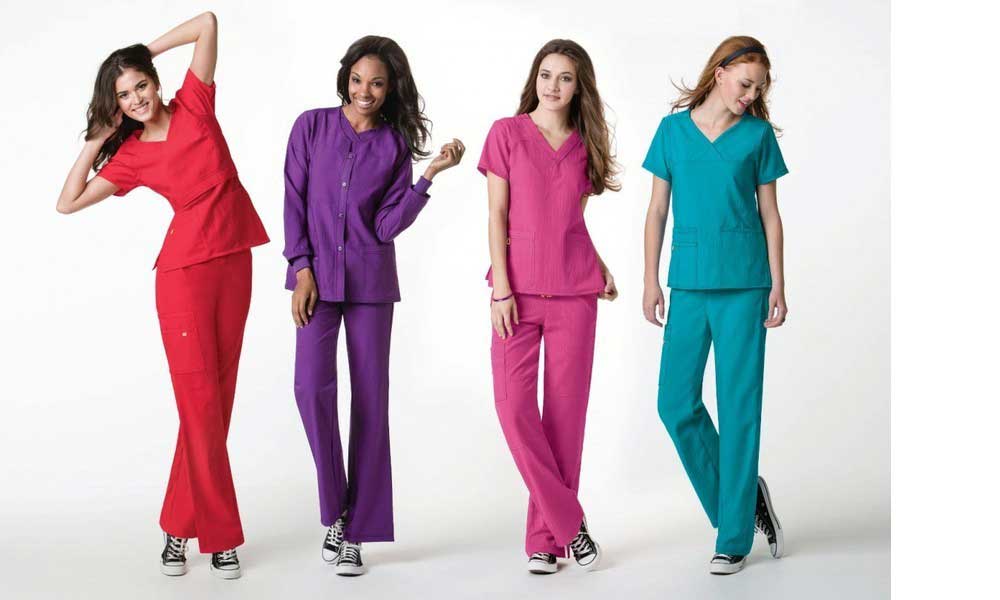
Medical scrubs are sanitary work clothing worn by clinical and allied-health staff to protect personal clothes from fluids, survive industrial laundering, and mark a professional role at a glance. Doctors, nurses, surgical techs, dental assistants, veterinary staff, and lab personnel wear them daily, as do nursing students, a first-year intern on rounds, home-health aides, and spa workers. No clinical license is needed to buy a pair. The garment came out of operating rooms, which is why blue and green displaced the white coat. Wikipedia’s entry on the garment traces that history.
One detail catches nearly every first-time buyer off guard: most employers assign shades, and sometimes brands, by department, and each facility picks its own palette. Your staff handbook decides what you wear before any retailer does.
Fabric, Pockets, and Cut: What Separates Good From Bad
Five things decide whether a piece survives a year of hard wear: fabric, finish, pockets, cut, and size range. The first two are what product photos hide.
Fabric and stretch. Poly-rayon-spandex blends deliver four-way stretch, wick moisture, and shed wrinkles, which matters because a clinical day is bending, squatting, and reaching over a patient. Traditional poly-cotton costs less and shrugs off bleach but fights you all shift. Read the fiber content panel, not the product copy.
Antimicrobial finish. Treat this as a laundry convenience, not infection control. No solid evidence shows treated healthcare apparel reduces transmission to patients, and the finish weakens with repeated washing.
Pockets, counted. Count them in the listing photo. Floor work needs six: two hip, one chest, and slots for pens, shears, and a stethoscope. A high chest pocket dumps its contents when you lean over a bed.
Cut and leg style. Straight-leg trousers are the traditional unisex shape, comfortable and the safe default. Jogger pants with ribbed cuffs keep the hem off casters and wet floors, though some departments still restrict them.
Size range and inseam. This is the real differentiator. Women’s scrubs dominate the market, and the labels worth your money publish petite and tall inseams separately and re-pattern plus sizes, with correct bust, hip, and rise proportions, instead of grading a small upward. One length for every height is a warning sign.
How to size a brand you have never worn:
- Measure your chest, waist, hip, and inseam, and write the numbers down.
- Compare them to that brand’s own chart, never to the last label you bought.
- Order one top and one pair of pants, wash them once, then buy the rotation.
Which Cut Suits Your Role
Which scrubs you need depends less on brand than on where you stand all day. Treat this as a starting point; your dress code wins.
| Role | What usually governs it | What to buy |
|---|---|---|
| OR and surgical staff | Many facilities issue and launder surgical attire | Little or nothing; a personal pair for the commute at most |
| Floor and ED nurses | Department color code | Stretch blend, six pockets, three to five changes |
| Pediatrics and outpatient | Looser codes; prints sometimes allowed on tops | Solid pants, printed tops if approved |
| Dental and veterinary | Frequent bleach washes | Poly-cotton or dark solids that hide stains |
| Nursing students | Program-mandated shade, often with a school patch | Only from the program’s listed vendor |
Where to Buy Scrubs in Person
Trying on beats any size chart, but places to do it shrank in 2026.
Scrubs & Beyond: Stores Closing, Website Open
Scrubs & Beyond ran more than 100 stores in 30 states, stocking Cherokee, Grey’s Anatomy Signature by Barco, FIGS, and Healing Hands. In September 2026 its parent, Kindthread (which also owns Landau), began closing every store with going-out-of-business sales and said it will keep selling scrubs mainly online. A location still open is a fine place to try cuts at a markdown, but not to count on returns. You can also browse their print top selection online.
FIGS Community Hubs and Uniform Advantage
FIGS is moving the other way, opening Community Hubs in Los Angeles, New York, Houston, and other cities, with fitting rooms and in-store embroidery. Uniform Advantage keeps a small chain of specialty stores, including Miami-area locations. Call the specific location first, because shade and size availability varies store to store.
Walmart, Target, Kohl’s, and JCPenney
Many Walmart Supercenters keep a small workwear rack, typically budget labels plus Cherokee Workwear Originals in plain shades. Right call for a fast replacement, wrong one for a full rotation. Browse the Walmart selection online if your store runs thin.
Department stores treat healthcare apparel as a side category with thin selection. Check the Kohl’s work-clothing category or the JCPenney workwear page before driving out, and expect some Target stores to skip the category entirely. For non-clinical layers, our guide to work clothes covers the same stores.
Buying Online: Retailer Comparison
Online is where the deep size runs live, including petite and tall inseams almost no store stocks.
Amazon
Amazon holds the widest brand and price spread: Cherokee, Dickies, Wonderwink, Koi, Landau, and Healing Hands on one screen, and fast delivery matters the morning a seam gives out. Check that the seller is the brand or an authorized retailer, since marketplace sellers set their own return terms. Shop medical uniforms on Amazon.
Manufacturer Direct: FIGS, Jaanuu, Medelita, and Cherokee
Buying direct gets the current line in full and no question about authenticity. FIGS and Jaanuu lean technical, Medelita focuses on physicians and tailored lab coats, and Cherokee direct stocks its Infinity and Revolution ranges alongside the workwear basics. Premium labels compete on innovative pocket design more than on price.
Specialty Retailer Websites
Dedicated healthcare-apparel retailers carry the deepest catalogs and discount often. allheart, an online retailer, and the Uniform Advantage website are the easiest places to compare Wonderwink, Healing Hands, Cherokee, and Koi side by side, printed tops included. The Scrubs & Beyond website carries deeper size runs than its shops ever did; work the outlet and clearance pages first, where discontinued shades hold the real markdowns.
One channel almost no buying guide mentions: your own employer. Some hospital systems contract a single supplier and run a payroll-deduction or allowance program. Ask HR before paying retail, since the contracted price is often lower and the shades are guaranteed compliant.
How Much to Spend, by Shifts per Week
Three tiers cover the market, and which one fits depends on how many shifts a week you work, not on brand prestige. Prices move with every new shade and promotion, so trust the live listing over any number printed in a guide.
- Budget. Basic polyester or poly-cotton with little stretch. Fine for a student rotation or a spare, rough for daily twelve-hour use.
- Mid range. Poly-rayon-spandex, real pocket layouts, and a full size range. Durability and comfort per dollar peak here for most working nurses.
- Premium. Technical knits, tailored cuts, and the newest palettes from FIGS, Jaanuu, or Medelita. Worth it when fit is what carries you through back-to-back shifts.
Here is when paying more is not worth it. If your facility bleaches everything and mandates one shade, designer knits get chewed through by industrial laundry at roughly the rate mid-tier ones do. Four mid-range pieces in rotation beat two expensive ones, because wash frequency kills a garment faster than price protects it.
Best Medical Scrubs Right Now
These five picks were selected on published fiber content, pocket layout, and size range.
| Pick | Best for | Fabric and finish | Fit note |
|---|---|---|---|
| FIGS (FIONx line) | Overall | Four-way stretch, antimicrobial finish | Hidden pocket layouts |
| Cherokee Workwear Originals | Budget | Poly-cotton that takes bleach | Roomy classic cut |
| Jaanuu (ultraSOFT line) | Premium | Soft four-way stretch knit | XXS to 3X, petite and tall |
| Grey’s Anatomy Signature | Traditional | Spandex stretch, wrinkle resistant | Classic cut, widely approved shades |
| Landau ProFlex | Extended sizes | Poly-rayon-spandex, two-way stretch | Unisex cargo pant to 5XL |
Best overall: FIGS, FIONx line. The design benchmark: four-way stretch, wrinkle-resistant finish, hidden pockets. Check price on Amazon.
Best budget: Cherokee Workwear Originals. The poly-cotton workhorse students and floor nurses have worn for years. See it on Amazon.
Best premium: Jaanuu. A soft four-way-stretch knit with a tailored cut, from a brand that sells petite and tall lengths. Check price on Amazon.
Best traditional: Grey’s Anatomy Signature by Barco. A boxy but flattering classic cut in long-approved shades. See it on Amazon.
Best extended sizing: Landau ProFlex. Retailer listings run the unisex straight-leg cargo pant from XS to 5XL, with six pockets and a drawstring waist. See it on Amazon.
Washing Scrubs at Home: What OSHA Actually Says
Everyday scrubs can go home; blood-soaked ones should not. OSHA’s Bloodborne Pathogens standard makes the employer responsible for cleaning, laundering, or disposing of contaminated personal protective equipment. In a 2009 interpretation letter, OSHA said uniforms and scrubs are generally not intended to be PPE, but once they go unprotected and become contaminated with blood or other potentially infectious material, the contaminated-laundry rules apply, and home laundering of contaminated PPE is unacceptable. Hand those pieces to your facility.
For ordinary wear, change at work if you can, bag worn scrubs for the trip home, and wash them apart from family laundry. What the care label does not spell out is that heat, not detergent, is what ruins a stretch blend: a hot dryer breaks down spandex, so stretch pants lose their recovery long before the fabric face looks worn. Wash warm, dry low, and save the bleach for poly-cotton.
Red Flags Before You Order
Buying before you confirm the dress code. Many hospital systems assign a palette by department, and some restrict brands, jogger cuffs, or sleeve length too. Worn items are rarely returnable, so a wrong shade is a total loss. Sizing does not transfer between labels either.
Shopping on price alone. The cheapest top is usually all polyester, no stretch, thin seams. Work more than two shifts a week and you belong in the mid range.
Counterfeit listings. Designer healthcare apparel attracts knockoffs. A premium brand priced far below the brand’s own site, sold by a seller name you do not recognize, deserves a second look.
Closing-sale traps. Holding Scrubs & Beyond store credit? Confirm it works online before your local shop shuts, and treat liquidation purchases as final.
Start by getting your facility’s color code in writing. Order one mid-range top and one pair of pants in that shade, wash them once, and only then buy the rest of your scrubs. Pair them with compression socks for long shifts and footwear built for standing, whether clogs like Crocs, cushioned athletic shoes, or anything else in our shoe buying guide.
Questions Buyers Ask Before Ordering
Why does my employer get to pick my color?
Color coding lets patients, families, and coworkers identify roles instantly on a busy floor. Each facility sets its own palette, so one shade can mean two different jobs at hospitals in the same city. Your employee handbook, not a retailer’s chart, is the authority.
What is the difference between jogger and straight-leg bottoms?
Jogger bottoms taper to a ribbed or elasticated ankle cuff, while straight-leg trousers fall loose to the hem. Joggers keep the hem off casters, cart wheels, and wet floors. Straight-leg runs cooler and is the safer buy when your dress code is vague.
Can I get my name or logo embroidered on scrub sets?
Yes. Specialty retailers, including Uniform Advantage and the FIGS Community Hubs, offer embroidery, and many local shops stitch it in house. Two catches: embroidered items are almost never returnable, and personalization adds days to turnaround.
When do retailers run the biggest discounts?
Specialty sellers discount hardest when a shade gets discontinued, so outlet and clearance pages usually beat sitewide sales. Nurses Week in early May and the back-to-school window each bring brand promotions worth watching.
Editor’s Note
Updated in October 2026 for the Scrubs & Beyond store closures, with defunct retailers removed and prices left out because they change too often to print. We make no claim to have worn every item listed; the picks come from published fiber content, size charts, and pocket layouts.