
Picture a first-time buyer who wears a 9.5 in running shoes and wants one sandal for creek crossings, camp, and a week of travel. Chacos are the adjustable sport sandals built for exactly that kind of use, and that shopper hits two snags before checkout: the Z/1 they want sells in whole sizes only, and the cheapest listing they find comes from a seller Chaco does not authorize, which can void the warranty. This guide covers where to buy a genuine set, how to size them, which return window protects a guess between a 9 and a 10, and when the factory resole beats buying new.
This page contains affiliate links. We may earn a commission at no extra cost to you.
What Sets a Chaco Apart From Other Sport Sandals
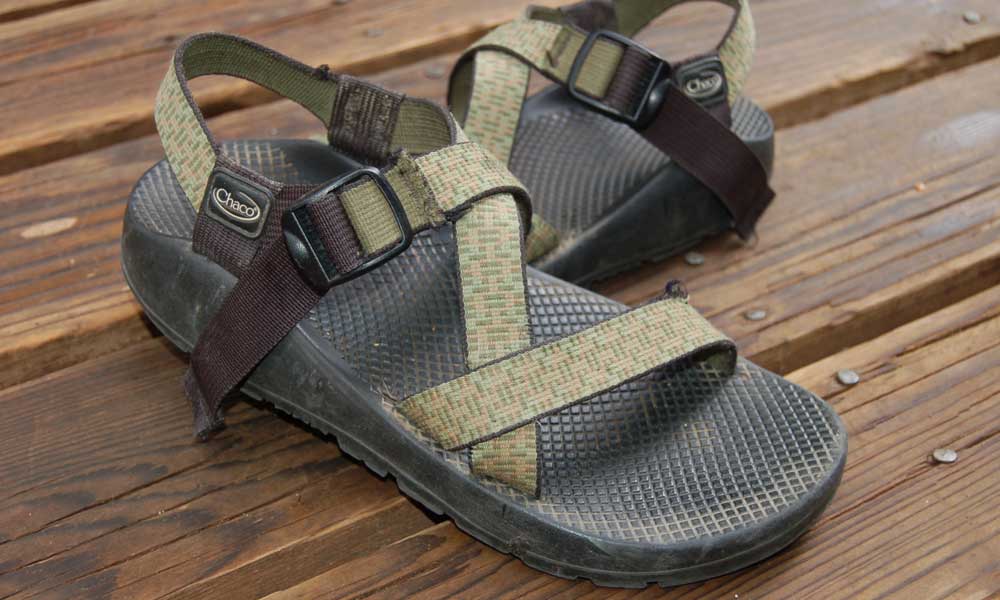
A Chaco Z sandal is an open-toed outdoor sandal built around one continuous length of webbing that threads through the midsole and wraps the arch, so tension spreads along the whole loop instead of piling up at a single buckle. Mark Paigen, a Colorado whitewater guide, started the company in 1989 to make footwear that stayed put in moving current. Wolverine World Wide, the Rockford, Michigan footwear group that also owns Merrell and Saucony, bought the brand in January 2009.
The footbed is the other half of the design. Chaco calls it LUVSEAT, a dual-density polyurethane (PU) midsole that is certified by the American Podiatric Medical Association, the professional body for US podiatrists. PU is denser than the EVA foam in most casual sandals, so a Chaco feels firm on day one and still holds its arch contour years later. Under it sits a ChacoGrip rubber outsole with 3 mm lugs tuned for wet rock.
They suit creek-crossing hikers, rafters, camp staff, and travelers who want arch support in an open design, the same structural argument people make for supportive running shoes. Skip them if you want the soft give of a flip-flop. For a cork bed that molds to you over time, Birkenstocks are the closer comparison, and our guide to buying shoes covers closed-toe options.
Z/1, Z/2, or Z/Cloud: Choosing a Strap Layout
The model decision comes down to one question: do you want the toe loop? The Z/1 uses the original single-strap layout. The Z/2 adds a loop around the big toe, which stops sideways slide on slick riverbed stone and in current, though the loop takes a week or two to stop feeling odd. The Z/Cloud keeps the same webbing system but adds a top layer of ultra-soft PU over the LUVSEAT base, and it comes in a toe-loop version (the Z/Cloud 2).
| Model | Toe loop | Best for | Feel |
|---|---|---|---|
| Z/1 | No | Trails, town, travel | Firm, structured |
| Z/2 | Yes | Creek crossings, rafting | Firm, locked in |
| Z/Cloud | Version 2 only | Long pavement days | Softer top layer |
| Mega Z/1 | No | A broader band across the instep | Extra-wide webbing |
| Chillos Slide | No webbing system | Camp, post-hike recovery | Loose and light |
CushZ is a separate, lighter casual line (Zappos lists the CushZ, CushZ Toe-Loop, and CushZ Slide), not a substitute for the Z/2 on a wet scramble.
Sizing: Whole Sizes, Wide Widths, and the First Adjustment
Core Z models sell in whole sizes only. In October 2026, the women’s Z/1 product page on chacos.com offered sizes 5 through 12 and the men’s cushioned Z page offered 7 through 15, with no half sizes in either selector. What the size chart does not tell you is that it still lists half sizes, because it is a conversion table shared across the site. Half-size wearers usually do better rounding down: the webbing tightens but sole length is fixed, and a heel hanging off the back edge blisters however hard you cinch it.
Width has a real answer here. The Z/1 and the cushioned Z each have wide-width versions sold as separate listings, and every MyChaco design can be ordered in wide. Search for the wide listing rather than sizing up, which only adds length you do not need.
Adjusting the webbing the first time
The reason most new owners call these uncomfortable is rarely the footbed. It is slack left in the wrong segment of the loop, which lets the heel drift while the forefoot gets pinched. This sequence fixes it.
- Loosen the entire length first. Pull slack through every slot before your foot goes in.
- Set your arch on the raised section. The high point belongs under your arch, not behind it.
- Move slack toward the heel, leaving a finger’s width of room. It is one continuous piece, so work the excess along it in stages until your heel stays planted.
- Break them in indoors. Short wears on carpet for a week, before sole scuffing makes a return harder.
Where to Buy Chacos: Official Site, Retailers, and Return Windows
Because you are often choosing between two whole sizes, the return window is the most useful thing to compare. Chaco sandals sell through the brand’s own site, its Amazon storefront, and authorized retailers online and in stores.
| Seller | Return terms (checked October 2026) | Best reason to buy there |
|---|---|---|
| Chacos.com | 30 days from shipment, unworn, original box; free | Full catalog, wide widths, MyChaco builds |
| Zappos | 60 days | Longest window for a two-size guess |
| Amazon brand storefront | Varies by seller; confirm the seller is Amazon or Chaco | Review volume on sizing |
| REI | Check the co-op’s current policy | Try-on in person, member rewards |
| Sierra, Nordstrom Rack | Retailer policy; clearance may be final | Past-season colorways at a discount |
The official site and MyChaco custom builds
The manufacturer site carries the full catalog, including limited editions that rarely reach third-party shops, with free shipping on orders over $49. Returns are free within 30 days of the ship date for unworn items in the original shoebox, and orders placed October 1 to December 31, 2026 can come back through January 31, 2027. Final sale colors cannot be returned or exchanged. Visit the official store for current stock and the size chart.
MyChaco is the build-your-own service: pick a design or upload your own, add embroidery, and choose a ChacoGrip or Vibram outsole. Custom sandals are handcrafted in the USA, and Chaco’s FAQ says all custom sales are final, so buy a stock model first. A site banner in October 2026 also offered 25% off through ID.me for teachers, first responders, nurses, students, and military.
Amazon
The official storefront stocks men’s, women’s, and kids’ lines, and owner reviews note whether a model runs narrow. Check that the listing is sold by Amazon or Chaco rather than an unfamiliar third party, since only purchases from authorized sellers are covered by the warranty. Shop the brand page on Amazon for the current lineup.
Zappos, Sierra, Nordstrom Rack, and other online sellers
Zappos is the low-risk pick for a first purchase: its 60-day return window is twice Chaco’s own, and its brand page offers Medium and Wide filters. View the full lineup on Zappos. Sierra, formerly Sierra Trading Post, discounts past-season colorways, though size availability there is thin. Browse their current deals. Backcountry, Nordstrom, and Nordstrom Rack also carry the line. Check the clearance inventory and filter by size first. Our list of stores with the best return policies compares the big retailers. Poshmark and eBay sales are secondhand with no warranty.
REI, outdoor shops, and sporting goods stores
Trying them on matters more here than for most footwear, since you cannot split the difference between whole sizes. REI is the most reliable brick-and-mortar option, typically stocking the core Z/1 and Z/2 near the hiking boots, and co-op members earn an annual reward on eligible full-price purchases. Browse their selection online and use the store-availability filter before driving over. Independent paddling outfitters often carry wide widths the national chains skip.
DSW, Dick’s Sporting Goods, Scheels, and Bass Pro Shops also list the label, though assortments run narrower and skew toward best-selling colors. Check availability on their site for your nearest location. The store locator on chacos.com shows which shops near you stock the brand, and it doubles as a quick authorized-seller check.
How to Avoid Fake Chacos and Unauthorized Sellers
Chaco’s FAQ gives the simplest rule: to avoid counterfeits, buy from chacos.com or an approved retailer. The warranty backs that up. It covers only sandals bought from Chaco or authorized US retailers, and Chaco may reject claims on items from unauthorized sellers, including unauthorized websites.
- Check the domain letter by letter. Lookalike stores add a letter to the brand name or use an unusual extension, then advertise deep discounts on social feeds.
- Distrust a price far below everyone else. Authorized retailers sell current colors at or near list, and real discounts show up on past-season stock at Sierra, Nordstrom Rack, and chacos.com sale pages.
- Call when unsure. Chaco’s warranty page lists (888) 211-1908 for checking whether a seller is authorized.
- Keep the receipt. Proof of purchase showing when and where you bought is required for every warranty claim.
The warranty runs five years from purchase or delivery and covers US defects in materials and workmanship. Worn tread, faded colors, frayed webbing, and sizing complaints are excluded, and claims can take 6 to 8 weeks.
ReChaco: Fix or Replace a Worn Set
ReChaco is Chaco’s paid factory service for Z sandals, run from its Michigan facility, and it is the reason a worn set usually gets rebuilt instead of binned. Chaco’s sandal repair page listed these prices in October 2026, per service, with return shipping not included and charges made only after the work is verified:
| Service | Listed price | When you need it |
|---|---|---|
| Resole | $50 | Lugs worn flat, traction gone |
| Replace webbing (buckle, heel, or full) | $20 to $45 | Frayed or torn webbing |
| New buckle | $10 to $20 | Cracked or slipping buckle |
| Shorten baggy webbing | $10 to $20 | Excess slack after years of use |
| Unstick webbing | $20 | Webbing seized in the midsole |
| Toe tightening (Z/2 only) | Free | Toe loop that cinches as you walk |
Fill out the online form, print it, box it with the sandals, and ship them in; Chaco quotes about two weeks once they arrive. Three signals a set is due: lugs worn flat under the ball of the foot, frayed webbing that no longer grips in the buckle, and a platform polished slick where the heel lands. Send them in before the sole separates at the toe, since that gap spreads fast.
Stuck webbing is often fixable at home first. Chaco’s FAQ suggests soaking the sandals in a bucket of 1 part water and 1 part unscented liquid fabric softener, then rinsing. Rinse them after salt or chlorine days, and never dry them on a radiator or hot dashboard.
Five Picks by Use
Prices are full list prices on chacos.com or Zappos in October 2026; sale colors run lower.
Best overall: Chaco Z/1 Classic. Original layout, recycled REPREVE webbing, ChacoGrip outsole, LUVSEAT platform. Easiest version to get on and off. Lists at $95 on chacos.com. Check price on Amazon
Best for rivers: Chaco Z/2. Identical build plus the toe loop, for stream crossings, kayaking, and slick rock. Zappos listed it at $94.95. Check price on Amazon
Best cushioned: Chaco Z/Cloud. A soft PU top layer over the same base, for when the standard platform feels too rigid on pavement. Lists at $105. Check price on Amazon
Best budget: Chaco Chillos Slide. A lightweight slide for camp and post-hike recovery, competing with Crocs more than the Z line. Up to $60 at full price, with sale colors far lower. Check price on Amazon
Best for kids: Chaco Z/1 EcoTread Kids. The adjustable webbing system scaled down, in Little Kid’s and Big Kid’s sizing, with a recycled-rubber outsole. $60 to $70 at full price. Check price on Amazon
Settle the toe loop question first, since it decides between the Z/1 and Z/2. Then order your whole size, or the wide listing, from Zappos or chacos.com so a wrong guess costs nothing, and break them in on carpet before deciding. If you already own a worn set of Chacos, price a ReChaco resole before buying new.
Questions Buyers Ask
Do Chacos come in half sizes?
No, not in the core Z models. The Z/1 and cushioned Z product pages on chacos.com offer whole sizes only, even though the shared size chart lists half sizes for conversion. Most half-size wearers do better going down, since the webbing tightens but length is fixed.
Are they good for plantar fasciitis or flat feet?
Often, yes. The LUVSEAT footbed is certified by the American Podiatric Medical Association and keeps its shape rather than collapsing, which is why it comes up for plantar fasciitis. Very low arches are the exception, since the arch height can feel like too much, and ongoing heel pain is a question for a podiatrist. For closed-shoe days, an insert like Superfeet is the usual stand-in.
Why do the sandals start to smell, and can you wash them?
Polyester webbing absorbs sweat and lake grime, and odor builds where it meets the footbed. Scrub them by hand with mild soap and cool water, then air dry completely. Skip the dryer and hot car, since heat weakens the adhesive holding the layers together.
Where are they made, and who owns the brand?
Wolverine World Wide, the Michigan footwear group behind Merrell and Saucony, has owned the brand since 2009. Most standard production happens overseas, while MyChaco builds are handcrafted in the USA and resoles run through a Michigan factory.
Does the warranty cover worn-out tread?
No. The five-year warranty covers defects in materials and workmanship, not normal wear such as bald tread or frayed webbing. That is what the paid factory resole is for, listed at $50 in October 2026.
About This Guide
In October 2026, our editorial team re-checked Chaco’s return, warranty, and repair pages, current sizes and list prices, and retailer availability for this guide.