
A money belt only works while nobody knows you are wearing one. That single fact should drive the purchase, and most listings skip it. Before you buy, sort out which style suits your trip, what belongs inside, where the good ones are sold, and what the RFID label is really worth.
This page contains affiliate links. We may earn a commission at no extra cost to you.
What Money Belts Do and Who Should Buy One
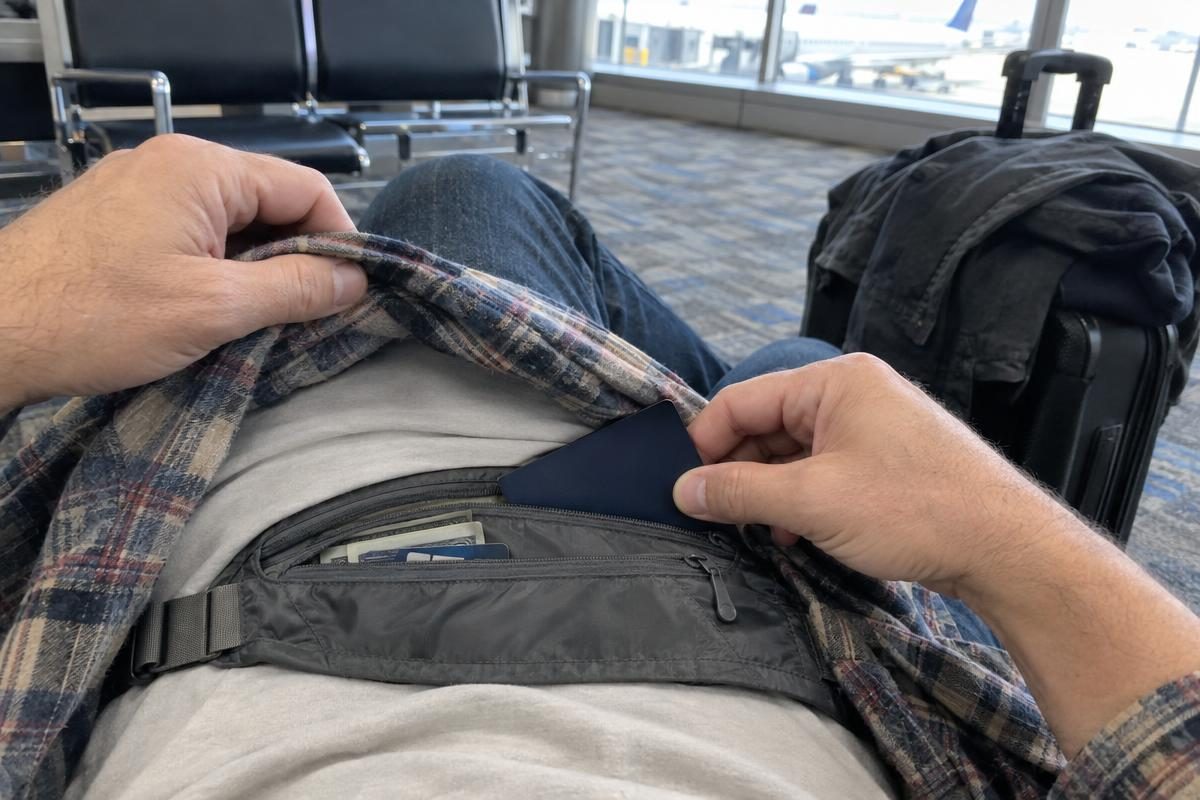
A money belt for travel is a flat, zippered carrier worn under your clothing at the waist, holding the valuables you do not need during the day. Passport, backup credit card, emergency cash, a spare hotel key: things you would be stuck without and have no reason to touch all day.
It suits travelers crossing crowded transit hubs and markets where pickpocketing is common, and anyone wanting a second stash apart from a normal wallet. Runners get less from one than the marketing suggests, and do better with a running belt or a hydration pack such as a CamelBak reservoir pack. The U.S. State Department advises carrying a copy of your passport separately from the original, and its traveler checklist is worth reading before a first trip abroad.
One rule makes all of it work: never open it in public. Digging under your shirt at a ticket counter tells everyone watching where your cash and travel documents sit, the exact outcome the design prevents. Keep a slim day wallet with small notes and one card in a front pocket, and treat what you wear underneath as a safe you open in your room.
Features Worth Paying For in a Money Belt
Comfort and concealment decide whether you keep wearing it past day two, so they outrank every feature on the packaging. First, settle the format: five products get sold under one name, solving different problems.
| Type | What it holds | Best for |
|---|---|---|
| Under-clothing waist pouch | Passport, folded notes, backup card | Long transit days, first trips abroad |
| Belt with a hidden zippered compartment | Folded bills only | Blending in, everyday wear at home |
| Neck wallet | Documents, boarding pass, cards | Airport days with frequent access |
| Leg wallet | Cash and one card, strapped to the calf | Hot climates, low-rise clothing |
| Hidden bra or sewn-in pocket | One folded note, one card | Minimal carry, fitted clothing |
The belt-style version causes the most confusion. It looks like an ordinary leather belt or nylon belt, and the secret compartment behind the lining takes folded bills, nothing thicker. No documents, no cards. Choose between the five like this:
- List what you will carry. If a passport is on that list, rule out belt-style versions straight away.
- Check the climate. Anything worn against skin in humid weather needs a moisture-wicking or washable backing.
- Decide how often you need access. Frequent access points to a neck wallet, once-a-day access to a waist stash.
- Measure your waist over the clothing layer you will wear it under, then compare against the listed waist sizes.
Backing material. Anything worn all day traps sweat. Look for a moisture-wicking mesh panel on the body side, and check the whole thing is washable. Paper currency goes damp against warm skin, and a slick polyester panel is the detail buyers regret in heat.
Zipper and buckle quality. The zipper fails long before the textile does, so a smooth, well-anchored pull matters more than any other hardware. On dress models, a non-metal buckle sits flatter and spares one beep at airport security.
Profile and color. Flat, thin, close in color to your base layer or underwear. A thick one prints through a shirt. Fabric weight counts too: heavy canvas is easy to spot, thin ripstop nylon is not.
RFID blocking, with realistic expectations. Almost every listing advertises RFID protection, and it adds little to the price, so there is no reason to refuse it. Be clear about what it is, though. Modern contactless cards send a one-time cryptogram for each tap rather than a reusable number, so RFID-blocking lining is a selling point more than a demonstrated need. Take it if it comes on the model you like, do not pay a premium, and do not treat it as identity theft protection.
When to Replace a Money Belt
Replace it once the parts that keep it shut or keep it hidden stop working. With a few trips a year, a well-made waist pouch lasts three to five years; daily wear at home shortens that. Three triggers:
- The zipper skips teeth or needs two hands. Anything you fight open is something you will leave in your bag.
- The elastic strap no longer springs back, so it rides and shifts, which is how it becomes visible.
- The fabric stays stiff or discolored after washing. Dried sweat salt is abrasive on the coated lining as well as the outer shell.
To stretch its life, rinse it in cold water after hot trips and dry it flat, never in a machine. Heat kills the elastic first. One trigger is not negotiable: if a seam beside the hidden pocket opens, retire it. Something that quietly drops a passport is worse than nothing.
Ordering a Money Belt Online: Where and Why
Online is where the real selection lives, since in-store travel sections rarely stock more than two or three styles. Five channels cover almost everything in the category.
Amazon
Amazon, the largest online retailer in the United States, carries the widest range, from plain waist stashes to leather designs with a secret compartment. As of September 2026, listings run from roughly $8 for a basic nylon model to $30 or more. Read the buyer review photos rather than the studio shots; those show the real profile under a shirt.
eBay
eBay keeps a dedicated category for travel wallets and security pouches, including discontinued models. Check the seller rating, and confirm a photo shows the interior layout before bidding.
Etsy
Etsy is where handmade leather work turns up. Listings skew toward the belt-with-a-hidden-pocket format, so read the description before assuming a piece holds documents.
Eagle Creek
The brand’s own online store lists its Undercover range alongside lanyard styles and other anti-theft travel accessories. Buying direct shows the current lineup, since third-party listings often carry older versions.
BeltOutlet.com
BeltOutlet stocks the dress format with a hidden zipper pocket sewn inside. Worth a look if you want something that passes as ordinary with business clothing. Same caveat: folded bills only.
Finding a Money Belt Near You: In-Store Options
Shelf stock is thin and seasonal, so call before you drive. Five places worth trying:
Walmart
Travel essentials sit in the luggage aisle, though shelf selection is narrower than the site suggests. Most of their catalog is online, with ship-to-store pickup.
Target
Check the travel section beside the luggage. Lewis N. Clark travel security items appear on their category page, and same-day pickup covers the gaps.
REI
REI carries the higher end, including Pacsafe and Eagle Creek gear. Its wallets category is the closest thing to a curated shortlist, and handling one settles the size question fast.
Macy’s and Department Stores
The luggage department is the place to look. Macy’s lists a Samsonite travel security waist belt, worth checking while you shop for other gear.
Local Luggage and Travel Shops
Independent shops are the only place you can reliably try several styles on. Bring the shirt you will wear over it. Many also stock the region’s printed travel maps.
What Not to Buy: Common Money Belt Pitfalls
The costliest mistake is treating a hidden carrier as a wallet. Everything else follows from that.
Using it for daily spending. Every public opening cancels the concealment you paid for. Split your cash: a small float in a front pocket, the rest out of sight.
Buying belt-style when you need document space. A hidden money compartment inside a dress belt holds folded notes, full stop. Catch that mismatch while you are still reading the listed interior dimensions.
Assuming you can keep it on at airport security. You generally cannot. Body scanners image what sits under your clothing, and anything worn at the waist reads as an anomaly resolved by hand. Plan to take it off and send it through the X-ray, and check the current TSA screening rules if you fly rarely. Advice to never remove it is simply wrong.
Mistaking a fanny pack or belt bag for concealment. Both sit outside your clothes and advertise themselves to a pickpocket. Convenient, not discreet, and a soft target in a crowd.
Overstuffing it. A bulging shape shows through fabric and gets uncomfortable within an hour. Phone, sunglasses, and daily cash belong in a pocket or a day backpack.
Top Money Belts Worth Buying
These four are picked on what decides the purchase: concealment, comfort against skin, and whether a passport fits. Prices are ranges we saw in September 2026.
Best overall: Eagle Creek Undercover RFID Money Belt. A slim travel money belt with RFID-blocking lining and a low profile that stays flat under a shirt. Typically $20 to $30. Check current pricing on Amazon
Best budget: Zero Grid RFID Travel Belt. The listing describes two zippered pockets and an adjustable elastic waistband, roughly $10 to $15. Confirm the stated interior dimension against your passport. See it on Amazon
Best for everyday wear: Cashsafe anti-theft travel wallet belt. A leather-look dress belt with a non-metal buckle and a hidden compartment inside. Folded bills only. Usually $15 to $25. Check current pricing on Amazon
Best for active travelers: Peak Gear waist stash. Lighter and thinner than most, the trade you want in heat, with multiple pockets inside. Around $12 to $18. See it on Amazon
Start by writing down what you will carry, then measure it. If a passport is on the list, buy a waist model or a neck-worn style. Order two weeks before you fly so you can wear the money belt around the house under your travel shirt, and return it if it prints through or itches.
FAQ: Buying a Money Belt
What should you actually keep in one?
Only what you will not need until you are back in your room: passport, one backup credit card, emergency cash, a spare key. A useful test is frequency. If you unzip it more than once a day, you are carrying the wrong things.
Can you leave it on at airport security?
Usually not. PreCheck lanes let you keep an ordinary belt on, but something worn under clothing is different: the scanner images what is beneath and flags it for a pat-down. Send it through the X-ray with your bag.
Does RFID blocking really stop card theft?
There is little evidence it prevents a common crime. Contactless cards issue a fresh cryptogram per tap, and a passport chip will not release data until a reader has optically scanned the printed code inside the booklet. Take the shielding if it is free, but not at the cost of a better product.
Is a neck wallet better than a waist pouch?
Access decides it. The neck-worn version is easier to reach on airport days, but its lanyard shows at the collar and the weight pulls forward. A waist model hides better once you clear security, which is why some travelers pack both and switch after check-in.
Will a passport fit every model?
No, and this is the most common sizing error. A U.S. passport book is about 5 by 3.5 inches, so compare that against the stated interior measurement, not the outer size. Belt-style versions with a hidden slot never fit one.
Do these mark you out as a tourist?
Not on their own. Behavior gives people away: reaching under a shirt in a queue, or checking the waistband repeatedly. Worn under clothing and left alone, it is invisible. Some experienced travelers skip it in favor of a plain second wallet or a sewn-in pocket.
Editorial review: wheretobuyguides.com team. Retailer links and price ranges last verified September 2026.