
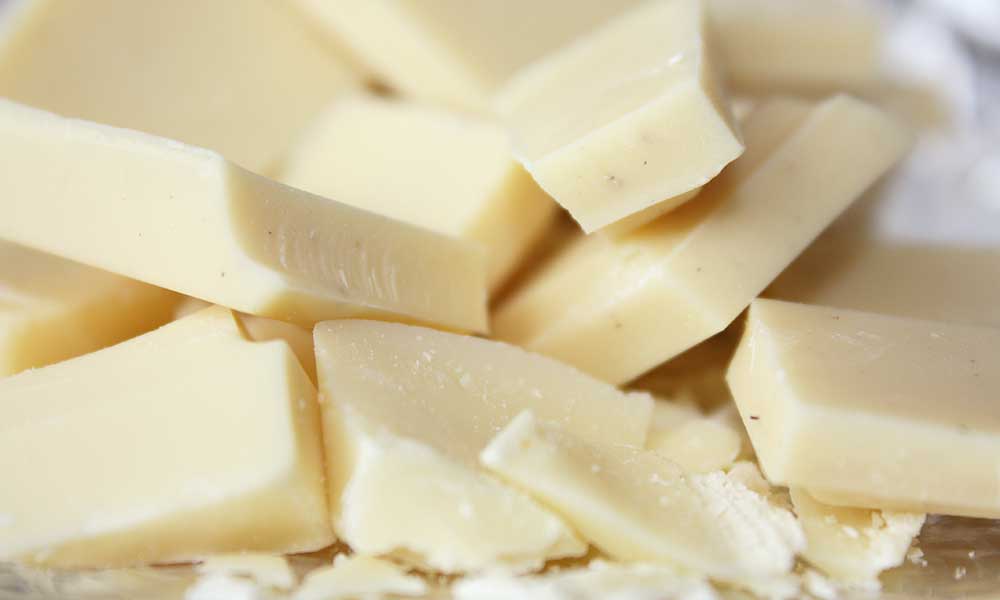
You can buy white chocolate at almost any US supermarket, Target, Walmart, or Amazon, but the bag you grab first is often not white chocolate at all. Check the fat. Real white chocolate is a confection of cocoa butter, sugar, and milk solids that contains no cocoa solids, which is why it stays ivory. Many baking-aisle chips swap that cocoa butter for palm kernel oil, and they melt and taste differently because of it. Pick the product by label first and store second.
This page contains affiliate links. We may earn a commission at no extra cost to you.
Why Most Baking Chips Aren’t Real White Chocolate
The name is a legal standard, not a color. The Food and Drug Administration, the federal agency that sets US food labeling rules, defines the product in its standard of identity at 21 CFR 163.124: at least 20 percent cacao fat, at least 14 percent total milk solids, at least 3.5 percent milkfat, and no more than 55 percent sweetener. Replace the cocoa butter with palm or palm kernel oil and the maker must call it something else, so the bag says white morsels, white baking chips, or vanilla flavored chips.
That rule catches more of the baking aisle than most shoppers expect. Ingredient lists posted by US grocery retailers break down like this:
| Product | Main fat on the label | Sold as |
|---|---|---|
| Lindt Classic Recipe bar | Cocoa butter | White chocolate |
| Ghirardelli 4 oz baking bar | Cocoa butter | White chocolate |
| Ghirardelli Classic White chips | Palm kernel oil, no cocoa butter | Baking chips |
| Nestlé Toll House Premier White | Palm kernel and palm oil | Morsels |
| Guittard Choc-Au-Lait chips | Palm oils plus some cocoa butter | Baking chips |
| Hershey’s Cookies ‘n’ Creme | Vegetable oil blend | White creme candy |
The pattern is clear: the eating bars and the 4-ounce baking bars use cocoa butter, and the bagged chips mostly do not. Chips with vegetable fat are not a scam. They hold their shape in chocolate chip cookies and cost less. They are simply the wrong buy for ganache, bark, or dipping, where the deodorized cocoa butter in the real thing gives the snap, gloss, and creaminess you are paying for.
The ten-second label check
- Turn the package over: cocoa butter should sit above any palm, palm kernel, soybean, or shea oil.
- Read the legal name, since confectionery coating, morsels, or creme mean the fat was swapped.
- Check the date code, because milk fat goes stale and picks up fridge odors faster than cocoa solids do.
Two more details sort the good from the merely legal. Real vanilla reads richer than artificial flavor, and the Lindt bar lists artificial flavor while the Ghirardelli bar lists vanilla extract. And when a percentage of cocoa is printed on a white bar, it is the cocoa butter share: higher means thinner flow when melted. With no cocoa powder or roasted solids in it, there is none of the bitterness of cacao, dark chocolate, or a milk chocolate bar. You taste sugar and milk, vanilla, and however much cocoa butter the maker paid for.
Where to Buy Real White Chocolate in Stores
Nearly every US grocery store stocks it in two places: the baking aisle for chips and baking bars, and the candy aisle for eating bars. If you need cocoa butter, head for the bars in either aisle and treat the bags as a separate product.
Supermarkets and the baking aisle
Kroger and most regional chains shelve Ghirardelli, Nestlé Toll House, and a store brand beside the flour, with Lindt in the candy aisle. Fastest option for a last-minute baking run. Store-brand white chips are usually the vegetable-fat version, so flip the bag before it goes in the cart.
Target, Walmart, and warehouse clubs
Target and Walmart, the largest brick-and-mortar retailer in the US, both list the Ghirardelli baking bar, Toll House morsels, and Lindt bars, and both show store stock online before you drive over. Warehouse clubs such as Costco and Sam’s Club carry baking supplies unevenly by season, so call ahead if you want a bulk bag.
Whole Foods, Trader Joe’s, and World Market
Whole Foods leans organic and bean-to-bar. Trader Joe’s rotates its own-label bars, so the lineup changes by season. World Market is the sleeper, with imported European bars a supermarket will not have.
Baking and restaurant supply shops
For couverture, skip the supermarket. Couverture is professional-grade chocolate with extra cocoa butter for thin, glossy coating. Baking supply shops sell it by the pound, and restaurant supply stores that serve the public stock the cases chocolatiers and pastry chefs buy for dessert work.
Ordering Online Without a Melted Box
Every grade is sold online, from grocery morsels to pastry-grade callets. The risk is heat: a bar that softens in a hot truck sets again with gray streaks, so order in cool weather, pay for insulated shipping, or choose pickup.
Amazon
Amazon, the largest online retailer in the US, has the widest range, from Toll House morsels to Callebaut blocks, and it is the easiest place to compare ingredient panels side by side. Check who the seller is and whether the listing mentions cold packs in warm months.
Walmart, Target, and Whole Foods delivery
All three offer store pickup and same-day delivery in most metro areas, and Whole Foods delivery runs through Amazon. Pickup is the move in July and August: the bar spends minutes in a warm car instead of hours in a truck.
King Arthur Baking and specialty sites
For serious baking, search King Arthur Baking or a dedicated specialty retailer, where Guittard, Valrhona, and Callebaut come in bulk. Sur La Table lists some professional callets too. Ask about temperature-controlled packing in summer. Shopping for a gift instead? Our Godiva guide and the Lindt buying guide cover boxed sets.
Five Picks Matched to the Job
Match the format to what you are making: a bar to eat, a baking bar or callets to melt, chips for cookies. These picks follow the labels in the table above. Prices move often, so check the current listing.
For eating: Lindt Classic Recipe White Bar. Sugar, cocoa butter, and milk, sweet and creamy, and fresh in most stores because it sells fast. It comes from Swiss maker Lindt & Sprüngli. Check price on Amazon, or find it at Target and Whole Foods.
For cookies: Ghirardelli Classic White Premium Baking Chips. Palm kernel oil instead of cocoa butter, which is why they keep their shape in baked goods. Use them in dough, not in a saucepan; for melting, the Ghirardelli 4-ounce white baking bar is the cocoa butter version from the same shelf. Check price on Amazon, Target, or Walmart.
For melting and dipping: Callebaut W2 Callets. A Belgian couverture that Callebaut specs at a minimum of 28 percent cocoa and 22 percent dry milk, with medium fluidity that suits bark and molds. Check price on Amazon or Sur La Table.
For pastry work: Valrhona Ivoire or Dulcey. Ivoire is a 35 percent cocoa butter couverture with a milky, vanilla profile. Dulcey is blond chocolate, a caramelized style with toasted, biscuit-like notes. Both turn up at specialty retailers more than grocery stores.
For a budget cookie run: Nestlé Toll House Premier White Morsels. Cheap, everywhere, dependable in a cookie. The label lists sugar, fractionated palm kernel oil, milk, and hydrogenated palm oil, so treat them as a white baking chip. Check price on Amazon, Walmart, or Target. For an organic bar instead, Green & Black’s makes one; it is easiest to find in the UK, and US stock is patchy, so check the Amazon listing before planning around it.
Melting, Bloom, and Storage
Milk solids scorch at a lower temperature than the cocoa solids in dark chocolate do, so this is the most fragile thing in the baking aisle to melt. Use low, indirect heat in short bursts, stir often, and keep every tool dry. One drop of water seizes the bowl into paste.
Bloom is the gray, chalky film that shows up after a bar gets warm and the fat recrystallizes. Safe to eat, and fine to melt into a ganache, but it will not give a glossy shell without tempering. Chocolate is tempered by melting, cooling, and gently rewarming it so the cocoa butter sets into stable crystals. Store any chocolate cool, dark, and sealed, away from onions or coffee, because the milk fat absorbs odors.
Start with the ingredient list, not the brand. If cocoa butter sits high on it and no vegetable oil comes first, you are holding real white chocolate, and a 4-ounce baking bar or a bag of callets is the buy for anything you melt. Keep cheap morsels for cookies. If your store only stocks chips, order bars or couverture online for pickup, and for more brands see the main chocolate buying guide.
Common Questions
Is white chocolate made from real chocolate?
It comes from the cocoa bean, but only the fat. Cocoa butter is pressed from the bean, while the roasted solids that turn milk and dark chocolate brown are left out. Purists say it is not real chocolate for that reason, but the FDA allows the name once a product meets the 20 percent cacao fat minimum and its milk and sugar limits.
Is white chocolate good or bad for you?
Treat it as candy, not a health food. It contains milk solids, so it is never dairy-free and is out for a milk allergy or a vegan diet. Since it contains no cocoa solids, it has little to no caffeine and none of the flavanols people cite for dark chocolate.
What is the difference between baking chips and a baking bar?
Most white baking chips swap cocoa butter for palm kernel or palm oil and add an emulsifier, so they hold their shape in a hot oven. A baking bar such as the Ghirardelli 4-ounce bar uses cocoa butter and melts into a smooth pool, so it wins for ganache, bark, and coating.
What melts best for dipping strawberries?
A high-fat couverture such as Callebaut W2 or Valrhona Ivoire gives the thinnest, glossiest shell. If chips are all you have, stir in a little neutral oil to loosen them, and dry the fruit completely first, since a single drop of water seizes the bowl. Our covered strawberries guide has the rest.