
Decide what you want the dye to tell you before you decide where to shop. If you only need to see what your toothbrush missed tonight, any single-color pack of plaque disclosing tablets will do, and a pharmacy or Walmart pickup order gets you one fastest. If you want to tell fresh film from older buildup, you need a two-tone product such as TePe PlaqSearch, and that usually means ordering online or through a dental supply house. The rest of this guide follows from that one choice.
This page contains affiliate links. We may earn a commission at no extra cost to you.
What Plaque Disclosing Tablets Show, and What They Do Not
A plaque disclosing tablet is a chewable dye tablet that temporarily colors dental plaque, the soft bacterial biofilm that builds on tooth surfaces between cleanings. Chew one, swish, spit, and look in a mirror. Tinted patches are what you missed. That is the whole mechanism: a feedback tool for self-examination, not a treatment. These remove nothing, kill nothing, and cure nothing.
Children get the most out of them. A kid who cannot picture bacterial plaque can see a pink tooth, which turns tooth brushing into a game with a scoreboard and builds good brushing habits faster than a lecture. Pediatric dentistry practices run the same chairside demonstration. Orthodontic patients benefit nearly as much, since brackets, wires, and the gum line underneath them are awkward to reach, and anyone undergoing orthodontic treatment has more places for plaque accumulation to hide.
What stays on the teeth hardens into calculus, the mineral deposit dentists call tartar, and only a hygienist can scrape tartar buildup off safely. The National Institute of Dental and Craniofacial Research links deposits at the gum line to periodontal disease and bad breath. The American Dental Association, the largest professional body in United States dentistry, publishes the brushing and flossing standard you are measuring yourself against.
Reading the Dye Label: One Color, Two Colors, and the Red No. 3 Phase-Out
The dye system is the only spec that changes what you learn. Single-color products stain every deposit the same shade. Two-tone products pair a red dye with a blue one, so plaque that has sat longer reads blue while fresh film reads red.
| Product | What the dye shows | Manufacturer or listing details |
|---|---|---|
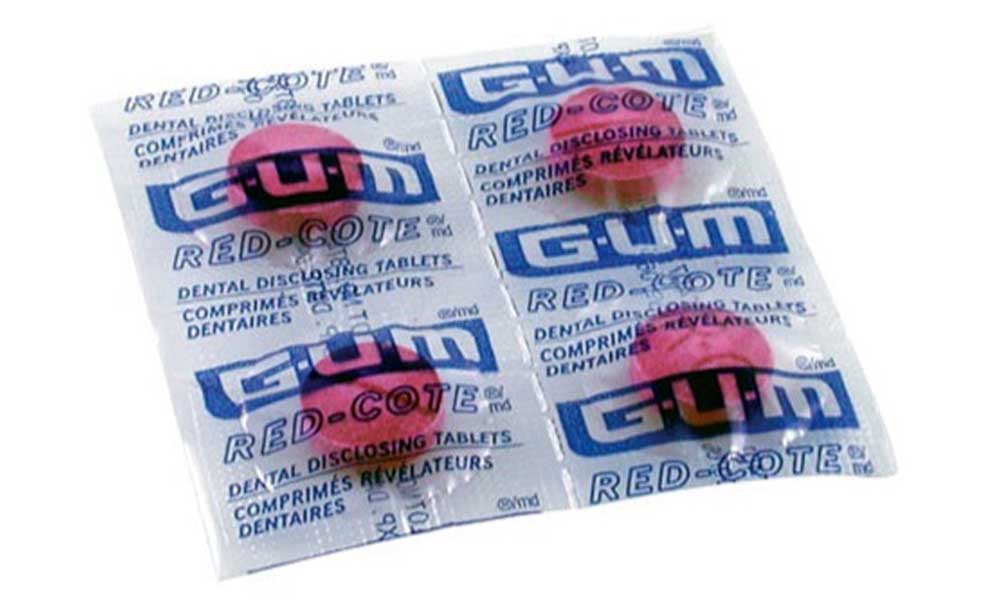
| GUM Red-Cote | Plaque turns red | D&C Red No. 28 and FD&C Blue No. 1; 12-tablet pack; age 6 and up |
| TePe PlaqSearch | New plaque red, plaque older than 12 hours blue | Two-tone; colorants CI 45410 and CI 42090 |
| Fresh Knight Tru-Clean | Purple tint on missed areas | Berry flavor; 96 count; 30-second limit |
| Oraline | Plaque areas turn red | Cherry flavor; 248-tablet bottle |
Which red dye is in yours. Erythrosine, listed as FD&C Red No. 3 (CI 45430), has a long history as a dental plaque disclosing agent. In January 2025 the FDA revoked authorization for Red No. 3 in foods and ingested drugs, with a January 15, 2027 deadline for foods and January 18, 2028 for ingested drugs. Sunstar’s GUM Red-Cote tablets use D&C Red No. 28 (CI 45410, also called phloxine B) instead, the same vegetable dye Wikipedia’s entry names as typical. If anyone in your house has a colorant sensitivity, read the ingredient panel that FDA color additive rules require, and match CI numbers rather than brand claims.
Flavor. Berry, cherry, and mint coatings exist because a chalky, bitter tablet ends compliance in about three uses. Buying for a child? Flavor outranks every other feature.
Pack size and wrapping. Counts run from a 12-tablet trial pack to bottles of nearly 250. Buy small the first time, and check the expiration date on anything sold in volume. Individually wrapped units cost more per use but survive a gym bag or a pill organizer without crumbling.
How to Use Them Without Staining the Bathroom
Use them after your normal routine, not before, because the point is grading that routine.
- Brush and floss exactly the way you normally do. That routine is what the dye grades.
- Stand over the sink. Anything that colors a tooth also colors skin, clothing, and unsealed grout.
- Chew the tablet for about 30 seconds, the time Sunstar and Oraline both direct, and work the color across every tooth surface. Longer can leave extra tint that is harder to remove.
- Spit, then rinse once and gently. A hard rinse strips color off the deposits you were hunting for.
- Rebrush the colored areas only, and note which spots showed so you can fix your brushing technique there.
Repeat offenders matter more than any single session. If the same back molar or the same stretch behind the lower front teeth colors three nights running, that is a technique gap, often a brush angle that never reaches the gum line. Those are the areas that need more attention, with a manual toothbrush or a powered one.
Where to Buy Plaque Disclosing Tablets in Store
Pharmacy and big-box chains shelve these in the oral health aisle, though local selection runs thin next to what each chain lists online.
CVS Pharmacy
Start with the CVS Pharmacy search page, then look beside the toothbrush and dental floss displays in the oral hygiene aisle, not at the pharmacy counter.
Walgreens
Walgreens lists more dental items online than any one store shelves. The chain has been closing underperforming locations since 2024, so confirm your store is still open before driving.
Walmart
Walmart, the largest retailer in the United States, carries a deeper online catalog than shelf presence, including Fresh Knight’s 96-count pack from listed sellers. Order for store pickup and you skip the empty-shelf trip.
Target
Target gives dental products less aisle space than a drugstore chain does, though drive-up and same-day pickup help when a store has stock. Check the app first.
Your Dentist’s Office
The channel shoppers forget. Practices keep these on hand for chairside demonstrations, and Sunstar markets GUM Red-Cote to dental professionals for exactly that, so ask your hygienist at your next cleaning which brand the office buys. Keep the box with your toothbrush, not buried in the first aid kit.
Ordering Online: Amazon, Walmart.com, and Dental Supply
Online is where the real selection lives: more brands, more pack sizes, two-tone formulas, and professional lines that rarely reach a drugstore shelf.
Amazon
Amazon lists the widest range, from trial packs to bulk counts, with Fresh Knight’s 96-count tablets for kids or adults among the most visible listings. Listing reviews help you compare stain visibility and taste before committing to a large pack.
Walmart.com
Walmart.com lists brands the aisle never stocks, and marketplace sellers there sometimes carry clinical products the retail side does not touch. Check who the seller is, because marketplace sellers set their own return terms.
Dental City
Dental City is a dental supply retailer whose catalog lists Oraline’s cherry-flavored 248-tablet bottle alongside other professional lines. It is the route to classroom-size quantities.
Smile Brilliant
Smile Brilliant sells Plaque Highlighters for Kids in a 30-tablet package. Buying direct sidesteps the counterfeit and expired-stock risk of unknown third-party sellers, which matters on anything going in a child’s mouth.
Buying Mistakes That Waste a Pack
The costliest mistake is buying a bulk bottle of something untested, because taste and stain visibility, the two variables that decide whether you keep using it, are both brand specific.
Expecting treatment instead of feedback. These stain a problem so you can see it. They do not treat a cavity, stop dental caries, reverse gum disease, or replace a professional cleaning. If your gums bleed or tartar has hardened, book the appointment and use these as homework.
Buying two-tone when no one will read it. Two colors only help someone who will act on the difference. For a seven-year-old learning to brush their teeth, one bright color is easier to understand.
Using one before you leave the house. Color on the tongue and lips fades with time and normal eating, but no label promises how long yours takes. Treat it as an evening oral care step.
Confusing them with their shelf neighbors. Denture cleaner tablets, teeth whitening kits, and breath mints sit inches away and do different jobs. A denture cleaner fizzes in a glass of water. A disclosing product goes in your mouth and adds color rather than removing discoloration.
Tablet, Solution, Swab, or Rinse?
Three other disclosing formats do the same job, and a tablet is not always the right one.
Disclosing solution. A liquid painted on with a cotton swab. Dental offices lean on it because the operator controls where the color lands and can treat one quadrant instead of a whole mouth. Better for a targeted adult check, worse for a squirming six-year-old.
Pre-soaked swabs. A solution’s precision without an open bottle. These cost the most per use and travel best, which is why they end up in school bags.
Plaque-detecting rinse. A swish-and-spit mouthwash version. Fastest of the three and gentlest on a child who refuses anything chalky, though coverage is less thorough. If you lean toward natural oral care, ingredients like tea tree oil show up in some rinses but reveal nothing.
Skip all of them if your hygienist finds nothing at your checkups. At that point you are paying to stain your tongue for information you already have.
Five Disclosing Tablets Worth Buying
These five are weighed on dye system, flavor, and pack size, using manufacturer pages and retailer listings. Prices move often.
Best for families: Fresh Knight Tru-Clean. A berry-flavored tablet that tints missed plaque purple, sold in a 96-count pack that lasts a household a while. The label caps contact time at 30 seconds. Check price on Amazon
Best professional grade: GUM Red-Cote. Made by Sunstar GUM and marketed to dental offices for patients age 6 and up. It colors plaque red and comes in a 12-tablet pack, a sensible size for a first try. Check price on Amazon
Best two-tone: TePe PlaqSearch. From the Swedish oral care brand better known for interdental brushes. New plaque shows red and plaque older than 12 hours shows blue, which tells you whether a spot was missed tonight or missed for days. Check price on Amazon
Best for kids: Smile Brilliant Plaque Highlighters. A 30-tablet package built for younger children and sold direct, so the stock is fresh. The use case is a child who will not believe a tooth is dirty until it turns color. Check price at Smile Brilliant
Best bulk: Oraline. A cherry-flavored, red-staining tablet in a 248-count bottle from dental supply channels, the most tablets per bottle of the five. Check price at Dental City
Start with one small pack and use it three nights this week, over the sink, after your usual brush and floss. Write down which spots color twice, then change your brush angle there. Once nothing shows two sessions running, drop to a weekly check. Used that way, plaque disclosing tablets become the only honest report card your brushing gets. See also our guides to activated charcoal and coconut oil.
Common Questions About Disclosing Tablets
Do you use them before or after brushing?
After. The point is revealing what your normal routine missed, so brush and floss the way you always do first, then chew one and look. Some offices have a patient color before and after, to show what a corrected angle changes.
Do you spit out disclosing tablets?
Yes. Keep it moving for about 30 seconds, work the color around all tooth surfaces, then spit and rinse once, gently. Sunstar says GUM Red-Cote is made from food ingredients and unlikely to be harmful if swallowed, but it was not developed to be eaten. A hard rinse strips color off the exact film you were hunting, which is why people conclude a product failed when it worked fine.
How long does the color last, and how often can you use them?
Color on the teeth comes off as soon as you rebrush those spots, and Sunstar recommends a full two-minute brush to clear any lingering pink. What lingers longest is the tint on the tongue and lips, which fades over the following hours as you eat and drink. Frequency is a label question: package directions differ by brand, so follow the one printed on yours.
Are plaque disclosing tablets safe for children and pets?
They are widely used with children, including in pediatric dental offices, and the coloring is temporary. Follow the age guidance on the package (Sunstar recommends GUM Red-Cote from age 6, since younger children may not follow the instructions), supervise anyone young enough to swallow one, and read the ingredient panel if your child has a known colorant sensitivity. Pets are a separate question: these are formulated for people, and a veterinarian should decide what goes in an animal’s mouth.
Do they stain braces, retainers, or clear aligners?
Clear and ceramic brackets, elastic ligatures, and clear plastic appliances can all pick up temporary color, while metal brackets will not. Take out any removable retainer or aligner first, then brush and rinse it separately. Sunstar states its tablets do not stain the teeth themselves, and enamel color returns once you brush.
Is a disclosing tablet the same as a denture cleaner tablet?
No, though they share a shelf, which causes real mix-ups. A denture cleaner fizzes in a glass of water to clean an appliance you have removed. A disclosing tablet goes in your mouth and only adds temporary color, so never put a denture cleaner tablet in your mouth.
Written with reference to guidance from the American Dental Association, the National Institute of Dental and Craniofacial Research, the FDA, and manufacturer product pages.