
Three buyers, three different stops for compression gloves. If you want to try a pair this week, Target, Walmart, and the big drugstore chains list mainstream brands like IMAK and Copper Fit in common sizes. If you need XS, XL, or a full-finger night style, order online, where size runs are deeper. If a doctor has diagnosed lymphedema and ordered a gradient garment, skip retail entirely and go through a Medicare-enrolled medical supplier, because that pair may be covered.
This page contains affiliate links. We may earn a commission at no extra cost to you.
What Compression Gloves Do, and What the Evidence Shows
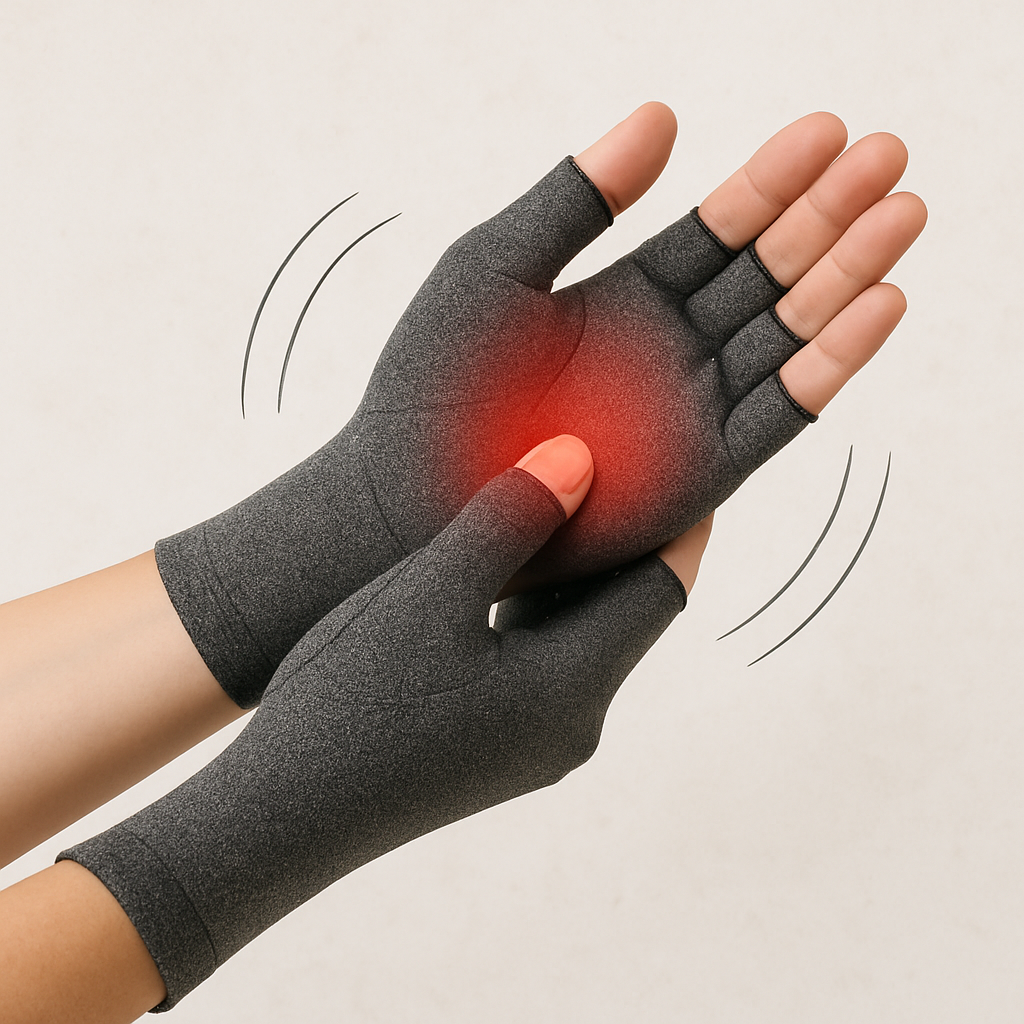
Compression gloves are close-fitting knit hand garments that apply gentle compression across the fingers, knuckles, and wrist. They work on the same idea as graduated compression socks and arm compression sleeves, scaled down to the hand: steady, even pressure is meant to help reduce swelling and keep stiff joints warm enough to grip a mug or keep up with computer typing.
The people who buy them most have hand arthritis, usually rheumatoid arthritis (an autoimmune disease that inflames joint linings) or osteoarthritis. Others are dealing with carpal tunnel syndrome, tendonitis, a repetitive strain injury (RSI), or edema, the excess fluid that collects in tissue and leaves a hand puffy.
Be realistic about results. A large placebo-controlled trial, A-GLOVES, published in BMC Musculoskeletal Disorders in 2021, gave 206 adults with rheumatoid or inflammatory arthritis either Isotoner arthritis gloves applying 23 to 32 mmHg or loose placebo gloves with little or no pressure. After 12 weeks, hand pain improved by about the same amount in both groups, and the authors found no clinically important effect on pain, function, or stiffness. Adverse events were reported by 51% of the compression group and 36% of the placebo group.
That does not mean a pair is useless to you. Warmth and a snug fit help some people feel steadier during a task, and many keep wearing them for that. It does mean a glove is a comfort aid, not a treatment: it will not slow joint damage, reduce inflammation, or cure carpal tunnel syndrome. Anyone with diabetes, poor blood circulation, peripheral neuropathy, or a fresh injury should ask a doctor or hand therapist before wearing anything that squeezes, and the NIH institute covering joint conditions has guidance.
Sizing and Style: How the Pair Should Fit
A good fit feels snug and even, never tight. Fingertips that turn cold, pale, or tingly mean the pair is too small, and a glove that wrinkles at the palm is too loose to do anything.
How to measure your hand before you order
- Wrap a soft tape measure around your dominant hand at the widest point across the knuckles, thumb tucked away. That number drives every size chart.
- Take the reading in the afternoon. Hands swell through the day, and a size matched to a morning measurement is tight by dinner.
- Use the specific brand’s chart, never a generic one. One label’s medium is another’s large.
- Between sizes, order from the retailer with the longest return window and treat the first pair as a fitting.
When we refresh this guide, the first thing we check on any listing is whether it publishes a knuckle-width size chart. Listings that only say “one size fits most” are guessing on your behalf.
Open finger versus full finger. This is the dexterity tradeoff, and it decides whether a pair gets worn or abandoned in a drawer.
| Style | Fingertips | Best for | Tradeoff |
|---|---|---|---|
| Open finger | Exposed | Typing, phones, crochet | No warmth at the tips |
| Half or three-quarter finger | Partly covered | Mixed desk and household work | Bulk at the finger joints |
| Full finger | Covered | Overnight, cold rooms, Raynaud’s | Fine motor control drops |
| Long cuff | Varies | Ache that sits in the wrist | Warmer, harder to pull on |
Fabric and washing. Cotton and spandex blends stay breathable through an all-day shift and are the most common build. Copper infused yarn is the biggest marketing claim in the category, and the evidence behind it is thin: a 2013 double-blind trial in PLOS ONE found copper bracelets had no meaningful effect beyond placebo in rheumatoid arthritis. That study tested bracelets rather than gloves, but nothing comparable shows copper compression yarn does better. Buy copper gloves for fit and price, not for the copper.
Wrist coverage. A long cuff adds wrist support through the lower forearm. If the ache sits there rather than in the finger joints, a longer cuff can save you from layering a separate wrist brace over a sleeve, though a rigid brace is a different product with a different job.
Retail versus medical grade. Most consumer pairs are sold by size alone and do not state a pressure. Medical gradient garments for lymphedema are specified by a clinician, often custom fitted, and rated in mmHg. A retail listing that advertises clinical pressure with no measurement behind it is marketing.
Where to Buy Compression Gloves Online
Online is where the sizes and styles are. Shelves rarely go past small, medium, and large, so anyone who needs XS, XL, a full-finger night glove, or a long cuff is usually ordering.
Amazon
Shop their full selection for everything from budget two-packs to brand-name pairs from IMAK, Vive, Copper Fit, Dr. Arthritis, and ComfyBrace, most sold as unisex gloves for women and men. Return terms differ between Amazon-sold items and third-party sellers, so read the return line on the listing before you order. Reviews are the fastest way to spot a chart that runs small.
Copper Compression
The brand sells direct from its hands collection, which in October 2026 listed half-finger compression gloves, full-finger “Smart Touch” arthritis gloves, long arthritis gloves, and heated vibrating CopperVibe models, next to a wrist brace and finger splint. Its marketplace listings for copper compression arthritis gloves carry far more sizing feedback, so buy direct mainly when your size is gone elsewhere.
Grace & Able and Vive
Grace & Able is a smaller brand built around hand arthritis. It sells cotton-stretch pairs, runs a “Find Your Fit” sizing page, and advertises 30-day returns with free exchanges, which takes most of the risk out of a first order. Vive Health sells fingerless, full-finger, copper, and grip-palm arthritis gloves on its own store, mostly at the budget end.
Store Shelves: Target, Walmart, CVS and Walgreens
Buying in person gets you one thing worth having: you can feel the fabric before you pay. Stock varies by location, so check the retailer’s app for your store before you drive.
| Retailer | Brands seen in its listings | Note |
|---|---|---|
| Target | IMAK, OTC Premium Support (XS to XL), Swede-O Thermal | Isotoner and Vive pairs come from third-party sellers |
| Walmart | Browse their health section for IMAK and other brands | Shelved with braces, not winter gloves |
| CVS | Copper Fit Hand Relief gloves | Small in-store assortment |
| Walgreens | IMAK arthritis relief gloves | Phone the store first |
Drugstores keep hand support next to wrist braces and knee sleeves. If you need XS, XL, or a wide fit, call ahead. Those are the first sizes off a small shelf.
Medical supply stores
Local durable medical equipment shops, the same places that fit canes, mobility walkers, and hearing aids, carry the widest in-store range of gloves and braces, including gradient garments a drugstore never stocks, plus finger splints. Prices run higher. If your glove is prescribed, ask whether the shop can bill your plan. Online, stick to established medical sellers, because unbranded listings are where mislabeled sizing turns up.
Paying for Them: FSA, HSA, and Medicare
Ordinary retail pairs are paid out of pocket. Some FSA and HSA marketplaces list arthritis gloves as eligible, but your plan administrator makes the call, so check before you buy and keep the receipt.
Prescribed lymphedema garments are the exception. Since January 1, 2024, Medicare Part B covers gradient compression garments for people with lymphedema when a doctor orders them, and the supplier billing codes include gradient compression gloves and gauntlets. After the Part B deductible, you generally pay 20% of the Medicare-approved amount. Arthritis alone does not qualify.
Five Buying Mistakes That Waste a Pair
The question we get most is whether tighter means better. It does not, and buying a size down is the most common way a pair ends up unworn.
- Guessing your size. Charts differ between brands, and clothing size is irrelevant. Match your knuckle measurement to the chart on the listing you are buying from.
- Chasing pressure. A pair that leaves fingertips cold, tingling, or pale is restricting blood flow. Size up.
- Expecting treatment. Claims that a pair will ease pain and swelling describe what some buyers report, not a tested result. A listing that promises to cure arthritis or fix carpal tunnel tells you plenty about the seller.
- Using the dryer. Heat breaks down the elastic fibers that create the compression. Wash gentle, air dry, and own two pairs so one is always ready.
- Ignoring the return terms. Opened health items are often non-returnable, and marketplace sellers set their own policies.
Top Picks: Five Pairs Worth a Look
These cover the formats most buyers settle on: fingerless for daytime, full finger for nights, and a long cuff for wrist pain. Prices move weekly, so check the listing.
Best overall: IMAK Compression Arthritis Gloves. Fingerless cotton knit with mild compression, sized by knuckle width. IMAK gloves appear in the Arthritis Foundation‘s Ease of Use product listings, a program the Foundation says relies on independent expert testing and evaluation by people with arthritis. That is a usability review, not a health claim. Check price on Amazon
Best budget: Vive Arthritis Gloves. Fingerless gloves in a cotton and spandex blend, with a grip-palm version for jars and handles. Cheap enough to test whether the format suits you. Check price on Amazon
Best for all-day comfort: Grace & Able Compression Gloves. Cotton-stretch knit that looks less like medical equipment, backed by the brand’s free size exchange. Check price on Amazon
Long cuff option: Dr. Frederick’s Original Arthritis Gloves. Sold on Amazon as a longer-cuff style for an ache that sits in the wrist. Check the listing photos for cuff length before ordering, since styles change. Check price on Amazon
Full finger: Tommie Copper Compression Gloves. Tommie Copper’s own site did not list gloves when we checked in October 2026, so treat marketplace stock as remaining inventory. If it is gone, Copper Compression and Vive both sell full-finger pairs for overnight use and cold rooms. Check price on Amazon
Start with a tape measure in the afternoon, then pull up the chart for the brand you want. Buy your first pair of compression gloves from a retailer whose return window you can live with, Target or Walmart if you want to try one on today, Grace & Able if you want a free exchange. If a pair numbs your fingertips, size up, and talk to a clinician if your symptoms keep worsening.
Frequently Asked Questions From Buyers
Do compression gloves work for arthritis?
The best evidence says not much beyond comfort. In the 2021 A-GLOVES trial, people with rheumatoid arthritis improved about equally whether they wore real compression gloves or loose placebo gloves. Some wearers still like the warmth and snug joint support, so a low-cost trial pair is a reasonable experiment. Stop wearing them and call your doctor if pain increases.
How many hours a day should you wear them?
There is no universal number, and any guide handing you one is guessing. Follow the wear time printed on the product label, then ask your occupational therapist or hand therapist what suits your diagnosis. Build up gradually, and stop immediately if you feel tingling or numbness.
Can you sleep in them?
Yes, if the pair is designed for overnight use and fits loosely enough. Do not sleep in a firm daytime pair unless a clinician told you to, because you cannot notice numbness or restricted circulation while asleep.
Are arthritis gloves the same thing?
Mostly, yes. Arthritis glove is the shelf name retailers use for the same category, usually pointing at open finger daytime styles. The label describes the intended buyer, not different technology, so compare the size chart and fiber content instead of the name.
Will they help carpal tunnel, tendonitis, or trigger finger?
Some people find products sold as gloves for carpal tunnel take the edge off, but a knit garment treats none of those conditions. Carpal tunnel syndrome is pressure on the median nerve, which runs from the forearm through the wrist into the palm, and the NIH notes that a hand and wrist splint worn at night is a common first treatment. Trigger finger involves a tendon catching in its sheath. Ask a hand therapist, not a product page.
Does insurance cover them?
Ordinary retail pairs are almost never covered. Prescribed gradient garments for lymphedema are different, and Medicare Part B has covered them since 2024 with a doctor’s order. Check Medicare’s coverage rules or call your plan administrator before assuming either way.
About This Guide and How We Checked It
Reviewed by the wheretobuyguides.com editorial team. Retailer listings and brand pages checked October 2026. Evidence summaries come from the published A-GLOVES and copper bracelet trials, NIH (NIAMS) carpal tunnel guidance, and Medicare’s lymphedema coverage page. No clinician has reviewed this page, none of it is medical advice, and anyone with a diagnosed hand condition should raise it with a doctor first.