
Buy boric acid by the job, not by the box. For roaches and ants, that means an EPA-registered powder or bait from the pest-control aisle. For a recurrent vaginal infection a clinician has already diagnosed, it means an insert from a pharmacy. For rinsing an eye, it means a sterile eyewash that comes sealed and ready to use, never something stirred together from a jar. One compound, three grades, three different sets of rules.
This page contains affiliate links. We may earn a commission at no extra cost to you.
Chemists call it orthoboric acid (H3BO3). It is a white powder made from boron, a mineral element found in soil, water, and rock deposits, and it dissolves in water to form a very weak acid. Manufacturers make it by treating borax with sulfuric acid or hydrochloric acid. The National Pesticide Information Center (NPIC), a service of Oregon State University and the EPA, counts more than 500 products containing boric acid sold in the United States, from roach killers to eyewash buffers.
Three Grades of Boric Acid and the Shelf Each One Sits On
The label decides the grade, and the grade decides where it belongs. Read the front panel for the intended use, then the back for the registration or grade mark.
| Grade | What the label shows | Intended use | Where it is sold |
|---|---|---|---|
| Pest powder or bait | EPA Reg. No. and a list of pests | Roaches, ants, silverfish | Hardware stores, garden centers, big-box pest aisles |
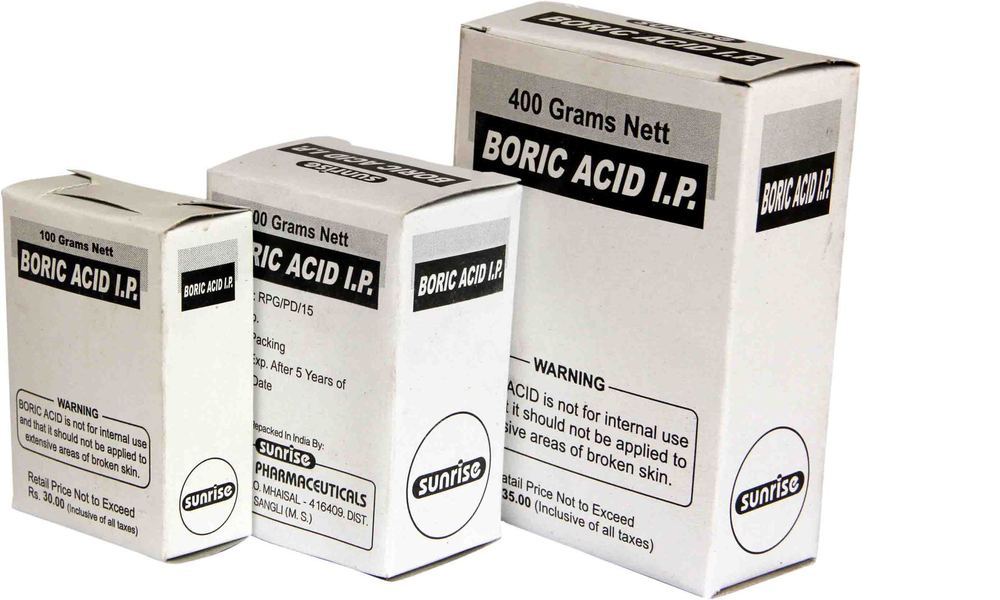
| Pharmacy NF powder | “NF” (National Formulary) grade | External use a pharmacist or clinician directs | Pharmacy counter, first aid shelf, chemical suppliers |
| Bulk technical or reagent | Purity grade plus a safety data sheet | Lab work, manufacturing, pool borate dosing | Lab suppliers, pool distributors, online |
| Vaginal insert | Single-dose inserts, never taken by mouth | Recurrent BV and yeast infection, on clinician advice | Feminine care aisle, pharmacy websites |
Purity is not the same as suitability. NF on a pharmacy bottle means the powder meets the National Formulary monograph. A roach powder can be nearly pure too: Harris sells a 16-ounce roach killer listed as 99% boric acid with a lure. That bottle is still a pesticide, with flow agents, an attractant, and a label that limits it to pest sites. It never goes on skin, in eyes, or in the body.
Container and seal. Choose a screw-top jar or a sealed puffer bottle over a cardboard shaker. Caked powder will not spread in the thin film pest labels call for.
Four steps get you to the right product:
- Name the job: pests, pool water, or a use a clinician has directed.
- Match it to a grade in the table above.
- For pest products, confirm the EPA Reg. No. and check that your pest and your site are on the label.
- Buy the smallest sealed container that covers one season.
Roach and Ant Powder: What the EPA Label Tells You
Every pesticide sold in the US must carry an EPA registration number under the Federal Insecticide, Fungicide, and Rodenticide Act (FIFRA). Registration means the United States Environmental Protection Agency reviewed the product’s safety data and approved its label. It is not an endorsement, and the label directions are legally binding. No Reg. No. means it was never registered as a pesticide.
Boric acid pest products have been registered in the US since 1948. They come as dusts, baits, granules, tablets, pellets, rods, and liquids. Insects die after eating it, because it disrupts the stomach and can affect the nervous system. Roaches pick up the dry powder on their legs and swallow it while grooming, which is why labels direct a light, even dusting into cracks, wall voids, and the gaps behind appliances. A visible mound works against you: roaches tend to walk around it. NPIC explains pesticide uses and toxicity in plain language. Read their fact sheet.
When a different product fits better
Gel bait (fipronil or indoxacarb) suits a heavy infestation, since roaches carry it back to the harborage. Diatomaceous earth kills by abrasion but stops working once it gets damp, which rules it out under a leaky sink. Borax is sodium borate. Borax and boric acid share boron but are different products; our borax buying guide covers which stores stock it. Disodium octaborate tetrahydrate, sold for wood treatment, is another inorganic borate.
Pool owners are the other bulk buyers. Distributors sell pool-labeled granules in 40- and 55-pound bags, and in pools boric acid is used to help keep pH from drifting upward. For alkalinity, soda ash is the usual product, and it does not buffer pH the way borates do.
Boric Acid Vaginal Suppositories: Sold Over the Counter, Not FDA Approved
Boric acid suppositories are 600 mg inserts sold without a prescription, yet the Food and Drug Administration has not approved them for any vaginal infection. Poison Control points out that, because they are unapproved, there is no FDA standard dose. In September 2020, pH-D Feminine Health ran a Class II FDA recall of its 24-count boxes, with the stated reason “marketed without an approved NDA/ANDA,” meaning no approved new drug application.
What the CDC treatment guidelines say
The professional guidance US clinicians follow here is the CDC’s Sexually Transmitted Infections Treatment Guidelines. For women with multiple recurrences of bacterial vaginosis, the CDC’s BV guideline describes intravaginal boric acid 600 mg daily for 21 days, after an oral nitroimidazole and before suppressive metronidazole gel, as an option backed by limited data. Its candidiasis section lists the same dose in a gelatin capsule, inserted vaginally once daily for 3 weeks, when non-albicans vulvovaginal candidiasis recurs. Both are follow-up treatments after a diagnosis, not a first move for a new yeast infection.
Cleveland Clinic’s drug page asks users to tell their care team about pregnancy, plans to conceive, breastfeeding, diabetes, and immune problems first. It also warns that vaginal boric acid may make condoms, diaphragms, and spermicides work less well. Poison.org says pregnant women should avoid them. This is not medical advice; get a diagnosis before buying.
Shopping for the inserts. pH-D Feminine Health and AZO Boric Acid are the names most shoppers see, and Walmart lists AZO in a 30-count box. Buy from the retailer itself rather than a third-party marketplace seller, check the strength on the box before using boric acid inserts, and store them apart from oral medicines. The inserts look like ordinary capsules, and the Missouri Poison Center reports calls from people who swallowed one by mistake.
Eyewash and Pharmacy NF Powder
Packaged eyewash is where most people use this chemical without knowing it. Several OTC eyewash labels list boric acid and sodium borate as inactive ingredients that buffer the solution’s pH. Those products come sterile and sealed in the first aid or eye care aisle, and they are the only eyewash to buy.
NF powder is a different purchase. Some pharmacy-grade labels give dilution directions for a weak external antiseptic, and the same labels warn against using the powder as a dusting agent or on open wounds. A solution mixed on a kitchen counter is not sterile, so it cannot stand in for packaged eyewash. If a pharmacist or clinician has not directed the use, leave the NF jar on the shelf.
Where Stores Shelve It, Store by Store
Most chains split it across two or three departments, and placement changes from one location to the next. Check the store app for local stock before you drive.
Walmart
Walmart’s online listings cover roach powders such as Harris and Zap-A-Roach plus the AZO inserts. In the store, pest powder belongs in the pest-control aisle and inserts in feminine care. Browse their selection here.
Home Depot and hardware stores
Home Depot lists the Harris 16-ounce roach powder and a two-pack bundled with a pro applicator, both under insect control. Hardware co-ops such as Do it Best carry the same Harris bottle. This is the right channel for pest work, not for anything personal. Check availability on their site.
CVS and Walgreens
Drugstores can stock it in up to three places: roach powder with household pest products, inserts in feminine care, and NF powder near first aid or behind the pharmacy counter. Not every store carries all three, so ask the pharmacist if the shelf is empty. CVS and Walgreens both list it online, and Walgreens carries a PIC-brand roach killer powder.
Grocery, farm, and pool supply stores
Some grocery chains carry a pharmacy-grade bottle; HEB lists Humco’s. Tractor Supply sells the Harris roach powder. Pool supply stores handle the granular pool product and borate-based pool treatments.
Amazon and online suppliers
Amazon has the widest range, from small pharmacy bottles to multi-pound bags, plus the main roach powders and insert brands. Judge the grade from the listing title and the ingredient panel image, not the product photo. Shop the selection here #ad. Lab suppliers such as Sigma-Aldrich sell ACS reagent grade. For anything that touches the body, buy from a pharmacy chain’s own site, not a marketplace reseller.
Children, Pets, and Poison Control
Swallowing a roach product is the usual cause of acute boric acid poisoning, according to MedlinePlus, and infants have a high death rate from it. That is why many pest labels require application in places out of children’s reach. Bait stations and dust inside wall voids keep the product away from hands and paws; a loose line along an open baseboard does not.
Signs of boric acid poisoning
- Classic signs: blue-green vomit, diarrhea, and a bright red skin rash.
- Severe signs: blisters, seizures, drowsiness, low blood pressure, and little or no urine output.
- Exposure to boric acid in the eyes: rinse with cool water for 15 minutes.
- Any swallowed amount of boric acid: call the Poison Help line at 1-800-222-1222 (free, 24/7), or 911 if the person is seriously ill.
Dogs and cats
Boric acid toxicity in animals looks much like it does in people, and NPIC notes that signs can start within 2 hours of eating it. Small dogs and cats get a bigger dose per pound from the same mouthful. Call your veterinarian or the ASPCA’s animal poison hotline at 888-426-4435 for any suspected ingestion of boric acid.
Product Picks by Job
Five products covering the realistic uses, picked on grade, format, and label clarity. Prices change often, so check the live listing.
Roaches: Harris Boric Acid Roach Powder with Lure. A 16-ounce bottle listed as 99% boric acid plus an attractant, stocked by Home Depot, Tractor Supply, and Walmart. Confirm the EPA Reg. No. on the bottle. Check price on Amazon
Pharmacy grade: Humco Boric Acid Powder NF. A plain pharmacy-grade powder in small bottles, for the uses a pharmacist or clinician directs. Check price on Amazon
Roach and ant two-pack: Zap-A-Roach Boric Acid Roach Killer. Sold by Mr. Brands, including a two-pack of 1-pound bottles at Walmart. Its EPA-accepted label excludes carpenter, fire, harvester, and pharaoh ants, so check your ant species first. Check price on Amazon
Pools: Milliard Boric Acid Fine Powder. A general-purpose fine powder some pool owners use for borate dosing. Pool-labeled granules from a pool distributor are the alternative if you want dosing directions on the bag. Check price on Amazon
OTC inserts: pH-D Feminine Health inserts. Widely stocked in 24-count boxes; note the 2020 FDA recall described above and talk to your clinician first. Check price on Amazon
Decide which job you are buying boric acid for, then buy that grade and nothing else. For roaches, start with one EPA-registered bottle from a hardware store and dust thinly. For pool water, buy the pool-labeled granules. For anything that touches the body, buy from a pharmacy and bring your clinician in first. More household chemistry: our citric acid guide, our Heinz cleaning vinegar guide, or the full Household Products category.
Boric Acid FAQ
Do the vaginal inserts need a prescription?
No. They sell over the counter in the US, but the FDA has not approved them, so no FDA-reviewed dose or label backs them. The CDC guidelines describe daily use for 21 days for recurrent bacterial vaginosis and once daily for 3 weeks for recurrent non-albicans yeast. A clinician should confirm the diagnosis first, and they are not for use during pregnancy.
Is it safe around children and pets?
Only when it stays out of reach. Dust placed inside wall voids or in closed bait stations keeps exposure low, while loose powder on open floors does not. Infants are the highest-risk group, and pets can show signs within 2 hours of eating it. Lock up the container and call 1-800-222-1222 for a person or 888-426-4435 for a pet.
What if someone swallows one of the inserts?
Call Poison Help at 1-800-222-1222 right away. Poison.org says serious harm from one swallowed insert in an adult is unlikely, though vomiting, stomach pain, and diarrhea can follow. Large amounts of boric acid can cause lethargy, kidney failure, and death, and MedlinePlus notes a high death rate in infants.
Can I make my own eyewash from the powder?
No. A homemade solution is not sterile, and pest powder carries lures and flow agents. Packaged OTC eyewashes already use boric acid and sodium borate as pH buffers, so buy one of those sealed bottles.
Where is it in CVS?
Check two or three spots. Roach powder sits with household pest products, inserts with feminine care, and NF powder, where stocked, near first aid or behind the pharmacy counter. Placement varies by store, so the CVS app or the pharmacist is the fastest answer.
Sources: NPIC, CDC STI Treatment Guidelines, MedlinePlus, poison.org, Missouri Poison Center, Cleveland Clinic, and the FDA recall record for pH-D Feminine Health. This page is not medical advice and is not medically reviewed.