
Moleskine notebooks are sold on the brand’s own website, in its company stores, and through retailers including Barnes and Noble, Target, Staples, Office Depot, Books-A-Million, Blick and Amazon. Where you buy matters less than what you buy. The black Classic is on almost every shelf, while exclusive collections, personalization and the full color range mostly live on the official Moleskine site. Before picking a seller, decide whether the paper suits your ink, the one complaint that has followed these notebooks for two decades.
This page contains affiliate links. We may earn a commission at no extra cost to you.
The Black Notebook’s Backstory, and Who Owns It Today
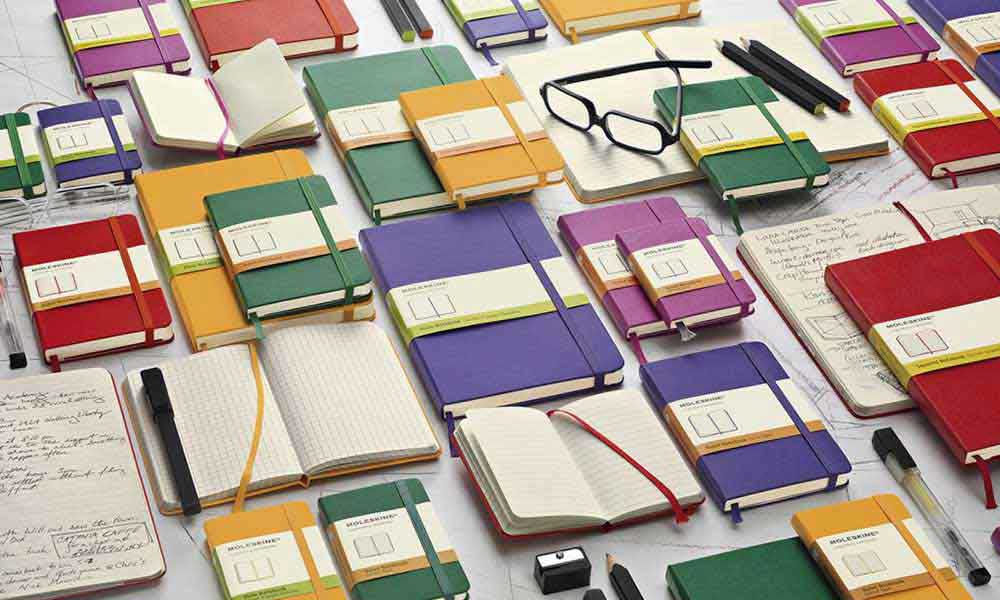
Moleskine is an Italian stationery brand, headquartered in Milan, Italy, that makes hardcover and soft cover notebooks, planners and sketchbooks around one iconic silhouette: rounded corners, an elastic band closure, a ribbon marker and an expandable pocket inside the back cover.
The company dates to 1997, when Modo & Modo trademarked the name and reintroduced the format, an idea credited to Maria Sebregondi. Its inspiration was the plain black notebook once sold by Paris stationers, which the travel writer Bruce Chatwin called “moleskines” in his book The Songlines. Ernest Hemingway, Vincent van Gogh and Pablo Picasso filled similar unbranded books, but no surviving maker links those notebooks to today’s factory-made product.
Ownership has changed twice since. Syntegra Capital, a European private equity firm, bought the business in 2006, and it listed on the Borsa Italiana in 2013 as Moleskine S.p.A. In 2016 the Belgian group D’Ieteren bought a 41% stake, followed with a takeover offer, and pulled the shares off the Milan exchange later that year. D’Ieteren, a holding company best known for car distribution, was reported as the 100% owner in 2024. So the Moleskine brand is Italian in design and headquarters and Belgian in ownership. It is not Japanese, despite how often that question comes up.
Which Moleskine Line and Size Fits the Job
Pick the range first. Binding, page count and paper change far more from one range to the next than the cover color does.
| Range | Build | Best for |
|---|---|---|
| Moleskine Classic notebook | Sewn block, hardcover or soft cover, elastic band, ribbon, back pocket | Daily writing, meetings, journaling |
| Classic Expanded | Same build with a much thicker page block | Writers who hate switching books mid-year |
| Cahier journals | Thin card covers, usually 80 pages, sold as a 3 pack | One project, one trip, one class |
| Volant journals | Soft covers sold in pairs, every page detachable | Pages you plan to tear out and share |
| Art collection | Heavier 165 gsm drawing stock, plus watercolor albums | Pencil, charcoal and ink drawing |
| Smart Writing Set | Coded paper tablet and a digital stylus that syncs strokes to an app | Handwriting you also want stored digitally |
Sizes use the same names across every range. Pocket is 9 x 14 cm (3.5 x 5.5 inches), Large is 13 x 21 cm (5 x 8.25 inches) and XL is 19 x 25 cm (7.5 x 9.75 inches). Large is the default most stores stock, since it holds real writing and still fits a backpack. The small size rides in a jacket, while XL suits a desk or lecture notes. Volant adds an XS size.
Ruling matters as much as size: ruled for prose and minutes, dot grid for bullet journaling, squared for math and plans, plain for sketching. Four steps narrow it down:
- Name the job: daily writing, planning, sketching, or short project notes.
- Pick the ruling that matches: ruled, dot grid, squared or plain.
- Choose the size by where the book will live: a jacket, a bag or a desk.
- Check the listed page count and paper weight against the ink you use.
Paper Weight and Fountain Pen Bleed-Through
Classic sheets are 70 gsm (grams per square meter), ivory and acid-free, made from sources certified by the Forest Stewardship Council, the main standard for responsible forestry. That weight handles a ballpoint pen, pencil and most gel ink without trouble, so plenty of buyers never notice an issue.
Wet ink is another story. Broad nibs, saturated fountain inks and alcohol markers feather and show through on Classic and Cahier stock, a finding repeated across r/notebooks and r/fountainpens threads and in a long reconsideration on the stationery blog The Well-Appointed Desk. A replacement copy will behave the same way, because the cause is the light sheet itself rather than a bad batch.
The Art range is the in-house fix: its heavier stock takes ink far better, though it only comes plain and costs more per sheet. A good rule before committing to any book: write a line with your usual nib on the last page and check the back.
One warning while you choose ink: never load India ink into a fountain pen. Shellac-based ink dries in the feed and ruins the nib. Use a dip nib or a brush.
Where to Buy Moleskine Direct: Brand Stores and the Official Site
Go direct when you want something nobody else carries. The official store is the only dependable source for exclusive collections, licensed tie-ins and personalization such as embossing, and it lists the full color run for each range. Prices run at list, so treat it as the place for things you cannot find elsewhere.
Moleskine also runs its own shops. Retail Dive reported in January 2026 that it had 12 US stores, including a small neighborhood concept store on Manhattan’s Upper East Side and a location in Moynihan Train Hall, with more planned. The same report listed Barnes and Noble, Target, Nordstrom, Walmart and independent bookstores among its wholesale partners.
Retailers That Stock the Notebooks
Bookstores and office chains carry the core range in most US markets, though depth varies by location. Online sellers go deeper, including sizes and colors that never reach a shelf.
Barnes and Noble
Barnes and Noble usually holds the deepest in-store assortment: Classic notebooks, planners, and seasonal limited editions, in the stationery display near the front. Handy if you are already picking up books or magazines.
Target
Target carries a small assortment, mostly black ruled and plain sizes, in the school and office aisle. Filter the site to stationery, because on-site search also returns moleskin blister padding. Shopping for a semester? The school supplies guide on this site covers the rest of the list.
Staples
Staples keeps notebooks, planners, and writing sets in the office supply aisle. The assortment skews toward the black Classic in one or two sizes.
Office Depot
Office Depot carries a comparable business-oriented selection, and Professional layouts are likelier here than at a bookstore.
Books-A-Million
Books-A-Million runs a gift and stationery section carrying it in many of its stores. Call ahead at smaller locations before driving over. For a wider look at pads, refills, and desk supplies, see our stationery buying guide.
Amazon
Amazon #ad stocks most Moleskine products, from the Classic range and planners to Cahier sets and accessories, and it is the fastest way to compare street prices across sizes. Read the seller name before ordering, because third-party listings sit beside the first-party ones.
Blick Art Materials
Artists should start at Blick Art Materials, which carries the Art collection and watercolor albums alongside professional-grade art materials. It is the easiest catalog for weighing heavier drawing stock against the standard sheets.
eBay
eBay is where discontinued and past-season limited editions surface, sometimes in bulk lots. Study the photos and seller history, since counterfeits circulate on resale platforms.
Leuchtturm1917, Rhodia or Field Notes Instead?
Three names come up over and over once a buyer decides the paper is the dealbreaker.
Leuchtturm1917. A German maker with a near-identical format, plus numbered pages, a pre-printed index, and a sticker sheet in the back. Fountain ink users generally rate its stock higher. Pick it if you journal with wet ink and want the same size and feel.
Rhodia. The reference point for ink performance, printed on Clairefontaine stock most reviewers treat as the benchmark. Pick it if writing feel is the whole point and you can skip the band closure and inside pocket.
Field Notes. US-made memo books sold in 3 packs for a fraction of the price. Pick these if you fill a small book every few weeks and treat it as disposable.
Skip the whole category if the job is holding a shopping list. A basic composition pad does that, and no amount of bookbinding changes it.
Buying Mistakes: Counterfeits, Name Mix-Ups and Edition Markups
The costliest mistake is buying on looks, then finding the sheets cannot take your ink. Three others follow close behind.
Confusing Moleskine with moleskin. One is the Italian stationery name. The other, without the final e, is a napped cotton fabric sold as adhesive blister padding. Search boxes routinely return both.
Counterfeits on open marketplaces. Fakes circulate widely, and the tell is consistent: a price far below every other seller, stock photos instead of real ones, vague size details, and a seller with almost no history. Buy from the official store, a first-party listing, or a long feedback record.
Paying extra for licensed and limited editions. Character tie-ins, museum collaborations, and anniversary runs carry a premium over the standard equivalent with the same block of sheets inside. Buy one for the cover art, not for better writing.
Five Picks Matched to the Job
These five cover the jobs buyers describe most often, chosen on format and size rather than a testing claim we cannot support. Prices move with color and season, so check the current offer.
Best overall: Moleskine Classic Notebook, Large, Ruled. The 5 x 8.25 inch hardcover, with acid-free sheets, an elastic closure, and a ribbon marker. Check price on Amazon
Best for bullet journaling: Classic Notebook, Large, Dot Grid. Same build in the dot layout, which is why bullet journal threads still point newcomers here despite the ink complaints. Check price on Amazon
Best budget: Cahier Journal, Large, 3 Pack. Thin, kraft card covers, three to a set. Good for one project or a trip. Check price on Amazon
Best for sketching: Moleskine Art Sketchbook, Large. Heavier drawing stock in a durable hard binding, built for pencil, charcoal, and ink work. Check price on Amazon
Best for planning: Moleskine 18-Month Weekly Planner. A weekly spread on the left, a ruled side on the right, running eighteen months so you can start mid-year. Check price on Amazon
Start by naming the job, then match line, size and ruling to it. If you write with a ballpoint or pencil, a Large Classic is the safe Moleskine buy, and Amazon or Target is the quickest place to get one. If you write with wet fountain ink, try the Art range first or move straight to Leuchtturm1917 or Rhodia. For a gift, the official store’s embossing beats a marked-up limited edition from a reseller, and grab gift wrap while you are there.
Frequently Asked Questions About Moleskine
Is the cover made of real leather?
No. The covers are a coated material over a cardboard core, bound in the style of a leather book without using any. Moleskin, without the final e, is a napped cotton fabric used in workwear and blister pads.
Why is it called Moleskine?
The name comes from Bruce Chatwin, who called the black notebooks he bought in Paris “moleskines” in The Songlines. Modo & Modo trademarked the name when it relaunched the format in 1997. The word echoes moleskin fabric, but no animal skin is involved.
Does the paper bleed with fountain ink?
On the Classic range, often yes. Fountain ink users on Reddit and stationery forums consistently describe feathering and show-through with saturated inks and broad nibs. Fine nibs with drier ink fare better, and the Art range handles ink more reliably because its 165 gsm stock is much heavier than the 70 gsm Classic sheet.
Where are the notebooks made?
Design and headquarters are in Milan, but production is outsourced. As of 2024, the company’s strategic suppliers were located in China, Vietnam, Turkey and Ecuador. Check the packaging of any copy on the shelf if the country of manufacture matters to you.
Is the Large size the same as A5?
Not exactly. The Large size, at 13 x 21 cm, is close to A5 (14.8 x 21 cm) but narrower, so A5 refill sheets, printable inserts, and some third-party covers will not line up. If true A5 compatibility matters, check the metric dimensions before ordering.
Why does it cost more than similar notebooks?
You are paying for the build and the name, not for premium sheets. Sewn signatures, a rigid board, an elastic band, a ribbon, and a rear pocket cost more to assemble than a glued paperback block, and nearly three decades of recognition carry the rest. Store-brand copies often sell for about half.
Reviewed by the wheretobuyguides.com editorial team. Ownership, store count and retailer details checked October 2026.