
Interstate Batteries are sold mainly through authorized dealers (independent repair shops, parts counters and service centers), the brand’s own Interstate All Battery Center franchise stores, Firestone Complete Auto Care, and Costco warehouses, with online listings on InterstateBatteries.com, Amazon, Walmart.com and eBay. For a car battery you need installed today, the dealer locator on the official site is the fastest route. For the lowest shelf price on a common group size, Costco is usually the first call, but its warranty runs through a separate program.
This page contains affiliate links. We may earn a commission at no extra cost to you.
That channel mix exists because of how the business is built. Interstate is a Dallas-based distribution company, founded in 1952 and now more than 70 years old, that writes the specifications and contracts out production, ordinary practice in the automotive industry. Its homepage describes a distributor network of 300 wholesale warehouses serving more than 150,000 repair businesses and parts stores, plus 200 franchise All Battery Center stores. That is why you can drive past three superstores without seeing the green logo, then find a full rack at the garage on the corner.
The catalog runs from car, truck, marine, golf cart, powersport and mobility units down to AA, AAA and 9V cells that overlap with ordinary household batteries. Race fans know the name from a NASCAR partnership with Joe Gibbs Racing that goes back decades: the No. 18 car carried Dale Jarrett in the early 1990s and Bobby Labonte to the 2000 Cup Series championship.
Interstate Batteries at Costco: Same Power, Different Warranty
Costco still sells Interstate. Its automotive battery page lists Interstate products for cars and trucks plus boats, RVs, golf carts and lawn mowers, in both standard flooded and AGM types. Selection leans on high-volume group sizes, so use the online battery finder or ask at the Tire Desk before driving over.
The difference is the warranty, not the product. In Costco’s own words, its Interstate units “offer the same reliable power as Interstate batteries, but a different warranty program supports them.” Costco advertises a 36-month limited prorated warranty on automotive units, serviced at your local warehouse, and tells buyers to check the duration printed on the label. Dealers follow Interstate’s own chart instead. The practical rule: a Costco-bought unit goes back to Costco, a dealer-bought one goes back to a dealer.
Bring the old one along when you shop: Costco gives a core credit when you return it for recycling. For the rest of the cart, see the guide to what to buy at Costco; the warehouse is also a reasonable stop for other car parts.
Dealers, All Battery Center Stores and Firestone
The dealer locator on the official site returns authorized locations by zip code. Expect garages and service centers more often than retail chains; it is also how you find an IB Authorized Warranty Dealer for a claim.
Interstate All Battery Center
The company’s franchise outlets carry the widest range under one roof: automotive batteries, marine and deep-cycle, powersport, mobility, plus watch, key fob and phone cells. The limited warranty names them alongside authorized dealers as places to present a failed unit. If your group size is unusual or you need a golf cart set, start here.
Firestone Complete Auto Care
Firestone says it installs Interstate in its service bays, which is the practical argument for a service center over a website: the vehicle is already on the lift. Ask the tech to test the old unit and the charging system first. A failing alternator produces the same slow-crank symptoms, and swapping the wrong component fixes nothing.
Independent garages and parts stores
Thousands of independent repair shops and counter dealers across North America are supplied by the distributor network, and the company backs them with exclusive tools and training. Between them they stock more group sizes than any single chain, and testing is often free with a purchase. Tractor Supply Company carries the brand for the farm equipment, ATV and mower fitments the auto chains skip, handy if you are already picking up tools.
Ordering Online: Official Store, Amazon, Walmart.com and eBay
Online ordering suits household sizes and specialty items better than a starting battery: freight on a heavy lead-acid case eats the savings, and the warranty below only covers units bought from an authorized seller.
InterstateBatteries.com. The official site carries the full catalog, including golf cart, mobility and deep-cycle items local shops rarely stock, and location listings offer an order-online option. Buying direct removes any authenticity question.
Amazon. Amazon.com lists starting and marine units alongside AA and 9V multipacks. Browse the brand’s listings there #ad. Third-party sellers sometimes put the name in a title for a product that is not theirs, so confirm the seller and check the case logo.
Walmart.com. Walmart.com lists the brand’s car batteries in its auto parts category. Walmart Auto Care Centers stock a house line, so the listing is no promise of local shelf stock.
eBay. Listings turn up on eBay Motors, mostly from small distributors and often local pickup only. You cannot verify a date code from a photo, and a seller outside the authorized network may leave you with no warranty at all.
How the Interstate Warranty Works by Model
The free-replacement period is set by the model code on the label. Interstate’s US limited warranty for units purchased on or after July 15, 2026 lists these automotive periods:
| Model code begins with | Free replacement | Discount period after that |
|---|---|---|
| M | 18 months | None |
| MT | 24 months | Yes, tiered percent off SRP |
| MTP | 30 months | 45% off SRP to month 48, 25% to 60, 10% to 72 |
| MTX | 36 months | See the chart for your purchase date |
| MTZ | 48 months | See the chart for your purchase date |
Three details in the fine print matter more than the headline number. First, the discount period is not prorated credit on what you paid. It is a percentage off Interstate’s suggested retail price (SRP) for the replacement at the time you return the old one, and you still pay tax, fees and any labor. Second, a replacement inherits whatever coverage remained on the original; it does not start a new clock. Third, an automotive unit used in a commercial vehicle, a truck over one ton, or a diesel other than a personal car or pickup drops to a one-year free-replacement period (two years for MTZ).
To claim, take the original unit, fully charged, to an IB Authorized Warranty Dealer or All Battery Center store that has a replacement in stock. Earlier purchases follow the warranty document for their own date range, which the official brand website posts by purchase date, along with a warranty lookup for anyone without a receipt.
How to Read the Date Code on Interstate Batteries
The date code tells you when a unit shipped from the plant. Costco’s battery FAQ describes the method: a two-character code stamped into the cover or printed on the top or side label, where the letter is the month (A is January, B is February, C is March) and the digit is the last digit of the year. A code starting “B6” means February 2026.
It matters twice. A lead-acid cell loses capacity on a shelf as surely as in service, so take the freshest one on the rack and as a common rule of thumb skip anything more than about six months old. And if you lose the receipt, Interstate’s warranty says the dealer will estimate your purchase date from the manufacturer code, which usually lands earlier than the day you actually bought it. Keep the receipt in the glove box, as the warranty itself advises, and write the purchase month on the case in marker.
Picking the Right Line: Group Size, CCA and AGM
Fit is decided by group size, not by brand or price tier. Group size is a standardized number (24F, 35, 48/H6, 65, 94R) defining case dimensions, terminal placement and hold-down design. Get it wrong and nothing else rescues the purchase, because a unit that does not fit the tray cannot go back once installed and charged.
Cold cranking amps. CCA is the current a fully charged 12-volt unit delivers for 30 seconds at 0 degrees Fahrenheit before voltage falls to 7.2 volts. Match or beat the engine maker’s figure. Check reserve capacity beside it, which is how long the vehicle runs on stored power if the alternator quits.
AGM or flooded. An AGM unit is a VRLA battery, meaning valve-regulated lead-acid, with the acid absorbed into fiberglass mats instead of sloshing free. It handles vibration, accessory drain and deep discharge better, which suits start-stop systems. If the vehicle came with AGM, stay with AGM. Flooded cases cost less and give reliable performance in a paved-road commuter.
- Read the group size off the old case, then confirm it against the owner’s manual, since one model year often shipped two or three fitments depending on engine and trim.
- Note the CCA and reserve capacity beside it so you can match or beat both.
- Check the date code before you pay, and reject old stock.
- Confirm the terminal layout matches your cable routing, since reversed posts leave your cables an inch short.
Start-stop pick: Interstate MTX. The AGM tier, so it shrugs off vibration and accessory drain better than a flooded case, and it carries the 36-month free-replacement period. Check price on Amazon
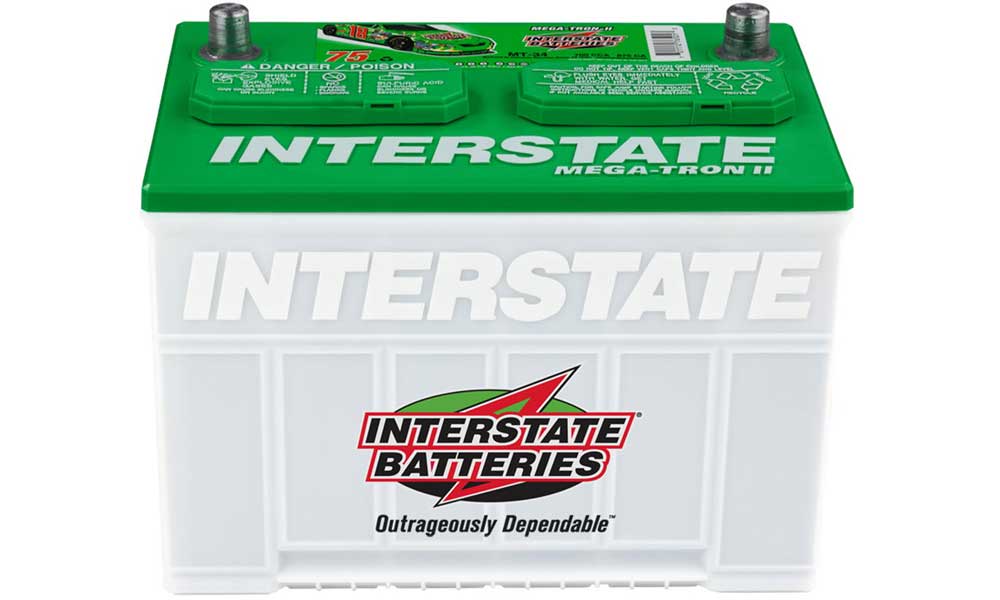
Value pick: Mega-Tron. A conventional flooded unit at the low end of the lineup. Less vibration resistance, but fine for a commuter that never leaves pavement. Check price on Amazon
Truck pick: Mega-Tron Plus. Built for high cranking demand. Many diesel pickups run two units, so check the tray before budgeting, and note the warranty’s diesel and commercial-use limits. Check price on Amazon
Marine pick: Deep Cycle. Designed for a slow sustained draw rather than one hard crank, which is what a trolling motor needs. Boat owners should also read up on ethanol-free gas. Check price on Amazon
Core Charges, Old Units and Battery Recycling
A core charge is a refundable deposit added at checkout when you buy a new unit without handing over the old one. The amount varies by state and seller, and it shows as its own line on the ticket. Bring the dead unit with you, or return it later with the receipt, and the deposit comes back. Costco describes the same deal as a core credit for returning your old one.
The system works. Battery Council International, the lead battery trade group, reported a US lead battery recycling rate of about 99 percent in its 2023 national study, because lead, plastic and acid are all worth reclaiming. Never put one in the trash; Interstate’s site has a Recycle With Us page for finding a drop-off.
Handle the old one with care. A starting unit weighs roughly 30 to 50 pounds, holds sulfuric acid and can vent flammable hydrogen, so keep flames away, carry it upright, and follow the label’s safety instructions.
Start in your driveway: pop the hood, photograph the label, and note the group size, CCA and date code. Then decide what matters more. If you want installation, testing and a warranty you can walk into a building to claim, buy Interstate Batteries from a dealer or All Battery Center store through the locator. If price on a common size wins, check Costco’s finder first and keep the receipt for its warranty desk. If you just bought a used car, read the date code before the first cold morning does it for you.
Interstate Batteries FAQ
Who makes Interstate Batteries?
The company is a distributor, not a manufacturer. Production is contracted to large lead-acid plants, with Clarios, formerly the power solutions arm of Johnson Controls, widely reported as the main supplier. Interstate sets the specifications and owns the distribution, dealer and warranty program.
Are the ones sold at Costco the same as those from a dealer?
Costco says its Interstate units offer the same reliable power, but a different warranty program supports them. Costco services claims at the warehouse under its 36-month limited prorated warranty, while dealer-bought units follow Interstate’s model chart. Check the duration printed on the label either way.
How long does one last, and what shortens its life?
Three to five years is typical for a lead-acid starting unit. Heat is harder on it than cold, because high under-hood temperatures speed internal corrosion and evaporate electrolyte, so a car parked outside in Phoenix burns through one faster than the same vehicle in Michigan. Short trips are the other killer, since the alternator never fully replaces what starting consumed.
Is the warranty a free replacement or prorated?
Automotive models start with a free-replacement period, from 18 months on M models to 48 months on MTZ. Some models then add a discount period, where you buy the replacement at a percentage off Interstate’s suggested retail price rather than receiving credit on what you paid. Costco-sold units use Costco’s own prorated program instead.
Does Interstate sell lithium batteries?
Yes, but not as a standard car replacement. The automotive and marine lines are lead-acid, either flooded or AGM, and lithium products carry their own separate warranty document. Do not swap chemistries without confirming your charging system supports it.