
Buy grab bars from a store with a 90-day return window, and only after you know where the framing sits behind your wall. That one decision prevents the two most common failures: a rail too short to reach solid backing, and a rail screwed into bare drywall. Home Depot and Lowe’s cover most homes in person, Amazon and specialty sites carry the odd lengths and finishes, and a medical supply store is the place for transfer poles.
This page contains affiliate links. We may earn a commission at no extra cost to you.
Who Needs One, and Why the Bathroom Comes First
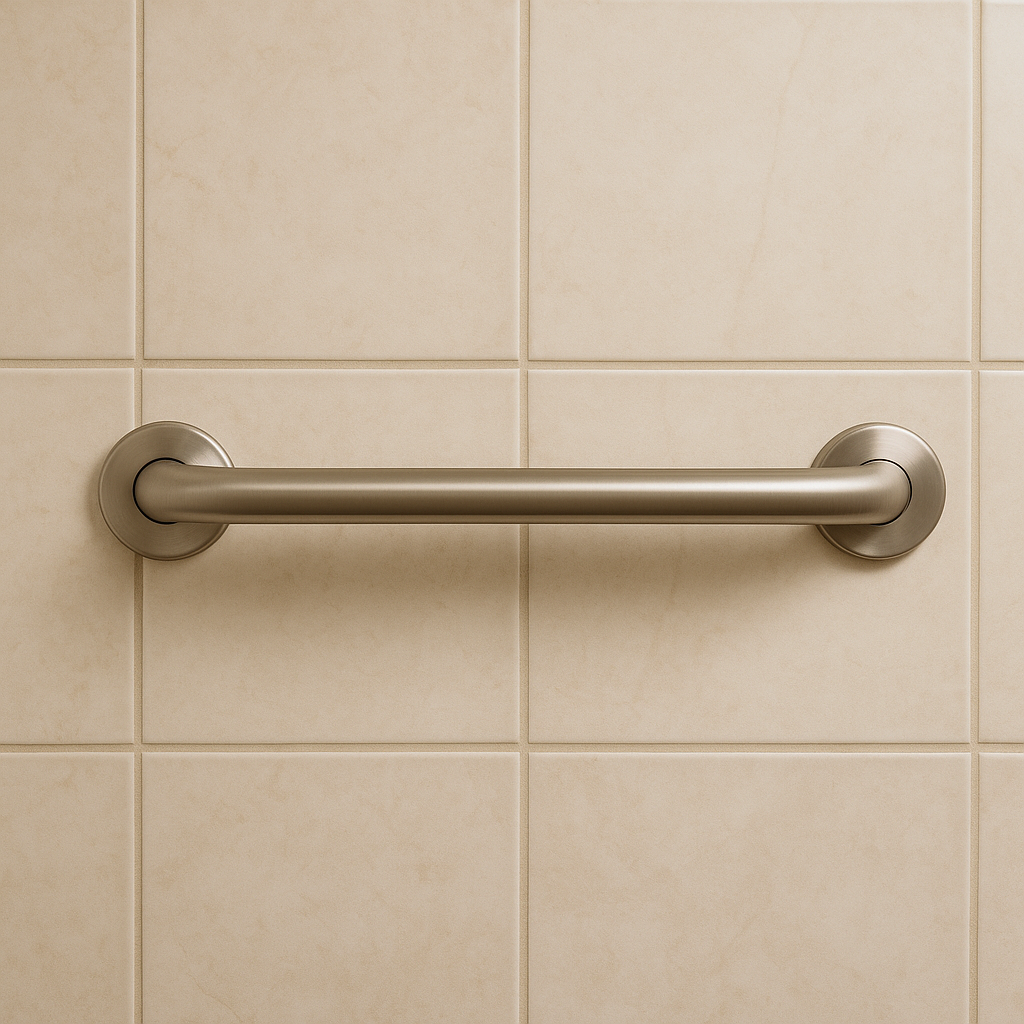
A grab bar is a load-rated rail fastened through the wall into structure, giving a person something solid to hold while sitting down, standing up, or stepping over a bathtub wall. It is fall prevention equipment first and a bathroom fixture second. A towel bar that looks the same is not a substitute, because towel hardware is built for a few pounds, not an adult catching a slip.
Four groups get the most out of one: seniors aging in place, anyone recovering from hip or knee surgery, people whose balance is affected by a disability, and households where small children climb in and out of the tub. Falls are the leading cause of injury-related death among adults 65 and older, and about 1 in 4 older adults report a fall each year, according to the CDC’s older adult falls data. A bathroom packs that risk into a few square feet of wet tile.
If transfers rather than balance are the real problem, pair a rail with a shower seat.
The ADA Numbers Worth Copying at Home
The Americans with Disabilities Act of 1990 sets rules for public accommodations, commercial facilities, and government buildings, not a private house. No inspector is coming to your bathroom. The 2010 ADA Standards for Accessible Design still matter, because section 609 is the most widely published strength and placement spec for this product. Occupational therapy home assessments lean on the same figures.
| Section | Requirement | Why it matters at home |
|---|---|---|
| 609.2.1 | 1.25 to 2 inch outer diameter | A hand can close around it |
| 609.3 | 1.5 inches of clearance from the wall | No forearm wedged behind the rail |
| 609.4 | Horizontal, 33 to 36 inches above the finished floor | Measured to the top of the grip |
| 609.6 | Must not rotate in its fittings | A spinning rail fails mid-slip |
| 609.8 | 250 pounds of force at any point | Covers bar, fasteners, and wall |
| 604.5 | Toilet: 42 inch side wall, 36 inch rear wall, minimum | Length to plan around a toilet |
Read 609.8 carefully. The 250-pound force applies to the bar, the fastener, the mounting device, and the supporting structure together. A rail stamped ADA compliant meets nothing once it is screwed into hollow gypsum. For tubs, section 607.4 adds a second, lower bar on the back wall, 8 to 10 inches above the rim, plus a 24-inch bar on the control end wall.
Load Ratings: Reading the Number on the Box
A grab bar load rating is the force the fixture is tested to hold when installed per the instructions. Treat 250 pounds as the floor, not a selling point. ASTM F446, the consumer safety specification for grab bars and accessories in the bathing area, is the other reference to look for on a spec sheet.
- Higher ratings come with conditions. Moen lists its Home Care 24-inch concealed-screw model 8724 at up to 500 pounds, with a 1.25-inch diameter and SecureMount anchors for installs with or without studs. Read the conditions on the sheet, not just the headline number.
- Suction handles carry no body-weight rating. Makers including Carex and Drive Medical label these clip-on pieces as balance aids only, not built to hold a person’s full weight, and Drive tells users to recheck the seal before every use.
- No number means no purchase. Skip any listing with no force rating and no ADA or ASTM reference, especially decorative pieces sold beside towel hardware.
Mounting: Studs, Blocking, and Flange Patterns
A bathroom grab bar is only as strong as the framing behind the tile, and that framing decides which length you can buy, so mounting comes before shopping. A stud finder and a drill with a tile bit are the only tools most installs need. Four mounting styles cover nearly every bathroom, and they are not interchangeable.
| Mounting style | Drilling | Best for | Watch for |
|---|---|---|---|
| Wall-mounted into framing | Yes | Permanent support | Framing spacing limits length |
| Flip-up, wall-mounted | Yes | Toilet-side, narrow rooms | Hinge quality varies |
| Floor-to-ceiling transfer pole | Both ends | Rising from a tub | Needs solid floor and ceiling |
| Suction cup | No | Travel only | Releases on textured tile |
Flange pattern. Spec sheets bury this one. A three-screw flange gives you a few degrees of rotation to catch the edge of a framing member; a symmetrical four-screw flange gives you none. On tight framing, that decides whether the piece fits at all.
- Have the user reach from a seated position and again standing, then mark where the hand lands.
- Scan that area with a stud finder and mark both edges of everything solid it detects.
- Pick a length whose flanges land on structure, or plan to add blocking behind the wall.
- Set horizontal rails 33 to 36 inches above the finished floor, per section 609.4.
Mounting into bare drywall is the most expensive mistake, worse than picking the wrong product. A plastic expansion anchor in gypsum holds a towel, not an adult in mid-fall. Fasten into framing, solid blocking, or a hollow-wall anchor system the manufacturer rates for the load.
Material, Diameter, and Grip
SAE 304 stainless steel is the default for a shower grab bar, because its chromium and nickel content resists pitting where water sits. Chrome and brushed nickel match a modern bathroom; nylon-coated versions feel warmer under a cold hand. Stock lengths run 12 to 48 inches, and 24 to 36 inches covers most shower walls.
For grip, knurled or peened surfaces stay secure under soap and water. Mirror-polished chrome turns slippery exactly when you need traction, so an anti slip textured grip beats shine. On diameter, smaller hands close more securely around 1.25 inches, while 1.5 inch stock feels more substantial and shows up more often in commercial restrooms. Both sit inside the ADA range, so grip each one in a store before deciding.
Where to Buy Grab Bars In Store
Buying in person lets you feel the grip texture and hold a flange against your tile. Bring wall measurements and your framing layout.
Home Depot
Browse their bathroom safety section for the widest local selection, including ADA-compliant stainless steel and brushed nickel from national brands. Look in bath hardware, not plumbing. Most merchandise carries a 90-day return window with proof of purchase.
Lowe’s
A comparable bath safety aisle with national brands. Lowe’s takes back most new, unused items within 90 days with a receipt, which matters if you are torn between two lengths.
Walmart
Smaller and cheaper, often shelved with home health rather than bath. Fine for a basic 16-inch rail or a travel handle. Stock varies store to store, so check the app or call ahead.
Medical supply stores
Durable medical equipment shops stock commercial-grade hardware and the floor-to-ceiling transfer poles big-box stores rarely carry. They also sell canes and mobility walkers, so one trip covers the whole transfer problem.
Where to Buy Grab Bars Online
Online is where the long spans, angled and flip-up configurations, and decorative finishes live. No local aisle goes that deep.
Amazon
Shop their full selection, from plain 304 stainless rails to matte black designer pieces. Sort by rating, then read the two-star reviews, where flange fit and anchor complaints surface. Third-party sellers can set their own terms, so check who ships the item.
GrabBars.com
A specialist with standard, designer, and modern rail lines plus placement guides for shower, bathtub, and toilet layouts. Its return terms are tighter than a big-box store: 30 days, an emailed return authorization, original packaging, and a 20% restocking fee.
Accessibility and commercial suppliers
Freedom Showers, HealthCraft, and Harney Hardware serve the accessibility and commercial market, where specifications get published rather than implied. HealthCraft’s Invisia collection builds support into designer pieces such as a toilet paper holder or shower shelf, the honest answer for a household that refuses anything medical-looking. Decorative makers such as Signature Hardware sell bronze and brass finishes; read the load rating on each product page, because not every catalog item is rated for support.
Return Windows to Check Before You Drill
Once you drill the flange holes, the piece is yours. Test-fit at the marked height and confirm both flanges land on structure before a bit touches tile. Published policies as of October 2026:
| Retailer | Standard window | Condition |
|---|---|---|
| Home Depot | 90 days, most merchandise | Proof of purchase |
| Lowe’s | 90 days, most items | New, unused, with receipt |
| Walmart | 90 days, most items | Marketplace sellers: 30 days |
| Amazon | 30 days from delivery | Third-party sellers may differ |
| GrabBars.com | 30 days | Authorization, 20% restocking fee |
Windows change, so confirm on the retailer’s own page or your order history. Between two lengths? Buy from a 90-day retailer and return the one you do not use.
Five Picks Matched to the Job
Each grab bar below covers a job buyers ask about most: a standard shower wall, a tight budget, matching hardware, a corner, and a hotel room. Prices move weekly, so check the current listing.
Best overall: Moen Home Care 24-inch stainless steel. The concealed-screw model 8724 is listed by its maker at up to 500 pounds with SecureMount anchors and a limited lifetime warranty, and wide big-box distribution makes a matching second piece easy to source. Check price on Amazon
Best budget: a plain 18-inch ADA-labeled stainless rail. Glacier Bay is one label to compare. A short plain bar is all many bathrooms need, provided the box states a load rating. Check price on Amazon
Best decorative: a solid brass or bronze rail. Signature Hardware is one source for oil-rubbed bronze or polished brass in a room where a clinical fixture looks wrong. Verify the load rating on the product page. Check price on Amazon
Best for tight spaces: a 12-inch assist rail. A short piece for beside a toilet or a corner shower where a full span cannot reach two solid points. Delta is one brand to compare. Check price on Amazon
Best for travel: a Vive-style suction cup shower handle. Tool-free and packs flat for a hotel tub. Treat it as a balance aid, as its makers do, and never let it replace a bolted fixture at home. Check price on Amazon
Start with the wall, not the catalog. Find the framing, mark the height the user actually reaches, and note the span that lands on structure. Then buy grab bars with a printed load rating from a retailer with a 90-day window, so a wrong guess costs a drive instead of a ruined tile.
Frequently Asked Questions
Do grab bars need to be installed on studs?
They need structure, and studs are the easiest kind to find. Solid blocking behind the tile works, as do a manufacturer’s mounting plate and hollow-wall anchors the maker rates for this use. Where the layout will not cooperate, installers open the wall and add a two-by-six across the framing as backing. A plastic drywall anchor never works.
Does Medicare pay for grab bars?
Original Medicare does not. The CMS durable medical equipment reference list (NCD 280.1) classifies them as a self-help device, not primarily medical in nature. Medicare Advantage plans often add extra benefits Original Medicare lacks, so ask your plan whether bathroom safety items are included, and check your options on Medicare.gov. Your state Medicaid office can say whether a home modification program applies.
Where should rails go in a shower, and how high?
Horizontal rails sit 33 to 36 inches above the finished floor on the long shower wall, measured to the top of the grip, within reach of the seated position if a shower bench is in use. A vertical rail near the entry helps most on the step in and out. Mark both with the actual user standing in the space, not from a diagram.
How much weight can a bathroom rail hold?
The ADA structural standard is 250 pounds of force applied at any point, covering the bar, fasteners, and wall together. Some products are rated higher, such as a concealed-screw model listed at up to 500 pounds, but only when installed into a stud or the anchors the maker specifies. Clip-on handles that stick to tile are not rated to hold body weight at all.
Which style is safest for an older adult?
A straight, wall-mounted rail fastened into framing, every time. Flip-up models are the exception beside a toilet in a narrow room, where a fixed rail blocks the approach. If the walls cannot take fasteners, a floor-to-ceiling pole is the next option. A cup stuck to tile is not in this conversation.
About This Guide
Last reviewed October 2026. Specifications were checked against the 2010 ADA Standards (sections 604, 607, 608, and 609) on ADA.gov, ASTM F446, CMS coverage records, CDC fall data, manufacturer product pages, and each retailer’s published return policy. Product picks carry no lab testing claims; confirm ratings on the packaging before installing.