
Buy Cards Against Humanity from the publisher’s own webstore, where the main game and the Family Edition each list at $29, or from the four retailers the publisher names: Amazon, Target, Barnes & Noble, and Walmart. Anyone who just wants to try it can download the base game free as a print-at-home PDF. That short list matters, because the game skips most big-box shelves on purpose and first-time buyers often land on a marketplace listing priced well above retail. Prices on this page reflect the official store in October 2026.
This page contains affiliate links. We may earn a commission at no extra cost to you.
What Cards Against Humanity Is, and Who Should Skip It
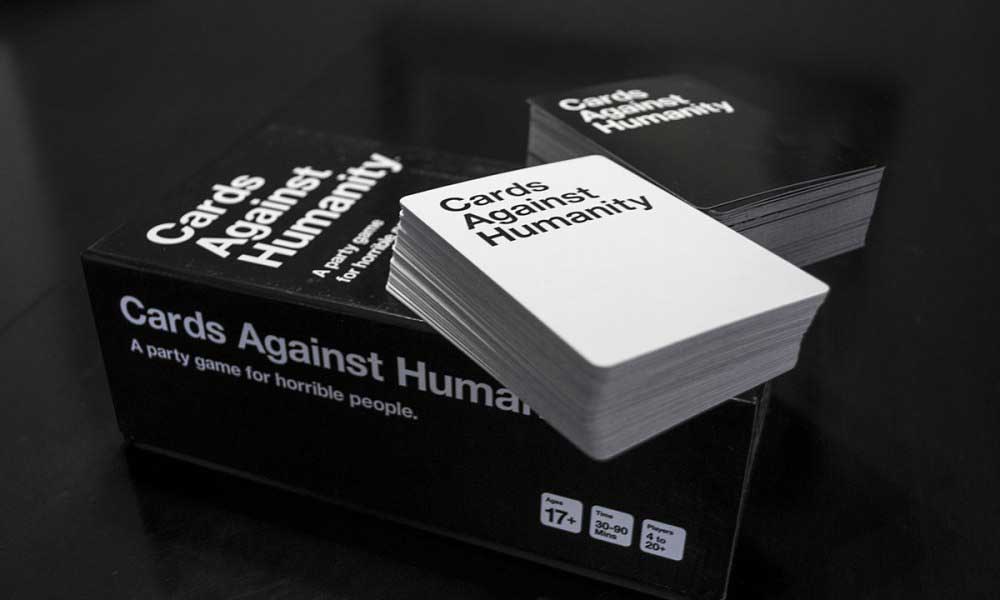
Cards Against Humanity is an adults-only fill-in-the-blank party game: one player reads a black card prompt aloud, everyone else answers from a hand of white cards, and the reader picks the funniest white card. The publisher’s slogan calls it a party game for horrible people. The format is openly borrowed from Apples to Apples, the family-friendly matching game. The writing is not. It runs on crude, taboo-breaking jokes about sex, death, and social norms, and that premise matters more than anything else when the box is a gift.
The original box is rated 17 and up. Buyers who want the same mechanic without that material should look at Cards Against Humanity: Family Edition, a standalone version rated for ages 8 and up, which the publisher says was tested with thousands of families. It is a full game for family game night, not a pack.
Typical buyers are adults hosting game nights, college students, and gag-gift shoppers. If someone at the table is likely to be offended, no expansion fixes that, and the guide to buying board games covers gentler options. Four to ten players is the sweet spot for this card game. Three works, barely.
Which Cards Against Humanity Edition to Buy First
Buy a standalone game first, every time. Expansions add cards to an existing deck and cannot be played alone, yet a $20 box looks like a cheaper entry point than a $29 game. That mix-up is the single most expensive mistake buyers make here.
| Product | What you get | Official store price | Plays alone? |
|---|---|---|---|
| Main game | 500 white and 100 black cards | $29 | Yes |
| Family Edition | 600 cards, ages 8 and up | $29 | Yes |
| More Cards Against Humanity | 600 expansion cards | $29 | No |
| Absurd, Hot, Everything, or Super Box | 300 themed cards each | $20 | No |
| Small packs | About 30, one theme | $5 to $7 | No |
| Print-at-home files | The base game | Free | Yes, once printed |
Version numbers. The 2011 Kickstarter release ran 550 cards. The 2.0 refresh brought the deck to 600, and the publisher (CAH to most fans) now lists 2.3 as the latest edition, because it rewrites large parts of the deck every year to retire dated references. Any recent box plays the same way. Versions are also localized for Canada, Australia, and the UK, plus an International Edition with no country-specific jokes.
Best overall: the 600-card base set. The only version that plays standalone for an adult group, with 500 white answer cards and 100 black prompt cards. $29 direct. Check price on Amazon #ad
Best for families: Family Edition. Same fill-in-the-blank structure with the adult material removed, the practical pick when the game is going under a tree for a mixed-age household. The publisher’s own FAQ sums up the humor as mostly fart jokes. $29 direct. Check price on Amazon #ad
Best second purchase: More Cards Against Humanity. The publisher’s own store labels it “buy this second”: 600 expansion cards collecting the strongest material from the Red Box, Blue Box, and Green Box, plus 50 new cards. Per dollar, it is the cheapest way to double a deck.
Best gift add-on: Absurd Box. 300 prompts and answers leaning surreal rather than shock-driven, easier to hand to someone who already owns the original. Requires the main game. $20 direct. Check price on Amazon #ad
Buy Order for a New Group
- Pick the version, adult original or family version, because returns on opened games are inconsistent.
- Buy the base set before anything else, because no expansion works without it.
- Add one large box rather than several small packs, for a lower cost per card.
- Verify the seller at checkout, because the seller matters more than the product page.
Older Boxes Still Listed by Resellers
The Green Box, Blue Box, and Red Box no longer appear in the official store, and retailer listings mark several of them discontinued. Leftover and resold stock still turns up, sometimes above its old price. Since More Cards Against Humanity already carries the best of all three, an old themed box only makes sense at a fair price for a collector filling gaps. Check price on Amazon #ad
The same goes for the Bigger Blacker Box, an empty storage case sized for the base set plus every expansion, shipped with spares for writing your own. It stores a collection and does not replace one, and many retail pages now show it sold out. Check price on Amazon #ad
The Free Cards Against Humanity PDF
The publisher has offered the game as a free download since day one, with PDFs and printing instructions on its homepage. The files are published under a Creative Commons BY-NC-SA license, which allows sharing and adapting for non-commercial use. That is why fan-made decks are legal to make and share. The publisher’s note is blunt: there is no legal way to use the files to make money.
The free version suits a group that wants to test its sense of humor before spending $29. The catch is the physical result. A household printer on plain paper produces flimsy stock that shows through when held up, and cutting out a full deck takes a long evening. Heavy card stock helps. If the game sticks, the boxed set is still the better long-term buy.
The license has a second consequence for buyers. Making an original deck in the same style under a different name is lawful, but the publisher owns the Cards Against Humanity name and branding. A box using that name that did not come from the publisher or an authorized seller is a counterfeit.
Where to Buy Cards Against Humanity Online
Online is the reliable route, and the publisher’s store is the only channel carrying the full current lineup, including dozens of $5 themed packs.
The Publisher’s Own Store
Buying direct removes the counterfeit question entirely and gives you the widest selection anywhere, including limited releases and new boxes such as the 2026 Super Box that retail partners may never stock. The same site hosts the free download. Visit their main site or shop directly at their online store.
Amazon
Amazon carries the base set, most expansions, and some products the publisher sells only there, such as the Ultimate Expansion. One check does most of the work: confirm the listing ships from and is sold by Amazon.com or the publisher’s storefront, not an unfamiliar third-party seller. Check the latest pricing on Amazon #ad.
Walmart.com
Walmart is on the publisher’s retailer list, but its site mixes first-party stock with marketplace sellers who set their own shipping and return terms. Read the seller name and return window on the listing page itself. See availability at Walmart online.
Barnes & Noble and Books-A-Million
Barnes & Noble is an authorized retailer, and both bookstore chains run first-party inventory rather than open marketplaces, so counterfeit risk is low. Buyers in the UK, Canada, or Australia should order the localized version from a regional listing instead of importing a US box.
Stores That Stock It on the Shelf
Physical retail is thin by design, so treat any in-store trip as a stock check first. Availability tightens from Black Friday through December, when gift demand clears shelves faster than they get restocked.
Target
Target is the most dependable national chain for finding a copy on a shelf, and the publisher links to it from its own site. Look in the games aisle near the adult humor titles, not with children’s toys. The Target app reports per-store stock, which saves a wasted drive. Browse their selection at Target.
GameStop, Urban Outfitters, and Spencer’s
All three treat the title as a novelty item: one or two boxes near the front, no depth in expansions. Spencer’s and Urban Outfitters lean into the gag-gift angle, worth a look in December once Target is picked over.
Local Game and Comic Shops
Independent hobby and comic shops sometimes carry the base set plus a big box or two, ordered through legitimate distributors, so what is on the shelf is real. Call before you drive over. Most Walmart stores do not shelve this title at all, and the website often shows marketplace stock rather than local inventory.
How to Spot a Fake or Overpriced Listing
Any listing far above the $29 official price deserves a look at the seller before the price. Four problems account for most bad purchases.
Ignoring the seller field. On Amazon and Walmart.com alike, the product page can be legitimate while the seller is not. Counterfeit stock arrives through the seller, and flimsy stock, misprinted type, and missing packs are what buyers report when it does. Genuine boxes use heavy matte stock, clean evenly spaced type, and a rigid two-piece lid. Compare the count printed on the box against the count in the listing.
Buying an unofficial deck by accident. Because the license is open, plenty of legal lookalike decks exist with similar black-and-white packaging and similar names. Some are good. None are the original.
Paying a gift-season premium. Third-party prices tend to drift upward once authorized sellers run short in November and December, and discontinued boxes carry collector markups year round. Check the publisher’s store first, because its price is the floor everyone else works against.
Buying the adult set for a mixed-age group. With teenagers or grandparents at the table, the original lands badly. The family version plays the same way without that problem. The party supplies buying guide covers the rest of the night, and an ugly Christmas sweater pairs well with the box at a holiday party.
Buying Cards Against Humanity comes down to three decisions in order: choose the adult original or the Family Edition, get the base set from the publisher’s store or an Amazon listing sold by Amazon itself, then add More Cards Against Humanity or one themed box. For a gift, the family version is the safer buy and doubles as a white elephant gift. If the recipient’s sense of humor is a mystery, an Amazon gift card lets them pick their own edition.
Common Questions About Cards Against Humanity
How do you play Cards Against Humanity?
One player takes the Card Czar role and plays a black card by reading the prompt aloud. Everyone else answers with the white card they think fits best, the Czar reads the answers anonymously, and the funniest one wins the round. The game is simple enough to learn in one round, and a session usually runs 30 to 90 minutes.
Do you need the base set to use an expansion pack?
Yes. Expansions hold only extra prompts and answers, with no rules sheet and not enough of either to run a game alone. The Bigger Blacker Box is a further trap for gift shoppers: it is storage with a handful of blank cards, not a playable set.
Can you download the game as a free PDF?
Yes, and it is legal. The publisher hosts the free game files with printing instructions under a Creative Commons non-commercial license. You supply paper, toner, and cutting time. Expansions are not free, and the printouts cannot legally be sold.
What age is the original set rated for?
The original box is rated 17 and up, and that rating is accurate rather than cautious. The family version is rated 8 and up. There is no in-between release for younger teens, so a mixed-age group should default to the family version.
Which box should you buy after the base set?
More Cards Against Humanity, at $29 for a 600-count expansion, is the publisher’s recommended second purchase and the lowest cost per card. For a narrower theme, the 300-card Absurd Box, Hot Box, Everything Box, and Super Box each cost $20.
Why do some listings cost so much more than others?
Almost always because a marketplace reseller set that price, not the publisher. The official store lists the main game at $29. Sort by seller rather than by price, and treat a large premium from an unknown seller as a reason to close the tab.
About This Guide
Prices, the current lineup, the retailer list, and licensing details on this page come from the publisher’s official store and FAQ as of October 2026, with retailer listings for discontinued boxes. Stock moves fast in gift season, so confirm both before ordering. See also the classic board games guide.