
The safest place to buy an AeroPress is aeropress.com or a retailer listed on the brand’s own store locator, because the company says buying from that list is how you avoid a counterfeit. Amazon (sold by Amazon itself), Walmart, Target, kitchen shops like Williams-Sonoma, and specialty coffee sellers also carry it. The bigger question is which body to get: the lineup now runs to eight coffee makers that share one brewing method but differ in capacity, material, and price.
This page contains affiliate links. We may earn a commission at no extra cost to you.
How the Coffee Press Works, in Two Minutes
An AeroPress coffee maker is a manual coffee press that steeps ground coffee in hot water, then uses air pressure from a hand plunger to push the brew through a paper micro-filter. It was introduced in 2005 by Alan Adler, the inventor behind Aerobie, the flying-disc maker, who wanted a better single cup than a drip coffee maker could give him.
The brewing process is immersion plus pressure. Grounds sit in the chamber for a short steep, you stir, and a slow press pushes the liquid out in well under a minute. Paper holds back fines and most oils, so the cup tastes cleaner than a French press and heavier than a typical pour-over. Use a stronger dose and less water and you get a concentrated coffee that works under milk, which is why people call it espresso-style.
It is a true single cup coffee maker, and three groups get the most out of it. Solo drinkers who want one good cup of coffee instead of a half-empty carafe. Travelers and office workers, since it is easy to clean (the spent puck pops straight into the bin). And coffee enthusiasts who like to tinker: competitive baristas brew on it at the World AeroPress Championship, so the ceiling sits far above the price.
The Current AeroPress Lineup, Model by Model
Capacity, body material, and portability separate the eight models. Every one uses the same brew method, so a pricier body changes how it looks, feels, and travels far more than how it tastes.
| Model | Capacity | Body material | Best for | List price on aeropress.com |
|---|---|---|---|---|
| Original | 10 oz, 1 to 2 cups | Polypropylene | Everyday home brewing | $39.95 |
| Clear (and Colors) | 10 oz, 1 to 2 cups | Tritan, shatterproof | Watching the brew | $49.95 |
| Go | 8 oz, 1 cup | Polypropylene, silicone lid | Packing light | $49.95 |
| Go Plus | 10 oz, 1 to 2 cups | Tritan with steel tumbler | Commuting with a travel mug | $89.95 |
| Original XL | 20 oz, 2 to 4 cups | Polypropylene, Tritan carafe | Two-person households | $79.95 |
| Clear XL | 20 oz, 2 to 4 cups | Tritan | Big batches you can see | $89.95 |
| Premium | 10 oz, 1 to 2 cups | Borosilicate glass, stainless steel, aluminum | A countertop showpiece | $199.95 |
| Steel | 12 oz, 1 to 2 cups | Stainless steel | A body that will not crack | $169.95 |
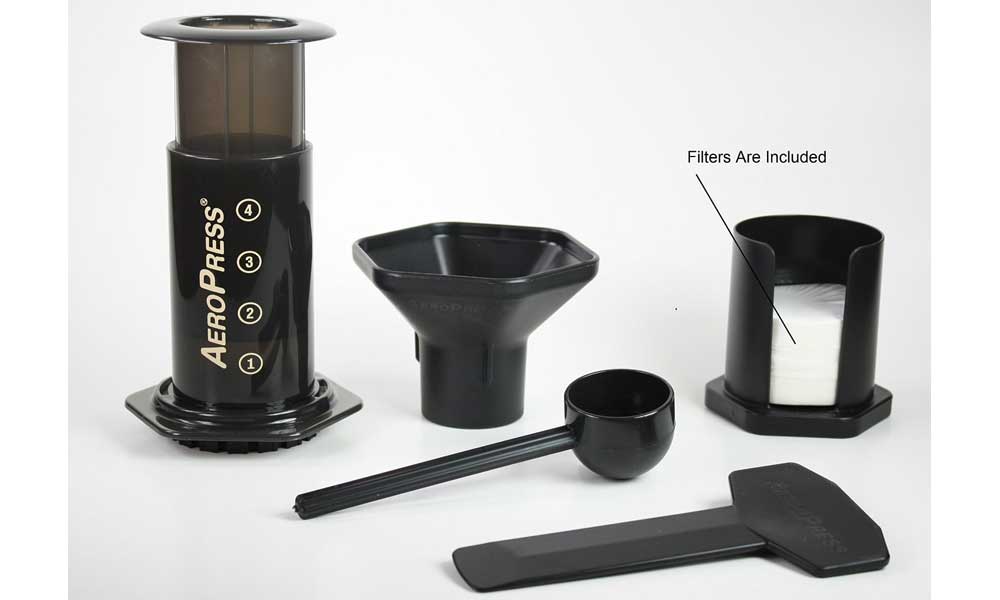
One detail the product photos hide: the 20-ounce models use their own larger filters. Standard paper micro-filters fit the Original, Clear, and Go, but not the big chamber, so stock the right size before your first bag of beans runs out.
How to Choose Your Model in Four Steps
- Count the servings you make at once. Two or more points to a 20-ounce model; one points to anything else.
- Decide whether it leaves the house. Regular travel points to the AeroPress Go, which packs its filters, stirrer, and scoop inside its own cup.
- Pick a material. Polypropylene survives drops, Tritan adds a see-through body, and glass or steel costs several times more for the same brew.
- Set aside part of the budget for a burr grinder before paying for a fancier body.
Paper or Metal: Picking a Filter
Paper gives the cleanest cup, and metal gives the fuller one. Every unit ships with paper micro-filters, which AeroPress says are compostable, so the disc can go out with the coffee grounds.
The brand’s stainless steel filter is the reusable alternative. AeroPress makes it from 316 stainless and lists it for the Original and Go. Because metal is more porous than paper, water runs through faster and more oil and fine grit reach the mug, so the result drinks full-bodied, more like a French press. If your cup turns muddy after switching, grind slightly coarser rather than steeping longer.
Grind size. Medium-fine, roughly table-salt texture, is the usual starting point. The reason a cheap blade grinder fails here is particle spread: it makes dust and boulders in one batch, the dust over-extracts into bitterness, and the boulders give up almost nothing. A burr grinder changes the cup more than any body upgrade does.
Accessories. The flow control filter cap lets you steep without drips, which replaces the upside-down “inverted” method many owners learned first. Third-party gear widens the ways to brew: the Fellow Prismo adds a valve, the Able Disk is a reusable metal disc, and the Puck Puck turns the chamber into a slow cold brew dripper. Skip starter kits that add a coffee scoop and stirrer already in the box.
Who Makes It Now, and What the Plastic Is
AeroPress Inc. has been controlled by Tiny, a Canadian holding company, since August 2021. Adler kept a minority stake and stayed involved, according to the company’s announcement. The headquarters and manufacturing were reported to stay in the San Francisco Bay Area at the time of the deal.
On materials, the Original, XL chamber, and Go use polypropylene, while the Clear and Go Plus use Tritan, a shatterproof copolyester. The seal is food-grade silicone. AeroPress states its coffee makers are free of phthalates and have been free of BPA (Bisphenol A) since August 2009. The practical takeaway: an early secondhand body from before that change is the one used purchase worth skipping, and anyone who would rather brew in glass or metal can choose the Premium or Steel.
Counterfeits, Authorized Sellers, and the Warranty
Counterfeits are a real risk with this brand, and the fix is simple: buy from a seller on the official list. The AeroPress store locator says to buy from an authorized retailer listed on its site “in order to avoid purchasing a counterfeit.”
The warranty gives that advice teeth. Under the AeroPress warranty terms, products are covered against defects in materials and workmanship for one year from the date of purchase from an authorized retailer. A unit from an unlisted marketplace seller may look identical and still leave you with no claim.
- Check the seller line. On Amazon, look for “shipped and sold by Amazon” or the official brand storefront, not a third-party name.
- Distrust deep discounts. A storefront offering most of the lineup at a fraction of list price is the classic counterfeit pattern.
- Inspect the parts. Knockoffs often skip the branded filter cap, print chamber markings poorly, or ship with a seal that binds.
- Keep the receipt. The one-year coverage runs from the purchase date, so proof of where and when you bought it matters.
Where to Buy an AeroPress Online
Online is where the full lineup and every spare part live. Stock usually matters more than the sticker, so compare availability first.
Buying Direct From the Manufacturer
The official brand site is the only channel with a guaranteed authentic unit and the full parts catalog: plunger seals, filter caps, XL filters, and bundles. If counterfeits worry you, buying here removes the question, and you can shop AeroPress models that big-box stores rarely stock, like the Steel.
Amazon
Amazon lists the widest selection, including grinder bundles and travel cases. One rule matters more than price here: shop the listings shipped and sold by Amazon or the official brand store, since third-party sellers set their own return terms and are where clones cluster. eBay suits a discontinued color or a used body, if you price in a fresh seal and check that it postdates 2009.
Specialty Coffee Retailers
Roasters such as Blue Bottle, Intelligentsia, and Counter Culture sell the brewer beside beans suited to immersion, often with a subscription. Gear specialists like Prima Coffee and Seattle Coffee Gear carry the parts general retailers skip. You pay close to list price, but the pairing helps a first-timer choose a roast, and it stays far more flexible than a capsule machine ecosystem.
Buying in Store
Big-box chains usually carry the Original and paper filters, while kitchen shops cover the higher-end bodies. Shelf stock varies by location, so check online inventory before driving over.
Walmart
Walmart sells the brand online and in many stores, usually in the small appliance aisle with replacement filters nearby. Selection swings by location, so check availability on their site and use store pickup. Watch the seller name on Walmart.com too, because its marketplace includes third-party sellers.
Target
Target lists the Original and micro-filter refills, often shelved near the electric kettles. Some stores carry only the basic model, so browse their listing before driving over.
Kitchen Shops, Outdoor Stores, and Local Roasters
Williams-Sonoma, which AeroPress links from its own retail page, and Sur La Table carry higher-end versions plus metal filters and the flow control cap. REI is worth checking for the Go, since it sits beside camp stoves and backpacking gear. Independent roasters are the best bet for the larger bodies and for advice on brew time and dose.
What Owners Praise and Complain About
Praise clusters around three things: coffee taste, speed, and cleanup. Owners describe the cup as smooth with little bitterness, and the quick rinse comes up nearly as often as flavor.
The complaints are just as consistent. Capacity is the big one: a 10-ounce chamber means two presses for a 16-ounce mug, and the Go holds only eight ounces. Second is the learning curve, since grind, water temperature, and steep time interact, so week one can taste worse than the machine it replaced. Third, the seal. It is the one part that genuinely wears, and AeroPress sells replacements, so a used listing with a stiff or cracked seal is worth less than it looks.
That capacity complaint is why the four-step check above matters more than any price comparison. Buy a 20-ounce body first if two people drink at once, and the most common regret never shows up.
Top Picks by How You Drink
The best coffee here comes from matching capacity to your cup first. These five are ranked on that fit, then material, then cost.
Best all-rounder: AeroPress Original. The classic polypropylene body, 10 ounces, the version most published recipes assume. Pro: the cheapest way to brew coffee this good at home. Con: two presses for a large mug. Check price on Amazon
Best for travel: AeroPress Go. The chamber, filters, stirrer, and scoop pack into its own cup with a silicone lid. Pro: a complete travel coffee kit in one hand. Con: eight ounces per press. See it on Amazon
Best for two people: AeroPress XL. A 20-ounce chamber that brews straight into its own carafe, two to four cups at a time. Pro: one press covers two mugs. Con: needs its own filter size and is too bulky for a backpack. Check price on Amazon
Best clear body: AeroPress Clear. The Original’s shape in shatterproof Tritan, so you watch the water level and plunger travel. Pro: same performance, sold in several colors. Con: no functional upgrade. See it on Amazon
Best premium build: AeroPress Premium. Borosilicate glass chamber with stainless steel and aluminum. Pro: no plastic in the chamber. Con: roughly five times the Original’s list price for an identical brew. Check price on Amazon
Start by counting your usual serving size, then buy that AeroPress from aeropress.com or another authorized seller that has it in stock, and keep the receipt for the one-year warranty. Add a burr grinder before any accessory, and keep a spare seal in the drawer. If you want beans to go with it, a roaster like Counter Culture Coffee or Stumptown Coffee sells grinds sized for immersion brewing.
Frequently Asked Questions
Which model should a first-time buyer get?
The Original, unless you regularly make more than 10 ounces at once. It has the lowest list price, most published recipes assume its chamber, and nearly every accessory is designed around it. Move up to a 20-ounce model only when two people drink at the same time.
Is the AeroPress worth it?
For a solo drinker, yes. The Original lists at $39.95 on aeropress.com, needs no descaling, and has no electrical parts to fail. The exception is a household making four or more servings each morning, where a drip machine wins on volume alone.
Why is it better than a French press?
The paper filter is the difference. It catches the fine sediment that settles at the bottom of a French press and holds back most oils, giving cleaner texture and less bitterness. Contact time is far shorter too, so over-extraction is harder to trigger by accident.
Who owns the company now?
Tiny, a Canadian holding company, bought a controlling stake in AeroPress Inc. in August 2021. Inventor Alan Adler kept a minority interest and stayed involved, according to the company’s announcement.
Is the plastic safe, and is it BPA-free?
AeroPress says its coffee makers have been free of BPA since August 2009 and have always been free of phthalates. Current bodies use polypropylene or Tritan with a food-grade silicone seal. To avoid a plastic chamber entirely, the Premium uses glass and the Steel uses stainless steel.
Can it make real espresso?
No, and no manual coffee press can. Real espresso needs roughly nine bars of pressure, while hand force on the plunger generates a fraction of that. You get a strong concentrate that works under steamed milk for a latte or cappuccino, but it is not an espresso machine.
Editorial review: wheretobuyguides.com team. Retailer links reviewed and aeropress.com list prices checked October 2026.