
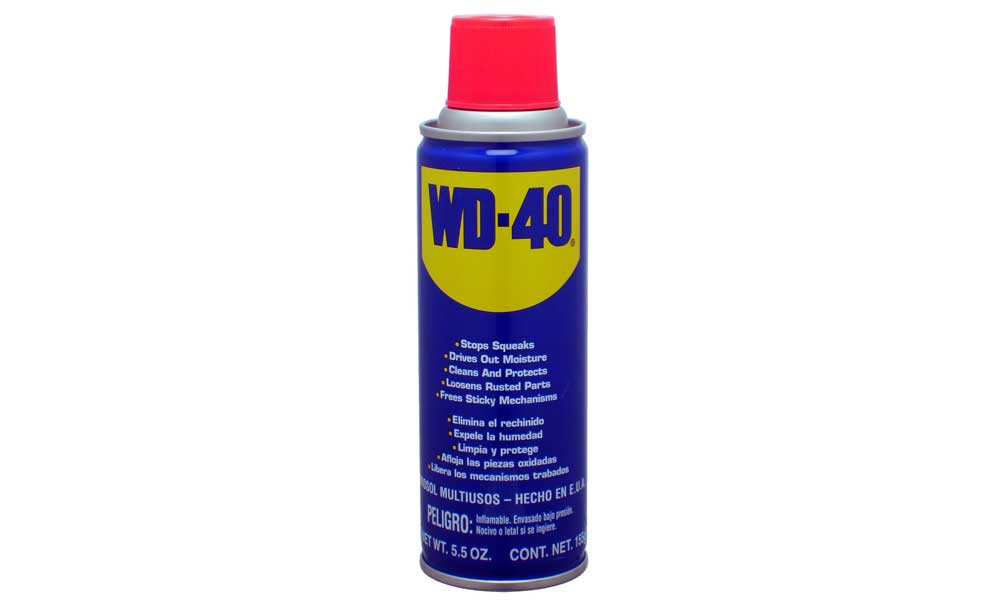
Buy WD-40 at Home Depot, Lowe’s, Walmart, Ace Hardware, AutoZone, O’Reilly Auto Parts, Advance Auto Parts, NAPA, Tractor Supply, and Amazon. Almost any store that sells tools keeps the blue-and-yellow can in the hardware or automotive aisle, so finding it is easy. The decision that matters is which formula to grab: the original Multi-Use Product and the Specialist line solve different problems, and the wrong one costs you a second trip.
This page contains affiliate links. We may earn a commission at no extra cost to you.
Quick decision: if the job is a squeaky hinge, a stuck bolt, or a damp ignition, original WD-40 from any hardware or auto store will do. For rubber seals, electrical contacts, a bicycle chain, or anything that carries load, buy a WD-40 Specialist or BIKE product instead, which usually means a home center, an auto chain, or an online order.
What Is WD-40, and Who Makes It?
WD-40 is a water-displacing spray that drives out moisture from metal, penetrates rusted parts, and leaves a thin film that helps protect metal from rust and corrosion. The name means Water Displacement, 40th formula: the small Rocket Chemical Company staff in San Diego needed 40 attempts to get the recipe right in 1953.
Who wrote that recipe is disputed. The company credits founder Norm Larsen, while historian Iris Engstrand of the University of San Diego attributes the mixture to Iver Norman Lawson. Either way, the first customer was the aerospace contractor Convair, which used WD-40 to protect the outer skin of the Atlas missile from rust and corrosion. Larsen packaged WD-40 as an aerosol, and it reached San Diego store shelves in 1958. Rocket Chemical renamed itself WD-40 Company in 1969 after its only product, and it trades on Nasdaq as WDFC.
The WD-40 Company brand portfolio today also includes 3-IN-ONE, GT85, Lava, Spot Shot, and 2000 Flushes. The formula was never patented, because a patent would have meant publishing it, so it stays a trade secret. The Safety Data Sheet names only broad ingredient classes, including petroleum-based hydrocarbons and oil.
It earns shelf space if you own a house, a car, a bicycle, or a toolbox. Seized bolts, a squeaky hinge, a damp ignition coil, sticker residue, adhesive, grime, and light surface rust are its territory, and it doubles as a parts cleaning solvent. Skip it if you need grease that stays put under load.
Which Stores Carry the Widest Range?
Home centers and auto chains carry the most WD-40 formulas. General merchandise stores stick mostly to the original in common sizes.
Home improvement stores
Home improvement retailers stock the broadest assortment, including the Specialist range that mass retailers skip. Home Depot files it under paint and cleaning supplies, and Lowe’s carries a comparable lineup. Both show store-level stock online. Stocking a workbench? Our guide to buying tools covers the same retailers.
Neighborhood hardware stores
Ace Hardware and similar neighborhood stores usually have the common sizes of the original. Specialist coverage varies because each store is independently owned and orders its own shelves, so call before a special trip for anything beyond classic WD-40.
Auto chains
National auto chains stock WD-40 because mechanics use it to loosen rusted lug nuts, clean battery terminals, and displace moisture from a damp ignition system. AutoZone, O’Reilly Auto Parts, Advance Auto Parts, and NAPA list the original along with Specialist items such as Rust Release Penetrant and Contact Cleaner; NAPA also lists the gallon as an order item. They make an easy one-stop for related supplies, as our car parts guide and battery guide explain.
Walmart and farm stores
Walmart shelves it in the automotive and hardware aisles, mostly in the smaller aerosol sizes. Tractor Supply lists the WD-40 gallon, which makes farm stores a practical stop for anyone who soaks or dips components rather than spraying them.
Buying Online, in Bulk, or for a Shop
Order WD-40 online when you want a size or formula your local shelf does not carry. Pressurized aerosols are regulated for shipping, so some sellers restrict them to ground delivery or limit where they ship.
Amazon
Amazon lists the widest selection, including WD-40 Specialist and BIKE items most stores never stock. Check who the seller is on any listing, since third-party sellers set their own return terms and prices often run well above what a store charges for the same item.
Retailer sites and industrial suppliers
HomeDepot.com, Lowes.com, and Walmart.com sell a larger catalog than their stores, usually with in-store pickup. For business and fleet maintenance, industrial distributors sell case quantities and the gallon size, and the company itself lists industrial distributors among its main sales channels. They are the fastest route to an unusual item such as non-aerosol bulk liquid.
Multi-Use Product or Specialist: Matching the Formula to the Task
Three things separate one WD-40 product from the next: the applicator, the format, and the formula family. Everything else is packaging.
| Format | Best for | Easiest place to find it |
|---|---|---|
| 8 oz or 11 oz with Smart Straw | Everyday household and garage use | Nearly every hardware, auto, and mass retailer |
| EZ-REACH (8 in. flexible straw) | Tight engine bays, behind appliances | Home centers, Walmart, online |
| 1 gallon | Soaking components, refilling trigger bottles | Tractor Supply, NAPA, home center websites, Amazon |
| Specialist aerosols | One task done properly | Home centers, auto chains, online |
| BIKE lubes and cleaners | Chains and drivetrains | Online and some hardware stores |
The applicator. The Smart Straw design is attached and has two positions: flip it up for a precise stream, fold it down for a wide spray. The loose red tube taped to older versions goes missing easily, which is the main argument for the attached version. EZ-REACH swaps it for an 8-inch flexible tube that holds a bend.
The formula family. The WD-40 Multi-Use Product is the classic version, a multi-purpose solvent blend that is mostly a penetrating oil with light lubrication as a bonus. Specialist is a set of purpose-built items, each designed for one task:
- Rust Release Penetrant uses capillary action to wick into narrow, corroded threads.
- White Lithium Grease suits metal-to-metal contact points that need heavy-duty protection.
- Silicone Lubricant dries fast and leaves a clear, water-resistant film for rubber, vinyl, and plastic.
- Dry Lube (PTFE) reduces friction without attracting dust, useful on a lock, a drawer slide, or power tools.
- Contact Cleaner is non-conductive and leaves no residue on electrical components.
- Degreaser cuts heavy oil and grease buildup that the original only moves around.
Read the label, not the color. Several WD-40 Specialist products share the blue-and-yellow look, with the product name in small type near the cap. Check it in the aisle, because Contact Cleaner and Silicone look nearly identical at arm’s length.
What Should WD-40 Not Be Used On?
The most common mistake is treating original WD-40 as a long-term lubricant. It frees stuck hardware and stops squeaks, then most of the solvent flashes off and the protection thins out. It does lubricate. Just not for long, which is why the same hinge squeaks again a few weeks later.
Bicycle chains. It strips the factory chain lube, and the light residue picks up road grit. Use a dedicated chain lube instead.
Rubber and neoprene. Repeated application may swell and degrade weatherstripping, bushings, and O-rings. Silicone spray is the better call for patio door tracks and car door seals.
Circuit boards. The oily film traps dust on electronics. Contact Cleaner evaporates instead, so it belongs on switches, relays, and electrical contacts.
Brakes, polycarbonate, and food surfaces. Keep it off brake components, drive belts, safety goggles, and headlight lenses, and away from food prep. For kitchen hinges, choose a food-grade lubricant (NSF H1 registered). Wipe overspray off fresh paint as well.
A hot vehicle. The WD-40 Safety Data Sheet says to keep aerosols below 120 degrees Fahrenheit and out of direct sunlight, and never to puncture or incinerate a container, even an empty one. Ventilate the space you work in. Safety Data Sheets are published at wd40.com.
Five Picks Matched to the Task
Each WD-40 pick below is matched to the task it is designed for and sold through mainstream retailers. Prices are left out because they shift by store and seller.
Best overall: Multi-Use Product with Smart Straw
The default for a squeaky hinge, stuck bolts, sticker residue, and light surface rust. The attached applicator is worth choosing over the loose-tube version.
Buy at: Amazon · Home Depot · Lowe’s · AutoZone · Walmart
Best value in bulk: Multi-Use Product gallon
Shop, farm, and fleet owners refill trigger bottles from the gallon or soak hardware in it. Cost per ounce drops sharply compared with aerosols, and the non-aerosol container avoids pressurized-shipping limits.
Buy at: Amazon · Home Depot · Lowe’s · AutoZone · Walmart
Best for load points: Specialist White Lithium Grease Spray
Sprays thin, then sets into a thick white coating that sticks where you put it. Garage door rollers, latches, and steel-on-steel moving parts are where it earns its keep.
Buy at: Amazon · Home Depot · Lowe’s · AutoZone · Walmart
Best for bicycles: BIKE All-Conditions Lube
A chain lube for wet, dry, and mixed riding. The maker leaves out wax to avoid sticky buildup in the links and adds corrosion inhibitors. Buy this instead of pointing the original at a drivetrain.
Buy at: Amazon · Home Depot · Lowe’s · AutoZone · Walmart
Best for seized bolts: Specialist Rust Release Penetrant Spray
Formulated to wick into corroded threads the original will not free. Reach for it before a torch or a breaker bar, and give it time to work.
Buy at: Amazon · Home Depot · Lowe’s · AutoZone · Walmart
When a Different Product Works Better
Three alternatives beat original WD-40 at specific tasks.
- Silicone spray. Better for anything involving rubber, vinyl, or plastic, and for dry slip on window tracks. It does not penetrate rust well, so it is a poor substitute on seized hardware.
- A dedicated penetrant such as PB B’laster. Built to creep into corroded threads. On a badly rusted bolt, a purpose-made penetrant or Specialist Rust Release frees it more reliably.
- 3-IN-ONE oil or white lithium grease. 3-IN-ONE, a sister brand under the same company, sells drip oils that act as true lubricants for sewing machines, fishing reels, and a sticking door lock. White lithium grease handles load-bearing steel points such as garage door rollers, where a thin solvent film fails in days.
Skip spray entirely if the fastener is aluminum and badly corroded, or if the component runs hot. Heat cooks off light oils, and patient mechanical persuasion plus the right grease beats another round of spray. Sometimes you just remove the rust by hand, which is where our sandpaper guide earns its place.
Three steps get you to the right product:
- Name the job. Free a bolt, quiet a hinge, protect metal from rust, or lift adhesive. The verb picks the product.
- Choose the size second. One-off repairs want the 8 oz aerosol. Routine shop maintenance wants the gallon and a refillable bottle.
- Check local stock first. Retailer product pages show store-level inventory, and most retailers offer in-store pickup on what they have.
Start by deciding whether you need original WD-40 or a Specialist formula, because that choice affects the result more than the store you buy from. Then check stock at the nearest hardware store or auto chain, and order online only for the gallon, a BIKE product, or a formula the shelf never carries.
Frequently Asked Questions
What does WD stand for?
WD stands for Water Displacement, and 40 marks the fortieth attempt at the formula at Rocket Chemical Company in 1953. Plenty of shoppers type it as WD40 with no hyphen, and retailer search boxes treat both spellings as the same product.
Is it a degreaser or a lubricant?
Strictly speaking, neither. The original is a water-displacing solvent that penetrates and lifts grime, with light, temporary lubrication as a side effect. The company sells it as a multi-purpose maintenance product, and the Specialist Degreaser and dry-lube sprays exist because the original does neither task especially well.
What is the difference between the Multi-Use Product and the Specialist line?
The Multi-Use Product is one general-purpose formula; Specialist is a family of single-purpose ones. The range reaches places the original should never go, notably electrical contacts and rubber seals, and it adds a true grease and a penetrant for heavier jobs.
Is WD-40 safe on rubber and plastic?
Brief contact is generally fine, but repeated application may swell and degrade natural rubber, neoprene, and some polyurethane seals, and it should stay off polycarbonate. Use a silicone spray on gaskets and weatherstripping instead.
Where is the cheapest place to buy it?
Per ounce, the WD-40 gallon beats any aerosol, and Tractor Supply, NAPA, home center websites, and Amazon all list it. For small sizes, compare the store pickup price with online listings, since third-party sellers often charge more and shipping adds cost on aerosols.
Editorial review: wheretobuyguides.com team. Last updated October 2026.