
Plasti Dip is sold at Home Depot, Lowe’s, Menards, Ace Hardware, Walmart, and auto chains such as AutoZone, plus Amazon.com, DipYourCar.com, and the manufacturer’s online shop. The harder question is how much to buy. The manufacturer’s care and use manual asks for at least five layers if you want the film to peel off cleanly later, and that one rule decides whether you need two cans, ten, or a gallon and a gun.
This page contains affiliate links. We may earn a commission at no extra cost to you.
What Plasti Dip Is and Who Makes It
Plasti Dip is a peelable, flexible rubber coating that goes on as a liquid and comes off in sheets, which is why people reach for it instead of paint when a change is meant to be temporary. It comes from Plasti Dip International, a privately owned company in Blaine, Minnesota, that says it began in 1972 as a maker of specialty rubber coatings. Founder Robert Haasl developed the original formula for tool handles, which explains the non-slip grip it still leaves. Many retail cans carry the Performix name, a brand from the same company.
The line covers the standard aerosol, brush-on dip cans, gallons, and finish families sold as Glossy, Blaze, Camo, Luxury Metal, Classic Muscle, and Craft, plus three enhancers: Glossifier, Metalizer, and Pearlizer. Car owners are the biggest audience: darkened badges, redone rims, and the occasional whole vehicle, a reversible way to change the look of your car without committing to automotive paint or a vinyl wrap. Crafters use it on bare metal that needs moisture resistance and a light sealant layer, and on plastic bins and truck hardware.
This is not natural rubber. Polyvinyl chloride and synthetic rubber both get referenced depending on the variant, so the safety data sheet on the manufacturer’s site is the reference that matters.
How Many Cans a Job Really Takes
Buy for five layers, not one. The manual rates an 11oz aerosol at roughly 5 to 10 square feet of coverage per can, and it warns that a thinner build can come off in little pieces that are tedious to remove. Divide that coverage by five and each can finishes only about 1 to 2 square feet at a peelable thickness. A badge fits inside one can; four rim faces do not.
| Format | Best for | Also need | Main tradeoff |
|---|---|---|---|
| Aerosol can | Badges, small trim, one or two rims | Masking tape, drop cloth | Highest cost per ounce |
| Brush-on dip can | Grips, hooks, hardware | Disposable brush | Brush marks show on flat panels |
| Gallon plus a gun | Full rim set, bumpers, a whole panel | HVLP gun, thinner, solvent | Equipment cost and cleanup |
Past a couple of small pieces, cost per ounce favors bulk liquid: a four-wheel job burns through aerosol fast, which is where a gallon and a gun pay for themselves. Keep WD-40 and a rag nearby for stray material on trim.
Picking a Color and Finish That Works
Choose the finish family first, then the color. Matte forgives an uneven pass; pearl shows every stripe in sunlight.
- Enhancers need a cured base. The manual says Glossifier, Metalizers, Pearlizers, and Chameleon colors must go over cured Plasti Dip to work properly, so budget for base cans separately.
- Blaze colors want white underneath. For the brightest Blaze and Glow results, the manufacturer recommends cured white first, which adds another color to your cart.
- Primer is permanent. Plasti Dip Primer boosts adhesion on smooth plastic and metal, but the manual states it is not peelable. Skip it on anything you plan to return to stock.
Gunmetal grey and black are the safe custom picks for rims, since both hide brake dust. Glossifier turns a flat base into glossy black or a deeper shine, but it never replaces the base build.
Where to Buy Plasti Dip Online
Online is where the odd colors live. Local shelves carry black, white, and a few standards; pearls, camo, and blue and grey shades are usually a web order.
Amazon
Amazon carries the broadest set of colors, sheens, and multi-can kits, including variants that never reach local shelves. Browse the current selection, then read each listing and its review count closely: case-of-six packs and single cans sit side by side at very different unit prices, and a six-pack is often the right size for a peelable build.
DipYourCar.com
This specialty shop stocks a deep set of custom colors, bulk liquid, and application equipment. Their collection page suits a whole-car project, where you dip your car with a gun, thinner, and material bought together.
The official store is the option for current-production stock and direct access to technical documents. The Home Depot catalog and Walmart’s listings both show items local stores do not shelve, with pickup where inventory allows. On Walmart, check the seller line, since some cans ship from third-party sellers.
Where to Buy Plasti Dip in Store
Same-day pickup is the reason to shop in person, and the paint aisle or automotive chemicals aisle is where it sits. The manufacturer’s where-to-buy list names Menards, Ace Hardware, The Home Depot, and Lowe’s, and its retailer materials also cite AutoZone and Advance Auto. Aerosol rules vary by state, so call ahead.
AutoZone and the auto parts chains
AutoZone’s brand page is the best start for a rim or badge job, since that aisle puts the cans beside the degreaser and masking supplies you need anyway. O’Reilly Auto Parts, Advance Auto Parts, and NAPA are worth a stock check too when you are one can short. The hubcaps guide covers the covers themselves.
Home Depot, Lowe’s, Menards, and Ace
The home centers shelve it with specialty coatings in the paint aisle, near truck bed liner. Check store stock here or at the Lowe’s listing, and grab masking tape and isopropyl alcohol in the same trip. Menards covers the Midwest, and Ace Hardware carries a smaller assortment, fine when you need one can today.
Walmart keeps it in the hardware aisle’s paint section, and stock is genuinely inconsistent between locations, so a store-level check saves a wasted trip here more than anywhere else.
Prep and Weather Before You Open a Can
The film fails on anything waxed, oily, or slick with tire shine, which is why prep beats technique. Work in this order:
- Wash the piece. Soap and water first, so solvents are not just smearing brake dust around.
- Wipe with isopropyl alcohol. This strips wax and tire shine residue, which no adhesion survives.
- Dry it completely. Trapped moisture in lug seats and panel gaps causes bubbles and lifted edges.
- Mask what you want left bare. Glass, tire sidewalls, brake calipers, and any surface you are keeping.
Loose rust gets a light sanding first, per the manual; the sandpaper guide covers which grit to grab. The manufacturer recommends 70 to 80°F, humidity below 60%, little wind, and no direct sun. A cold can spits coarse droplets and sags, so warm it to room temperature first.
When to Strip and Re-Dip
Replace the film when it tells you to, not on a calendar. Longevity swings with sun exposure, layer count, and handling, so any year figure online is anecdote, not specification.
Four signs matter. Edges lifting at panel gaps or lug seats mean water is getting underneath. A chalky, washed-out look on sun-facing surfaces means the top has degraded and will tear on removal. Thin, shiny patches mean the layer has worn through. A corner that tears instead of stretching is finished.
To extend its life, keep it away from automatic brush washes and pressure wands, and touch up a lifting corner before rock chips work under it. Remove it immediately if film tears loose near a brake caliper or touches a tire sidewall. Loose material near hot or moving components is a hazard, not a cosmetic detail.
Red Flags Before You Check Out
Buying one can to try it. A thin build tears into confetti on removal instead of pulling away in a sheet, and picking shreds off takes longer than the job did.
Ignoring ventilation and ignition sources. The label flags this as a flammable, solvent-based product needing ventilation away from heat, sparks, and open flame. A closed garage with a water heater pilot light is the wrong place to work. Check the safety data sheet for respiratory protection.
Treating it as paint. It is not spray paint, and it is no substitute for automotive paint on high-wear surfaces. Door edges, load floors, and anything that gets scuffed wears through fast. Its strength is cosmetic reversibility, not abrasion resistance.
Masking too close to calipers and tires. Stray material on a tire sidewall looks fine until it flaps at speed, and film that creeps into a caliper area is a real safety problem. Lens work has the same trap, covered in the headlights guide.
Four Picks for the Common Jobs
These four cover the usual projects. Prices move often, so compare the live listing and per-can cost before you add to cart.
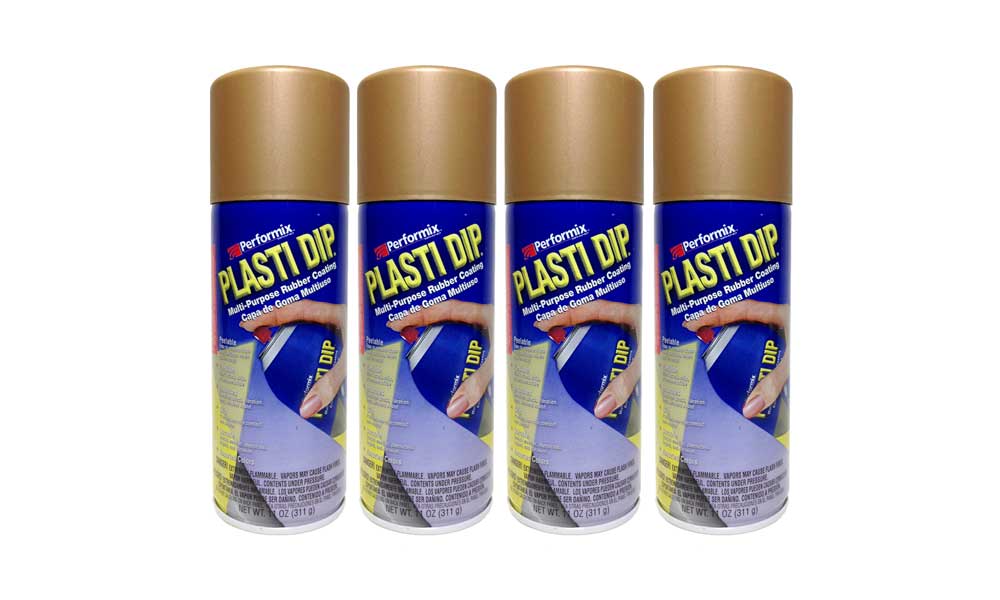
Best all-purpose pick: Plasti Dip 11oz Black Spray. The default for badges, grips, and touch-ups. Affordable and stocked at most stores above. Check price on Amazon
Best for a wet-look shine: Performix Glossifier. A clear layer for high gloss over a cured base, never instead of it. Check price on Amazon
Best for large jobs: gallon of black. Pair it with a gun for a full rim set, bumper, or panel. Far cheaper per ounce than cans, with more even coverage. Check price on Amazon
Best custom look: gunmetal grey aerosol. A popular non-black option for rims and trim, and a professional look without paint-shop costs. Check price on Amazon
Settle the scope, then buy for it in one order. Measure the area, divide by the 1 to 2 square feet a can covers at full build, and add one can. A badge? One or two cans and an afternoon. Four rims? Price a gallon plus a gun, because that is where Plasti Dip stops being a convenience buy and becomes a materials purchase. The lug nuts buying guide, the car parts guides, and the wider automotive product guides cover the hardware side of a wheel refresh.
Plasti Dip Questions, Answered
How long does it take to cure fully?
The 11oz aerosol manual calls for at least 30 minutes between layers and at least 4 hours of dry time before use, and it allows 4 hours per layer for a complete dry. Cool temperatures and high humidity stretch those times.
Does it really peel off?
Yes, when it is built thick enough. The manufacturer recommends at least five layers for easy peeling and warns that a thinner film can come off in small pieces. Primer changes that, because Plasti Dip Primer is permanent.
Will it survive a car wash?
Touchless washes are safe enough; automatic brush tunnels and close-range pressure wands are not. Spinning brushes catch a film edge and start it lifting, usually at the lug seats. Hand washing with a soft mitt is the least risky routine.
Is it the same thing as a vinyl wrap?
No. A wrap is a printed adhesive film laid on in sheets by hand, while this is a liquid you apply from a can, a brush, or a gun. Wraps resist abrasion better and cost far more to install. The dip is cheaper, easy to apply at home and easy to reverse, but it gives up durability on high-touch surfaces. For a truck bed rail, choose the wrap.
Will it damage the paint underneath?
A properly built film is made to come off without harming intact factory clear coat, which is the whole reason people choose it over spray paint. Two things create risk: a film too thin to release cleanly, and application over paint that is already failing, since the layer can pull loose flakes with it. Repair a chipped surface first.
Why do people say it is illegal in some places?
It is not illegal to own or use. Two unrelated things feed that idea. Aerosol product rules vary by state, which affects which formulas retailers can stock locally rather than what you may buy. Separately, many jurisdictions have vehicle-code rules about obscuring license plates or misreporting a registered color.