
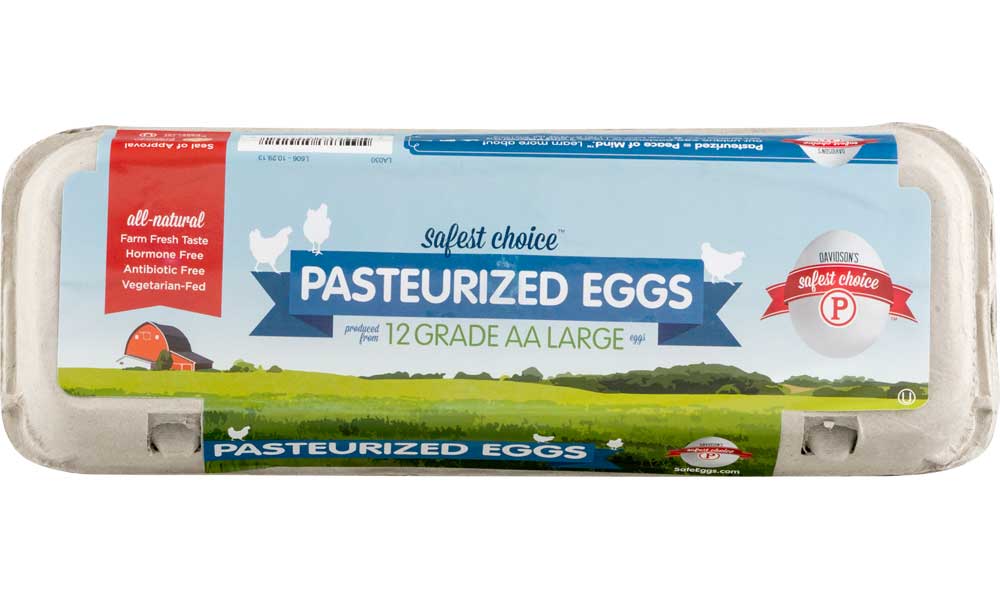
Pasteurized eggs are sold in two very different ways, and knowing which one you need decides where you shop. In-shell pasteurized eggs, mostly the Davidson’s Safest Choice brand, sit in the refrigerated case at a patchwork of regional grocers. Liquid and powdered egg products are pasteurized by law, so liquid whites from almost any supermarket already qualify. Need an intact yolk for Caesar salad dressing, eggnog, or tiramisu? Hunt for the shell version. Otherwise, the liquid aisle is the easy answer.
This page contains affiliate links. We may earn a commission at no extra cost to you.
Who Makes Pasteurized Eggs, and What the Treatment Does
A pasteurized shell egg is an ordinary one held in a warm water bath at precise time and temperature settings, long enough to kill Salmonella bacteria inside the shell without cooking the white or the yolk. After the bath, the shells are typically sealed with a food-grade wax coating. The result still looks, cracks, and whips like a raw egg.
The best-known US brand is Davidson’s Safest Choice, made by National Pasteurized Eggs, the Lansing, Illinois company that holds the in-shell process patent. Post Holdings, the Missouri-based packaged food group, bought National Pasteurized Eggs in October 2016 and folded it into its Michael Foods division. That ownership is useful to know at the store: Michael Foods also produces Crystal Farms All Whites, a liquid egg white product found in many dairy cases.
Pasteurization is meant to reduce the risk sharply, but it does not sterilize anything. The FDA, the federal agency that sets these safety rules, names four groups at greater risk of severe salmonellosis: children, older adults, pregnant women, and people with weakened immune systems. For any recipe served raw or undercooked, the agency advises using treated shells or pasteurized egg products. Its guidance for consumers is worth reading in full.
Everyone else buys for convenience. Hollandaise, béarnaise, aioli, and mousse all want an uncooked egg yolk, and the treatment leaves your technique alone. Anyone rolling fresh pasta dough or finishing carbonara off the heat has the same reason.
Shell, Liquid, or Powder: Match the Form to the Recipe
Pick the form before you pick the store, because only one of the four hands you a whole yolk in one piece.
| Form | Best for | Where to look | Watch out for |
|---|---|---|---|
| Shell (treated) | Mayonnaise, hollandaise, anything needing an intact yolk | Refrigerated case, select grocers | Regional stocking gaps |
| Liquid whole | Eggnog, custards, scrambles | Dairy case, most chains | Short window once opened |
| Liquid whites | Meringue, buttercream, icing | Dairy case and Amazon | Slower to stiff peaks |
| Powder | Long storage, royal icing | Amazon, baking suppliers | Needs exact rehydration |
Skip the premium entirely for anything fully baked or simmered. Cake batter at 350 degrees and a custard cooked to 160 degrees Fahrenheit handle Salmonella on their own, so untreated ones work fine there.
Grocery Chains That Carry the Shell Version
No US chain stocks treated shells in every store, so the surest way to find pasteurized eggs in the shell is store by store. Davidson’s comes in Original, Cage Free, and Free Range versions, and current retailer listings for the brand turn up at Publix, Cub Foods, Ingles, Sendik’s in Wisconsin, and Central Market in Texas. Four steps cut out the guesswork:
- Search “Davidson’s” in your grocer’s app with your own store selected. Inventory is set per location, not per region.
- Run the same search on Instacart across every store that delivers to your zip code. It shows which nearby chains list the brand at all.
- In the aisle, check the refrigerated case beside the organic and cage-free packs, not the value packs.
- If the shell version is absent, move to the liquid section a few feet away. Everything there is pasteurized by regulation.
Walmart
Walmart runs dedicated browse pages for this category on its website, and stocks the liquid versions far more widely than treated shells. Pull up your store’s page first. The guide to what to buy at the grocery store covers the rest of that aisle.
Kroger and Its Banners
Kroger and its banners, Fred Meyer, Ralphs, and Harris Teeter among them, set inventory by division and store. Check the natural foods set as well as the main dairy case.
Publix
Publix was among the early supermarket accounts for Davidson’s, and its delivery storefront lists the Cage Free dozen. Confirm with your store before a special trip.
Whole Foods Market
Whole Foods is a reasonable stop for pasteurized egg whites in liquid form. Its search page shows whether your location lists treated shells too. See the guide to the best things to buy at Whole Foods.
Target
Target is a maybe, and only at locations with a full grocery department. Small-format stores carry a thin refrigerated set.
Ordering Online: Liquid and Powder Ship, Shells Mostly Don’t
Online orders lean toward liquid eggs and powder. Fresh shell stock rarely ships nationally because the cold chain is expensive, so local delivery from a store covers the rest.
Amazon
Amazon carries powdered and shelf-stable whites and some liquid products. It is the most dependable channel for powder, which rarely turns up in a supermarket baking aisle.
Instacart
Instacart shops local supermarkets for you and carries Davidson’s listings, the practical way to get treated shells delivered the same day. Switch stores in the picker to see which shows real inventory.
Walmart grocery delivery
Walmart’s delivery service pulls from your local store, so a listing reflects shelf stock rather than a distant warehouse. For any food safety purchase, buy from the retailer or the brand, not an unfamiliar third-party seller.
How to Read the Label in the Store
The fastest check is the Safe Handling Instructions box. The FDA requires that statement (“keep eggs refrigerated, cook eggs until yolks are firm”) on every carton of shell eggs that has not been treated to destroy Salmonella. Treated ones are exempt, and their label usually says so outright. If that box is printed, the contents are unpasteurized.
- Pasture-raised is not pasteurized. Pasture-raised describes how the hen lived. The other word describes heat applied after laying. This mix-up trips more shoppers than any other on the shelf.
- Organic, cage-free, and “farm fresh” say nothing about heat treatment. Most packs on US shelves are untreated, premium lines included.
- Look for a stamp on the shell. Treated shells are commonly stamped with a red or blue “P” in a circle. It is a producer convention, not a federal mark.
- Farm stand dozens cannot be verified. Anything without a printed claim should be treated as raw.
Handling Mistakes That Undo the Protection
The pasteurization process happens once, at the plant. Everything after that is on the buyer.
A cracked shell. A crack is a contamination route the earlier treatment cannot undo. The FDA advises opening the package in the store and checking that shells are clean and intact.
A warm case or a hot car. Buy only from a refrigerated case and make the dairy aisle your last stop. At home, store the dozen at 40 degrees Fahrenheit or below, and use a fridge thermometer to monitor the temperature. Bacteria grow quickly between 40 and 140 degrees, which is why egg dishes should not sit out more than 2 hours, or 1 hour above 90 degrees.
Trusting a home sous vide rig. Instructions to pasteurize eggs at home with an immersion circulator circulate widely, but the water temperature window sits close to where the white begins to set, and a home setup has no way to confirm the result. Neither the FDA nor USDA publishes a consumer procedure for pasteurizing eggs at home, so this guide prints no times. If you already cook sous vide, see immersion circulators on Amazon, and buy commercially treated stock for anything served raw to someone at risk.
Buying shell when liquid would do. If a recipe never needs an intact yolk, the liquid version is simpler to measure and skips the hunt.
Four Picks by Form
Best overall: Davidson’s Safest Choice pasteurized shell eggs. The brand behind the patented in-shell process, sold in Original, Cage Free, and Free Range packs, and it behaves like any other in a recipe. The catch is distribution. Check price on Amazon
Best for meringue and buttercream: pasteurized liquid whites. A carton skips separating the yolks from the whites and pours to an exact measure, which matters when Swiss buttercream needs a precise white-to-sugar ratio. Expect a longer whip to stiff peaks; cream of tartar helps. Check price on Amazon
Best budget: store-brand liquid whole eggs. Most chains sell a private-label version. Treated by federal rule, so the cheap pick gives up nothing on safety. It just cannot hand you a yolk in one piece. Check price on Amazon
Best for the pantry: powdered whites. Shelf-stable and portioned by the spoon, the sensible choice if you make royal icing or edible cookie dough a few times a year. Rehydrate by weight rather than by eye. Check price on Amazon
Start by searching Davidson’s in your grocer’s app and on Instacart, since that settles the only real question: does any store near you carry treated shells. If none does, buy pasteurized liquid whites or powder instead. Making tiramisu with mascarpone for someone pregnant, immunocompromised, or older? Use pasteurized eggs for the raw parts and cook the rest through, as the FDA recommends. A little cheesecloth for straining finishes most of these recipes.
Common Questions Before You Buy
Are eggs in the grocery store pasteurized?
Most shells sold in US grocery stores are not. Only packs labeled as treated, such as Davidson’s Safest Choice, are pasteurized in the shell. Liquid, frozen, and dried egg products are a different story: rules enforced by the USDA’s Food Safety and Inspection Service do not allow any of them to be sold without pasteurization.
Are Eggland’s Best eggs pasteurized?
The Eggland’s Best in-shell line is not sold as pasteurized. The company points to hen vaccination and farm practices for Salmonella control, and its own FAQ answers the raw-use question by recommending a cooking step to 160 degrees Fahrenheit. Its liquid whites, as a regulated egg product, are pasteurized.
Can pasteurized eggs still carry Salmonella?
The risk drops sharply, but it is not zero. A cracked shell or a pack left warm can reintroduce bacteria after processing. The FDA still advises children, older adults, pregnant women, and anyone with a weakened immune system to take care with raw and lightly cooked dishes.
Do pasteurized eggs need to be refrigerated?
Yes, at 40 degrees Fahrenheit or below. Pasteurizing is not canning, so treated shells and liquid products are not shelf-stable. The FDA suggests using shell eggs within 3 weeks for best quality, and an opened liquid container follows the shorter window printed on it. Powdered whites are the exception, since removing the water makes them pantry-safe.
Editorial review: wheretobuyguides.com team. Written with reference to egg safety guidance from the FDA and the United States Department of Agriculture.