
The right measuring tape depends on what you are measuring. For walls, lumber and furniture, buy a 25-foot retractable steel tape from Home Depot, Lowe’s, Ace or Harbor Freight. For bodies and hems, buy a 60-inch soft sewing tape from Walmart’s craft aisle, Hobby Lobby, Michaels or a quilt shop. The two families share a name and little else, so name the job before you shop.
This page contains affiliate links. We may earn a commission at no extra cost to you.
Which Measuring Tape Fits the Job: Steel, Sewing, or Laser
A tape measure is a measuring tool that stores a long graduated strip inside a compact housing, so one person can take a length measurement well beyond the reach of a ruler. Three product types cover nearly every need.
Retractable steel tapes. A concave metallic blade springs back into its case at the press of a button, and that curve lets it stand out horizontally without folding. This is the tool of carpentry, home construction, and DIY work, and 25 feet is the contractor default because it covers a full room in one pull.
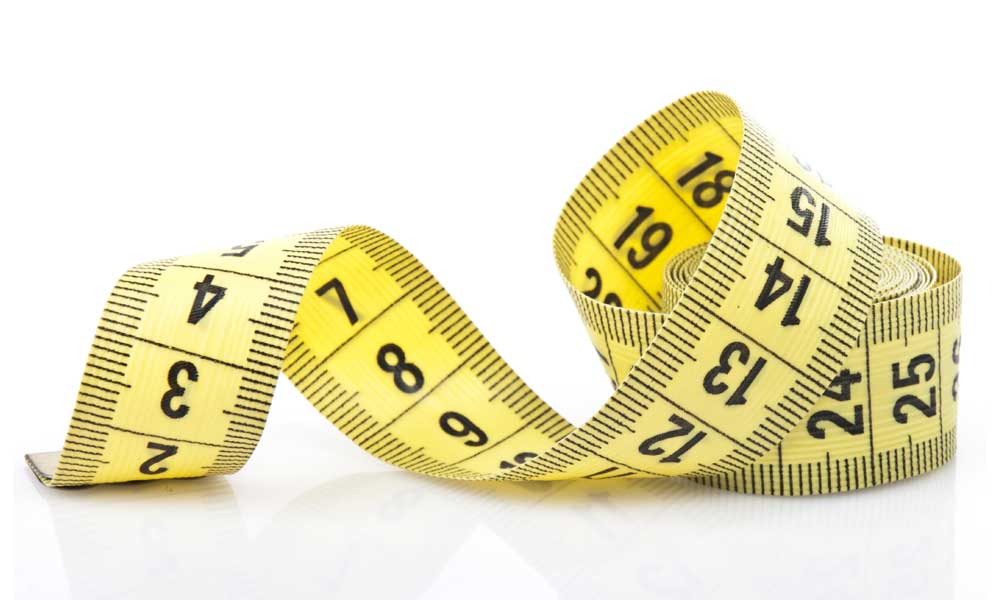
Soft sewing and body tapes. A flat vinyl or cloth strip that conforms to curves. Quilters and anyone taking a chest or waist figure need this one, and it sits behind every apparel size chart, which matters if you are working through a dress sizing guide. The mix-up we hear about most from readers is a steel tape bought for body measurements: rigid metal will not follow a waist, so the number reads short.
Laser distance measures. A laser measure fires a beam at a target and shows the distance on a screen. It is easy to use for ceiling heights and floor plans, but it needs a hard surface to hit and will not mark a cut line on a board. Treat it as a partner, not a replacement.
Open reel models fill the long end: a crank winds 50 to 300 feet of blade onto a frame for land layout. Most tape measures come with inches and feet on the top edge, and many add metric units along the bottom, so decide between imperial alone and a dual scale before you buy.
| Type | Best for | Typical length | Material |
|---|---|---|---|
| Retractable tape measure | Carpentry, home projects, DIY | 16 to 35 feet | Steel, nylon or chrome coated |
| Body measuring tape | Sewing, tailoring, fitness | 60 inches | Vinyl or fiberglass |
| Open reel | Land layout, floor plans | 50 to 300 feet | Steel or synthetic |
| Digital tape measure | Fast reads, unit conversion | 16 to 25 feet | Steel with display |
| Laser measure | Room dimensions, ceilings | Varies by model | Electronic, no blade |
Reading the Blade: Fractions, Stud Marks, and the Sliding Hook
Learning to read a tape measure takes about a minute:
- Hook the end on the edge, or press it flat, and let it settle.
- Read the biggest numbered mark. That is your whole inches.
- Count the smaller lines after it: longest is 1/2, then 1/4, 1/8, 1/16.
- Keep the blade square, since a twisted one reads long.
Standard blades break each inch into 1/16 increments. A dual blade adds centimeters and mm on the lower edge, the version to buy if you work from European furniture specs.
Red numbers every 16 inches mark stud spacing, the standard on-center interval for wall framing in US residential construction. Small black diamonds appear every 19.2 inches (19 3/16) for truss and joist layout, a spacing that divides an 8-foot sheet of plywood into five equal parts. Both let a carpenter lay out framing without doing math.
The loose end hook is not a defect. The hook slides on purpose, by exactly its own thickness. Press it against a wall and it slides in, subtracting itself; catch an outside edge and pull, and it slides out, adding itself back. Both readings land on true zero. A hook riveted solid is the broken one, and so is one bent out of plane.
Standout, Blade Width, and Lock: Hardware Worth Paying For
Standout and blade width. Standout is how far the blade extends horizontally, unsupported, before it buckles. Wider blades hold a deeper curve, which buys standout at the cost of a bulkier case on the belt clip. Interior work rarely needs more than 25 feet; exterior layout justifies 35. Listings bury standout deeper than any other spec, so test it on a display sample.
Lock style. A thumb lock frees the blade until you slide the lever. An auto-lock brakes by default, which is what you want one-handed up a ladder. A smooth self-retracting return matters more than a fast one that snaps the hook into your knuckles.
Hook, coating, and case. Magnetic tape measures grab steel studs and conduit but do nothing on wood. Blade coatings run from bare chrome to bonded nylon, which protects the printed markings. A heavy-duty, impact resistant case survives the sawhorse drop that cracks a cheap one.
How Accurate Is a Tape Measure? EU Classes and NIST Handbook 44
Accuracy is only as good as the standard a blade was built to, and most US retail models do not print one. Europe is stricter.
Under the EU Measuring Instruments Directive (2014/32/EU, Annex MI-008), a measure of length is sold in an accuracy class marked on the blade. The permitted error grows with length: a Class I blade may be off by up to 1.1 millimetres over 10 metres, while Class II allows 2.3 millimetres over the same span, or about 1.3 over a 5-metre (16-foot) blade. Class II is the common jobsite grade; Class I is the precision grade for shop and fabrication work.
In the United States, the closest reference is NIST Handbook 44, Section 5.52 (Linear Measures), the code state weights and measures officials apply to measures in commercial use. It sets tolerances that grow with length and tests blades under 25 feet at a 5-pound pull. A US blade carrying a “Class II” mark was built to the EU standard as well; an unmarked bargain import makes no accuracy claim at all, which is why precision work belongs on a named brand.
Soft tapes drift differently. Cloth stretches slowly, so the error stays invisible until a finished garment is a size off. Compare any soft strip against a rigid ruler once a year and retire it if the two disagree.
Where to Buy a Measuring Tape in Store
Buying in person lets you test the lock and judge standout before paying.
Home Depot and Lowe’s
These two carry the deepest professional selection, with Stanley, Klein Tools, Milwaukee, and DeWalt on the hand tools aisle. Display samples are often pegged where you can extend them. Both websites list far more of each brand’s line than the stores hold and support ship-to-store pickup.
Harbor Freight, Ace, and Menards
Harbor Freight covers the budget end with its house brands, a sensible source for a second one for the truck. Ace stores are independently owned, so brands vary by location. Menards (Midwest only) carries a big-box range. Our guide to where to buy tools covers the rest of the aisle.
Walmart
Walmart, the largest brick-and-mortar retailer in the United States, is the one chain that reliably stocks both families under one roof. Steel models sit in hardware, soft ones with sewing notions in crafts. You can check availability on their site first.
Hobby Lobby, Michaels, and local fabric shops
Sewing shoppers lost their default when Joann closed every store in 2025. Hobby Lobby and Michaels now carry the mainstream 60-inch soft versions, and quilt shops keep the odd sizes: 120-inch lengths and non-stretch tailor measuring strips the big boxes never order. Our where to buy fabric guide lists more shops; call ahead, since notions inventory turns slowly.
Buying Online: Amazon and Specialist Suppliers
Ordering online is the only way to compare published standout, blade width, and accuracy class side by side.
Amazon
Amazon, the largest online retailer, carries every category here, including digital units no local store stocks. Read the specification table, and check the seller, since a third-party seller sets its own return terms. You can browse the sewing bestsellers for the soft side.
Perfect Measuring Tape Company
This specialist supplier serves the soft side and buyers ordering by the dozen, such as sewing classes and workrooms. It is also the easiest place to find a professional tape measure in a nonstandard length.
Brand Warranties and Returns
Warranty coverage on tape measures is better than most buyers assume, but every brand excludes the damage that actually kills a blade. Terms vary by model and region, so read the package.
| Brand | Tape measure coverage | What to know |
|---|---|---|
| Stanley | Limited lifetime (US) | Excludes wear, misuse and accidents |
| Milwaukee | Limited lifetime, per retailer listings | Confirm terms on the product page |
| Klein Tools | Normal life of the product | Excludes cut tape, rust, cracked cases, bent hooks |
| Komelon | Varies by model and region | Check the package or listing |
A blade kinked under a boot or a hook bent by a dropped case is usually wear or accident, not a defect. For a cheap backup, coverage rarely changes the math, the same logic covered in our look at whether an extended warranty is worth it.
Returns matter more in the first week, because standout and lock feel are things you can only judge after opening the package. Our advice to readers is simple: buy your first one from a store with a generous return window, then buy spares wherever is cheapest. Our roundup of stores with the best return policies compares the major chains.
Five Tape Measures Worth Buying
These five cover the realistic buying situations. Confirm standout, width, and scale on the listing.
Best overall: Stanley PowerLock 25-Foot. The long-running default in American toolboxes, and the reference point other steel blades get compared against. Check price on Amazon
Best for solo framing: Klein Tools 25-Foot Magnetic. The magnetic hook is the whole argument, holding on steel studs while you walk the far end out alone. Check price on Amazon
Best for sewing: Singer 60-Inch Vinyl. The standard body option, dual-scale, cheap enough to keep one in every workbasket. Step up to a non-stretch fiberglass tape measure if you sew for clients, since it holds its length far better than cloth. Check price on Amazon
Best budget: Komelon Self-Lock 16-Foot. Auto-lock action in a compact case, and 16 feet genuinely covers furniture, curtains, and room checks. Check price on Amazon
Best digital: Reekon M1 Caliber. A digital tape measure that shows the reading on a screen, which helps anyone who finds a fraction slow to parse. Confirm battery type and supported units on the listing. Check price on Amazon
Start by naming the job out loud. Framing or a room layout sends you to a 25-foot steel blade with the best standout you can find and a Class II mark if you can get one; a hem or a size chart sends you to a 60-inch soft strip. Buy both if you do both, because no single measuring tape covers a whole house. Need adhesive rolls instead? Our electrical tape guide covers a different product entirely.
Common Questions
Are measuring tapes and rulers the same thing?
No. A ruler is a rigid straight edge, usually 12 inches, that doubles as a drawing guide. A tape stores many feet of graduated strip and cannot draw a line at all. Keep both, because a rigid ruler is how you test whether a soft strip has stretched.
Can I use my phone instead?
For rough estimates only. Apple ships a Measure app on the iPhone that uses augmented reality to judge distance, and comparable apps exist on Google Play. They drift on poor lighting and dark surfaces, so never size lumber or a garment with one.
Can you take one on a plane?
Generally yes. The TSA permits them in carry-on and checked bags, though the officer at the checkpoint has final say. Soft sewing versions raise no questions; a long steel model in a heavy metal case draws more attention.
What kind of measuring tape do tailors use?
A 60-inch soft one, inches on one face and centimeters on the other. Professionals lean toward fiberglass over cloth because it holds its length. Many also keep a hem gauge, since a limp strip cannot transfer a figure onto pattern paper.
How often should you replace one?
Replace a steel model when the blade kinks, the return spring stalls, or the printed marks wear off the first few inches. Replace a soft one the moment it fails a comparison against a rigid ruler. A flexible synthetic strip can outlast its owner.
Warranty terms and accuracy standards in this guide were checked against manufacturer, retailer and regulatory sources in October 2026.