
King Vitaman cereal is a discontinued corn and oat breakfast cereal that Quaker Oats introduced in 1968 and stopped making around 2019, and no grocery chain stocks it today. If you search for a box, what you will actually find is old inventory, collectible packaging, and stale retailer pages. None of it belongs in a bowl. The practical move is to buy the packaging as memorabilia if you want it, and buy breakfast from the short list of current cereals that land closest on grain base, sweetness, and crunch.
This page contains affiliate links. We may earn a commission at no extra cost to you.
Is King Vitaman Cereal Still Sold Anywhere?
No. Quaker Oats, the PepsiCo subsidiary behind Oatmeal Squares and Quisp, no longer produces it, and no other company makes it under license. The Wikipedia entry for King Vitaman lists 2019 as the end date, and most fan and nostalgia accounts repeat that year.
The date is softer than it looks. Wikipedia’s 2019 figure rests on a single Vocal.media article, and some nostalgia pages on social media say 2021 instead. What is certain: it was still on shelves in early 2019, when Cerealously published a review calling it a “Diet Cap’n Crunch,” and Quaker has announced no revival since. The gap between those dates is just leftover stock selling through.
Quaker has not published a reason for the decision to discontinue it. The usual pattern for a cereal this old fits, though: TV advertising support had faded decades earlier, shelf space consolidated around high turnover names, and a low volume classic with a small, loyal following is what gets cut first.
What the King Actually Sold: Crowns, Knights, and 6 Grams of Sugar
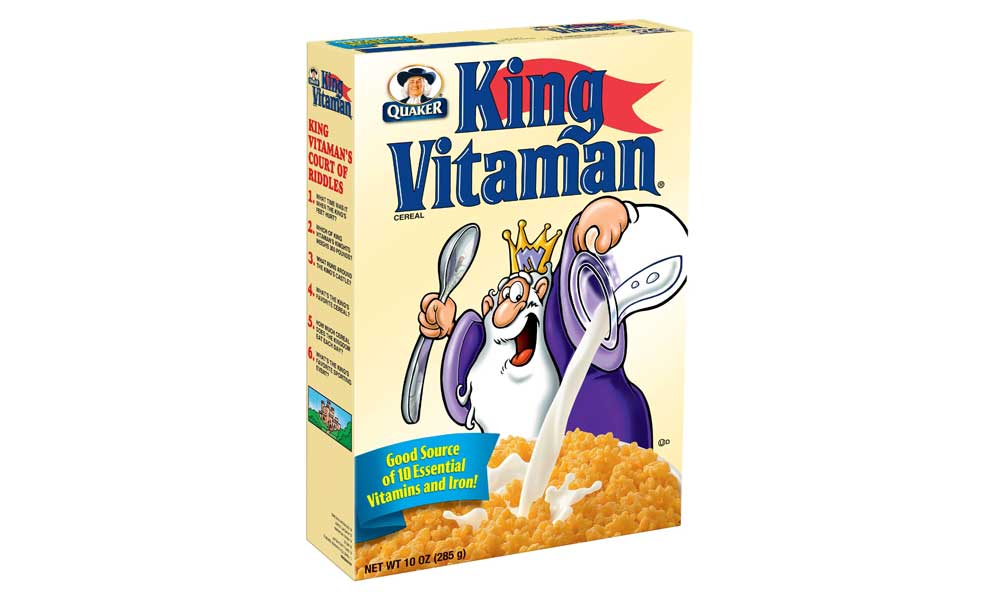
King Vitaman was a lightly sweetened cereal of crunchy, porous crown shaped pieces made from toasted corn and oats. Quaker marketed it on high vitamin and iron content rather than sweetness, and it carried 6 grams of sugar per serving, less than half the 13 grams or more that Wikipedia cites for sweeter shelf rivals like Lucky Charms.
The advertising is what most adults remember from their 70s and 80s childhood. Jay Ward Productions, the studio behind Rocky and Bullwinkle, animated the early commercials. Joe Flynn voiced the king, Bill Scott voiced Sir Cravenleigh, and Daws Butler played the villain, the Blue Baron. The running gag had a dim knight pouring milk over the king instead of the bowl, followed by “Not me, you dingaling, the cereal!” Later live action spots ended with a jingle inviting kids to have breakfast with the king.
From 1971 until his death in 1977, George Mann, a former vaudeville dancer from the act Barto and Mann, played the mascot for the cereal on the box and on television. In 2000 Quaker went back to an illustrated king on the packaging, which is the version most people under 40 picture.
Where Old Boxes Surface Online
No online retailer has fresh supply. Surviving listings fall into three buckets: collectible auctions, occasional third-party grocery listings, and dead grocery pages that look live.
eBay Is the Realistic Source, and It Is Collectibles
Browse the listings for the steadiest supply of anything tied to this brand: sealed vintage packaging, flattened cartons, promotional buttons, and print advertising. Asking prices swing hard by era and condition, so filter to sold listings for a number that reflects what people actually pay.
Amazon Carries the Substitutes, Not the Original
Amazon has no consistent supply of the original. Third-party listings surface now and then at prices well above the old retail level, and by definition they are old inventory. Where Amazon helps is the alternatives further down, which ship as normal current production.
Instacart, DoorDash, and Grocery Sites Show Ghost Pages
Instacart, the grocery delivery platform, plus DoorDash and regional grocer sites such as Festival Foods and Fair Play Foods still have indexed product pages for the old 10 and 12 ounce boxes, and several rank on the first page of Google. An “add to cart” button on those pages reflects a database record, not a shelf. Expect a substitution or an out of stock notice rather than a delivery, the same ghost-page pattern that shows up for Orbitz drink.
Store Shelves and Retro Shops
No United States grocery chain carries it. Manufacturing ended years ago and the last retail inventory cleared long since, so walking the breakfast aisle at Target or Kroger will not turn up a package.
Walmart: Search Results, Not Supply
Walmart, the largest brick and mortar retailer in the United States, is where many shoppers check first. A Walmart listing search for the name can still return results, but with Quaker no longer making it, anything there is third-party marketplace stock or an unrelated cereal. There is no restock to wait for.
Retro Candy Shops and Nostalgia Grocers
Specialty retro retailers are the only physical channel with any logic behind it. Rocket Fizz locations and online sellers like Hometown Favorites focus on hard-to-find American brands, and odd inventory does surface at them. Neither is a reliable source here, so call first and ask about date codes, not just availability. That is where Hubba Bubba Squeeze Pop hunters end up too.
Buyer Protection When You Buy From a Stranger
A box of a dead brand comes from an individual seller, not a company that stands behind the goods, so the platform guarantee is your only recourse when a package arrives crushed, opened, or years past its date code. The windows are short and they start at delivery.
| Marketplace | Window to act | Practical note |
|---|---|---|
| eBay | 30 days after the actual or estimated delivery date | The seller gets 3 business days to respond before eBay can step in |
| Amazon third-party (A-to-z Guarantee) | Up to 90 days after the latest estimated delivery date | Contact the seller first; for a missing package, wait 3 days past that date |
| Mercari | About 3 days (72 hours) after delivery | Inspect before you rate the seller, since rating closes the sale |
| Etsy | Case opens 48 hours after you message the shop | Vintage food and packaging listings are often final sale |
These windows match each platform’s help pages as of October 2026. They change, so check the policy page before you pay.
Here is the category trap. A seller who lists an item as a collectible display piece has not misdescribed anything by shipping food you should not eat, so a not-as-described claim will probably fail. Buy only from listings that show the date code in a photo.
Red Flags When Shopping for a Discontinued Cereal
The most expensive mistake is paying food prices for inventory that stopped being food years ago. Everything below follows from that.
Paying grocery prices for expired stock. Any sealed package still circulating is many years past packing. Grain goes stale and its oils turn rancid, and this cereal was made with coconut oil, so the risk is real even when the carton looks untouched.
Trusting an availability badge on a dead page. Delivery platforms and retailer sites leave product pages up long after a brand is delisted. That badge is a database entry, not a warehouse shelf.
Believing comeback rumors. Social posts periodically claim a revival is coming. As of October 2026 Quaker has announced nothing.
Confusing memorabilia with groceries. Most auction inventory is display material: flattened cartons, buttons, and advertising slicks. Fine to buy, as long as nobody treats a sealed box as edible. Fans of Crystal Pepsi learned the same lesson about vintage bottles.
If you do buy a box, run through these five steps first:
- Check for a date code. Read the description for one. A seller who photographs it understands why it matters.
- Vet the seller. Check their feedback on food and collectible sales, not their overall score.
- Price against sold listings. Filter to sold listings so you price against real transactions.
- Confirm the claim window. Know it before paying, because it starts running at delivery.
- Treat it as a display piece. Decide that in advance, then shop for breakfast separately.
Best King Vitaman Alternatives Right Now
None of these is a replica. The closest substitutes match three things the original competed on: a corn and oat base, low to moderate sweetness, and heavy vitamin and iron fortification. Read the nutrition panel against those three before committing to a carton, and compare the sweetener line per serving, since serving sizes differ by brand.
| Product | Grain base | Sweetness | Best for |
|---|---|---|---|
| Cap’n Crunch Original | Corn, oat | High | Closest overall taste |
| Kix | Corn | Low | Least sweet option |
| Quisp | Corn | Moderate to high | Same era nostalgia |
| Quaker Oatmeal Squares | Whole oat | Moderate | Dense texture in milk |
Best overall: Cap’n Crunch Original. Same parent company and the closest mainstream match on grain blend and bite. Reviewers who ate King Vitaman late in its run describe it as reminiscent of Cap’n Crunch with the sweetness turned way down, so expect the resemblance and a sweeter bowl. Check price on Amazon
Best low sugar: Kix. General Mills lists 4 grams of sugar per 1.5 cup serving, the lowest line in this group by a wide margin. Lighter and airier, so it softens in milk faster than the crowns did. Check price on Amazon
Best same era nostalgia: Quisp. Another Quaker launch, this one from 1965, with saucer shaped pieces instead of crowns. Distribution has been spotty for years and it comes and goes at grocers like Kroger, so confirm it is on shelves before you plan around it. Check price on Amazon
Best for texture: Quaker Oatmeal Squares. Dense enough to hold up in milk the way the crowns did, with a whole oat base and no frosting layer. Treat it as a texture match, not a flavor one. Check price on Amazon
Store brand crunch cereals from Great Value, Market Pantry, and Kroger usually sit under the name brands on price. Worth a try if you want the texture rather than a specific flavor memory. Nothing sold today uses crown shaped pieces, though, and the in-pack prize has largely left the category, so if the shape is what you miss, no substitute fixes it.
Start with the best overall pick above if you want the taste back, and switch to Kix if that reads too sweet. If you want the object instead, search sold eBay listings for sealed king vitaman cereal packaging and buy it as a display piece, not as breakfast. Either way, treat anything packed before the discontinuation as memorabilia, the same rule that applies to retired Bean Boozled editions.
King Vitaman Cereal Questions, Answered
Has King Vitaman cereal been discontinued?
Yes. Quaker Oats ended production around 2019, roughly half a century after the 1968 launch, though a few sources put the final date at 2021. No manufacturer has picked the brand up since. Anything still listed for sale is old inventory or collectible packaging.
What did it taste like?
It tasted like a less sweet Cap’n Crunch. Reviewers describe the same toasted corn and oat character with the sweetness turned down by roughly two thirds, closer to buttered toast with a little brown sugar. That gap is why straight swaps taste wrong to people who grew up on it.
Is King Vitamin the same product?
Yes. The brand was spelled King Vitaman, with an “a,” but many people search for King Vitamin cereal, and search engines treat the two as one query. Old retailer pages used both spellings inconsistently, which is part of why the confusion stuck.
Is it safe to eat a sealed box bought online?
No. Any sealed package on the market is many years past its packing date, and dry grain products develop stale flavors and rancid oils long before that point. No storage condition makes something that old worth eating. Buy it framed or shelved, not poured.
Will it ever come back?
There is no announced revival as of October 2026. Some retired brands return through licensing deals with smaller food companies, but nobody has licensed this one from PepsiCo. Watch Quaker’s official channels rather than social media reposts.