
Rent, buy used, or buy new: settle that first, because it decides where to buy instruments far more than any sale does. Musical instruments are devices built to produce sound through vibrating strings, moving air, struck membranes, or electronics. A school band newcomer belongs in a rental contract at a local store. A committed guitarist does well on the used market. An adult who knows the exact model can order new and compare return windows. Below: all three paths, the sellers behind them, and the cheap-import trap that leaves a first-timer with an unplayable box.
This page contains affiliate links. We may earn a commission at no extra cost to you.
Rent, Buy Used, or Buy New? Decide Before You Pick a Store
The answer depends on one question: how certain is the person who will practice on it? A musical instrument is any device designed to create music, from a bowed violin to a reed woodwind to a sampler running software, and the more uncertain the player, the less sense ownership makes.
Rent first if a child is starting school band or orchestra. Rent-to-own contracts through local shops and school rental programs let you pay monthly, swap a 3/4-size violin for a full size as your kid grows, and hand the horn back if interest dies after one semester.
Buy once the commitment is proven. After a year of steady practice, or when an adult already knows the tone they want, ownership wins on cost.
| Path | Best for | Main tradeoff |
|---|---|---|
| Rent to own | Band and orchestra beginners, growing kids, brass and wind families | Monthly cost stacks up past year two |
| Used student model | Committed learners on a budget, guitar and piano buyers | You inherit the last owner’s wear |
| New | Adults who know their sound, and anything mouth-contact | Highest upfront price, steepest resale drop |
We tell parents to ask one thing before signing a rental agreement: how much of each payment counts toward purchase, and does that credit survive a switch to a different size or a different dealer? If your school sends home a rental packet in August, act on it, since popular fractional sizes go early. Add the rest of the band list to your school supplies run while you are at it.
Where to Buy Instruments by Family
The best channel changes with the type of instrument, because each family wears out and gets repaired differently. The Hornbostel-Sachs system, created by Erich von Hornbostel and Curt Sachs, groups them by what vibrates: chordophones (strings), aerophones (air), membranophones (drumheads), idiophones (the body itself, like cymbals), and electrophones.
| Family | Examples | Best first channel | Why |
|---|---|---|---|
| Stringed instruments | Violin, cello, double bass, guitar | Local shop (orchestral), used market (guitar) | Setup and correct size matter more than brand |
| Woodwind instruments | Flute, clarinet, oboe, saxophone, bassoon | School rental program | Pads and corks need a repair bench nearby |
| Brass instruments | Trumpet, trombone, French horn, tuba | School rental, then used | Dents and stuck valves are fixable on known brands |
| Percussion instruments | Snare, drum kit, timpani, xylophone | Big-box chain or used | Few consumable parts besides heads and sticks |
| Keyboard instruments | Piano, digital piano, organ, synthesizer | Online retailer or used | Easy to test, easy to ship, slow to wear |
| Electronic instruments | Synths, drum machines, controllers | Specialist retailer | Shorter return windows; ask before buying |
Wind instruments are the riskiest family to buy blind: a clarinet can look perfect in photographs and still leak air through a dried pad.
In-Store Options: Hear It, Feel It, Meet the Repair Tech
Buying in person gets you three things a website cannot ship: you hear the sound, you feel the action, and you meet whoever will repair it later.
Independent Music Stores
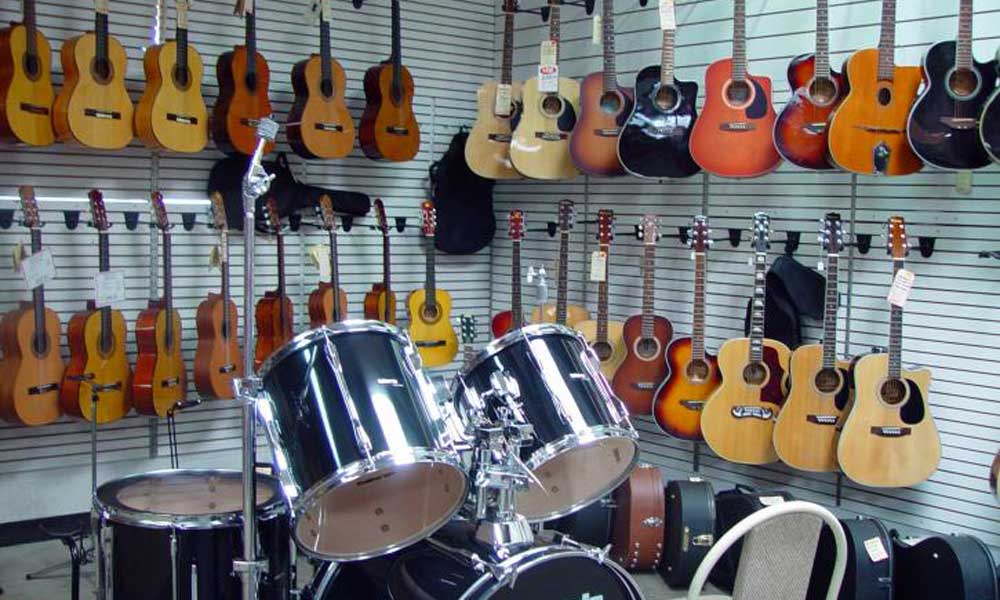
Independent dealers tend to put rent-to-own, repair, setup, and lessons under one roof, which makes them the right first stop for a school band family. Search Google Maps or local listings, then ask what they rent for your school’s program.
Guitar Center
Guitar Center calls itself the world’s largest musical instruments store and lists more than 300 U.S. locations on its homepage. It’s the easiest place to compare guitars, bass rigs, drums, and recording gear in one afternoon, though selection leans toward rock and percussion rather than orchestral strings. Browse their catalog, then call to confirm a model is on the floor.
Music & Arts
Music & Arts, a Guitar Center subsidiary since 2005, is built around school band and orchestra programs, so it’s the chain most likely to handle a rental contract for a middle school clarinet or a student trumpet. Many locations partner with district music departments, so what they hand you matches what the director expects in concert band.
Walmart, Target, and Secondhand Counters
Walmart carries entry-level acoustic guitars, ukuleles, portable keyboards, and small percussion. Target stocks a thinner starter-kit assortment around the holidays. Pawn shops and Goodwill turn up used gear cheaply, though condition varies wildly and warranties rarely exist.
Online Options: Deepest Catalog, Best Price Checks
Ordering online gets you the widest selection and the fastest price comparison, and it is the better channel once you know the exact model.
Sweetwater
Sweetwater is a specialty music retailer in Fort Wayne, Indiana. It assigns every customer a sales engineer who answers technical questions by phone or email, and it runs guitars through a multi-point inspection before shipping. Depth is strongest in guitar, keyboard, and studio gear, including electronic instruments.
Amazon
Amazon lists nearly every major brand plus a long tail of unbranded imports, which is why it rewards care. Read the seller name, not just the star rating, since third-party listings set their own terms. It is the most convenient source for strings, reeds, stands, and the accessory pile every musician uses. Shop the category on Amazon. Buying a digital piano? Budget for decent headphones too.
Reverb
Reverb is a marketplace built for musical gear, which makes it the strongest source for used guitars, amps, synths, and pedals. Etsy sold it in June 2025 to a group affiliated with Servco Pacific and Creator Partners, and it now runs as a standalone company. Sellers know the category, so descriptions name the year, the pickups, and the flaws, and its public price guide shows what a model has actually sold for.
eBay, Facebook Marketplace, and Craigslist
eBay is still the widest net for vintage and orphaned gear, from a 1970s Fender to a pipe organ pedalboard. Buy It Now listings beat auctions for anyone new to used. Browse the gear category on eBay. Facebook Marketplace and Craigslist are local-pickup channels with no buyer protection, so meet in daylight, bring a tuner, and test before cash moves. Collectors who chase vinyl records and CDs know these listings well.
Return Windows and Buyer Protection
For a purchase you cannot judge from a photo, the return window is often the deciding factor between two sellers at the same price.
| Seller | Standard window | Watch for |
|---|---|---|
| Guitar Center | 45 days | 14 days on recording, DJ, and workstation keyboard gear; 3 days on vintage; clearance is final |
| Sweetwater | Check before ordering | Keep the original carton and every accessory |
| Amazon | 30 days from delivery on most items it sells | Third-party sellers set their own policy |
| Reverb | Set by the seller | Read the listing before buying |
| eBay | Set by the seller | Money Back Guarantee covers not-as-described items, not a change of mind |
Under its return policy page (revised February 11, 2026), Guitar Center treats harmonicas, in-ear monitors, earplugs, and cleaning products as non-returnable and charges a sanitization fee on returned mouthpieces. Treat mouth-contact gear as a final sale anywhere. Policies change without notice, so read the page before you pay.
Seven Checks Before Money Changes Hands
The best predictor of whether someone keeps learning is how easy the thing is to handle, not the badge on the headstock. The trap that catches the most first-time buyers is the instrument-shaped object: a bargain marketplace listing that looks correct in photographs but cannot be made playable at any price.
- Setup, not brand. On a guitar or double bass, setup means string height, nut slots, and bridge fit. A well set up budget guitar beats a badly set up one costing three times as much, so ask the dealer what a setup costs before you carry it out.
- It holds pitch. Tune it, play for five minutes, then check again. Slipping pegs and drifting tuners signal cheap hardware, and nothing kills practice faster.
- Parts exist. Yamaha, Fender, Gibson, Pearl, Selmer, Bach, and Casio are long established makers whose parts any tech can source. Obscure import names often cannot be fixed economically, turning a small dent into a total loss.
- The materials match the claim. Solid spruce or cedar tops project more warmly than laminate, and horns made from yellow brass outlast mystery alloys.
- The size fits the player. Violins run in fractional sizes from 1/16 to 4/4, and keyboards range from 25 mini keys to 88 weighted ones, so measure the child instead of guessing.
- The serial number checks out. Fake Gibson and Fender guitars circulate on general marketplaces. Compare the serial format and headstock logo against the maker’s reference pages before sending money.
- You tried it, or can return it free. A neck profile one player loves feels like a fence post to the next. Timbre, the tonal color that makes a cello sound different from a flute on the same note, is just as personal.
Five Starter Picks Worth Owning
These five were chosen for out-of-the-box handling and for parts a repair tech can get. Prices move weekly, so check the current listing rather than trusting a printed number.
Best beginner acoustic guitar: Yamaha FG800. A solid spruce top rather than laminate, which is unusual in its class. Check price on Amazon
Best budget keyboard: Casio CT-S300. 61 touch-sensitive keys, 400 built-in tones, and a light chassis that runs on six AA batteries, so a kid can move it alone. Check price on Amazon
Best student violin outfit: Cecilio CVN-300. Ships with case, bow, and rosin. Budget for a bench setup, since factory bridges and pegs need attention. Check price on Amazon
Best starter drum kit: Pearl Roadshow RS525SC. A five-piece with a 22-inch bass drum, stands, a throne, a crash-ride, and hi-hats, from a long established percussion maker. Check price on Amazon
Best student saxophone: Jean Paul AS-400. An alto with a yellow brass body, gold lacquer, and mother-of-pearl key buttons, common in school jazz programs. Price it against a rental first. Check price on Amazon
Start with one phone call, not a checkout page. Ask the nearest music store what they rent for your school’s program and what a setup costs, because that answer decides whether you rent, buy used, or order new. Sure of the model already? Compare Sweetwater and Reverb against eBay before paying retail, and read the return page of whichever seller wins. Buying instruments works best in that order. Shopping for a fan rather than a musician? Our guide to band shirts is an easier gift.
Questions About Buying Instruments
Should you rent or buy for a beginner?
Rent if the student has not finished a full year. School rental contracts usually credit part of each payment toward purchase and bundle maintenance, which matters most for brass and woodwind gear where a stuck valve or torn pad means a bench visit.
What is the cheapest option that is genuinely playable?
A ukulele or a used entry-level acoustic guitar from a known maker. At the very bottom of the market, tuning hardware and neck geometry stop being correctable, and a tech will charge more to fix the thing than it cost.
Are used instruments worth buying?
Often yes for guitars, keyboards, and percussion, where few parts are consumable. Woodwinds carry more risk because pads and corks age even in storage. Check a horn’s body for dents, look for cracks on anything wooden, then price a service first.
Which instrument is easiest to learn as an adult?
Ukulele and piano are the two most common adult starting points, the first because four nylon strings are gentle on untrained fingertips, the second because notes sit in a straight visual line. Both are easy to find used, which keeps the cost of a trial year low.
Return windows and product specs were re-checked in October 2026.